



Most “how to choose a yoga teacher training” articles are written by schools, and end by recommending the school that wrote them. We run a yoga school, so treat this the same way — with suspicion, and by checking what we say.
What follows is what we would tell a friend. It includes the questions that make schools uncomfortable, the arithmetic that catches out the weak ones, and a section at the end about when you should not train with us. We have tried to write the page we’d want someone to read before they contact us.
The short version: five questions separate schools. Everything else is decoration.
Yoga Alliance registration is a floor, not a quality signal. Almost every school you’re comparing has it.
This is the single most misunderstood thing in the industry, and a lot of schools benefit from the confusion.
What it is. Yoga Alliance is a US-based membership registry. A school becomes a Registered Yoga School (RYS) by submitting a curriculum that meets published hour requirements across set categories, naming its lead trainers, and paying a fee. Graduates of a registered school can then register themselves as an RYT — a Registered Yoga Teacher — which is also an application and a fee.
What it verifies: that a curriculum on paper meets the hour standards, and that the named lead trainers hold the required registrations themselves.
What it does not verify: anything that happens in the room. Yoga Alliance does not inspect campuses, observe teaching, examine students, check that the timetable matches the submitted curriculum, or assess whether the teaching is any good. It is a registry, not an inspectorate.
Three things to check, which take about four minutes:
A phrase that should make you pause: “Yoga Alliance certified”. Yoga Alliance registers schools; it does not certify them. A school that gets this wrong on its own website either doesn’t understand what it bought, or is hoping you don’t.
And be clear-eyed about the limit of all this. Registration is a floor. It tells you a school filled in a form correctly. It tells you nothing about whether you’ll be able to teach at the end. For how certification pathways work in practice, see our yoga certification course guide.
A 200-hour training is 200 hours of contact time. Divide it by the number of days and see whether the answer is a real timetable.
Take the course dates and subtract the days off. A typical residential course teaches six days a week, so a 21-day course has about 18 teaching days.
Then ask for the daily timetable and add it up. A schedule of 6:00–8:30, 10:00–13:00, 15:00–17:30 and 18:00–19:30 is about 9.5 hours of contact a day — which over 18 days is around 170 hours, not 200.
That gap is not necessarily dishonesty. Some schools count self-study, reading, homework or “karma yoga” toward the total. But you are entitled to know which. Ask: “How many of the 200 hours are taught contact hours with a teacher in the room?” A good school answers with a number. A school that answers with a paragraph about the yogic journey is telling you something.
Do this to us too. Our Klungkung 200-hour runs 23 days; our Ubud 200-hour runs 20. Ask for the published daily timetable on the campus you’re booking and add the contact blocks yourself. If the numbers don’t reconcile, ask what fills the gap before you pay.
The number of students in the room is the difference between being taught and being processed.
At 10–15 students, a teacher can watch your alignment for a month and know by week two what you’re avoiding. At 35, they cannot, whatever they say. Neither can they give you meaningful feedback on your teaching practicum, which is the part of the course that actually determines whether you can walk into a studio afterwards.
Ask for the cap in writing, and ask what it has actually averaged this year. A school that says “usually 20 to 30, sometimes more in season” has told you the truth and you can decide. A school that won’t answer has also told you something.
Then ask who teaches which subject. Anatomy taught by the asana teacher is a warning sign — the two require different training. Philosophy taught by whoever is free that morning is another. A good school will name a person per module without hesitating, because they know.
And check the teacher is at your campus. Schools with multiple locations sometimes list a senior faculty roster on the main site while the course you booked is taught by someone else entirely. Ask: “Who specifically will be teaching my batch, at my location, in my month?” Browse our faculty by campus if you’re evaluating us: Goa, Rishikesh, Bali.
Less than you’d think, and not usually the teaching.
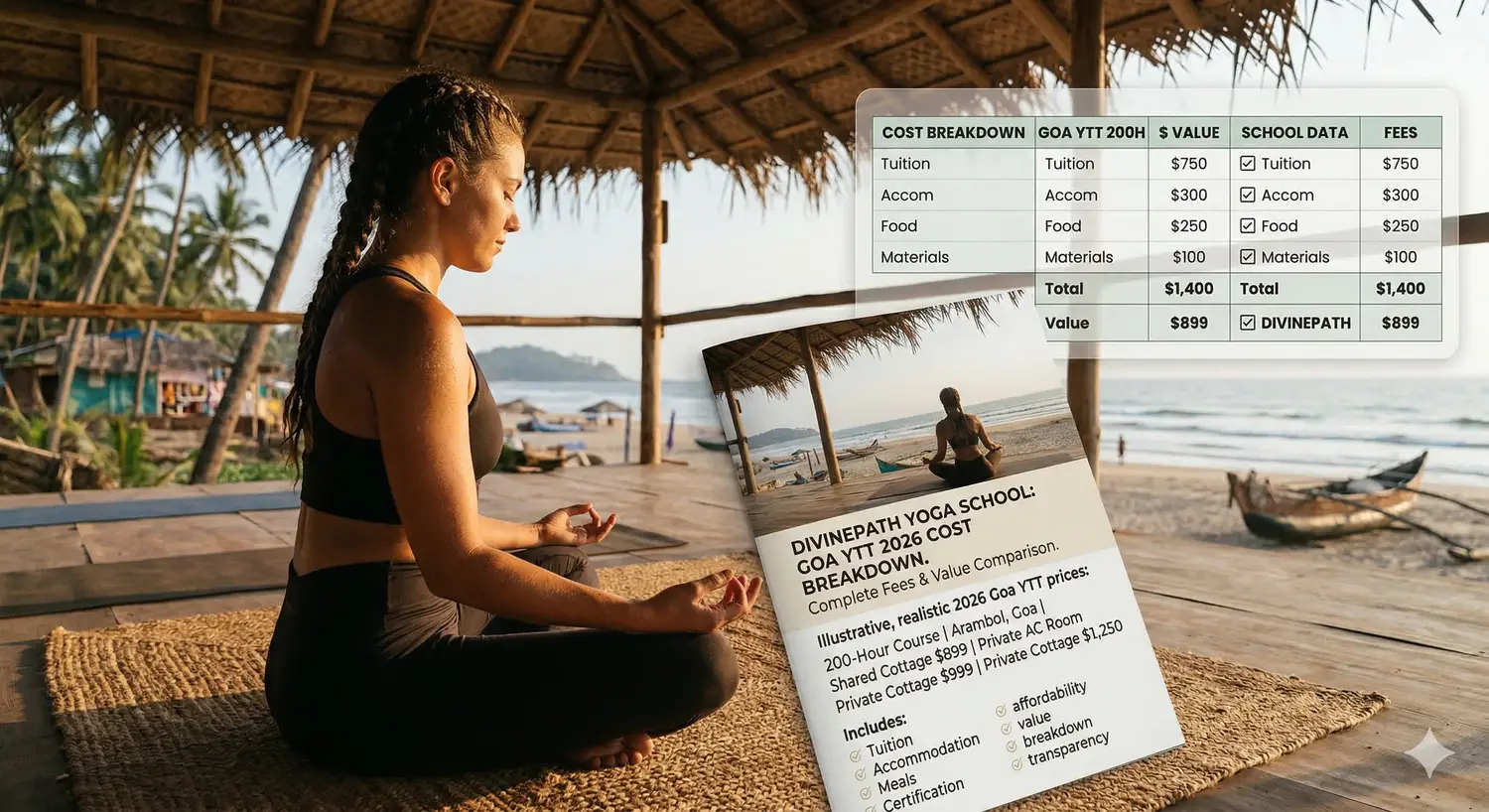
Here is our own pricing, which is the clearest illustration we can offer because we control every variable in it. Our 200-hour in Goa:
| Package | Price (USD) |
|---|---|
| Course and meals only (you arrange your own room) | $500 |
| Dorm bed | $699 |
| Shared room | $850 |
| Private room | $999 |
| Wooden cottage | from $1,050 |
Same course. Same teachers. Same 200 hours. Same certificate. The price roughly doubles, and every dollar of the difference is the room you sleep in.
That is the first thing to understand about YTT pricing: within a school, price signals accommodation, not quality. Someone who paid $1,050 does not get a better training than someone who paid $500. They get a better bed.
Across schools, price differences come from four things, in rough order of size:
What price almost never signals: teacher quality. There are excellent teachers at $600 schools and mediocre ones at $2,500 schools. There is no reliable relationship, and anyone who tells you otherwise is usually selling the expensive one.
So compare like for like. Take the all-in figure for the room you’d actually book, including meals, and put the two numbers side by side. Then ask what each one excludes. For India campus arithmetic specifically, start at our India teacher training hub.
Start with published Goa fees, then apply the same questions to every shortlist school — including us.
Any one of these is worth a question. Two or more, and walk away.
Copy this. Send it to every school on your shortlist, including us. How they answer tells you as much as what they answer.
Question 7 is the one nobody asks and almost nobody answers. Registering as an RYT costs money and effort, and graduates who don’t intend to teach often skip it — so the number isn’t a pure quality measure. But a school that has never thought about it has never followed up with its graduates. Ask us for ours when you enquire; if we can’t give you a clear answer, that is information too.
We would rather you read this now than find out in week two.
Don’t train with us if you want a specific lineage or style we don’t teach. The 200-hour path is Hatha, Ashtanga, Vinyasa and Yin, with pranayama, philosophy and meditation. We also run dedicated short courses: Yin TTC, Aerial TTC, and Prenatal & Postnatal TTC in Rishikesh, plus Sound Healing TTC in Goa. If you want Iyengar, Bikram or hot yoga, or a certified Kundalini training, we are not that school and you should go to one that is.
Don’t come to us for a silent retreat. We are not a Vipassana centre and our courses are not silent. If that is what you’re looking for, look for it specifically — the Vipassana network runs genuine ten-day courses on a donation basis and a yoga school is not a substitute.
Don’t book Goa between June and September. The monsoon closes most of North Goa. We can teach you, but it will not be the trip you’re picturing, and Rishikesh or Bali is the better answer in those months. More context in the Goa yoga guide.
Don’t book Rishikesh in December or January unless cold early mornings genuinely don’t bother you. A 6am practice in an unheated hall in a Himalayan January is a specific kind of commitment, and people underestimate it every year.
Don’t come to us if you want a large cohort. We cap at 10–15. Some people want thirty classmates and the social energy that comes with it. That is a legitimate preference and we are the wrong school for it.
Don’t book Bali if cost is your deciding factor. Our Bali 200-hour residential packages start around $1,299–$1,450 against $500 course-and-meals in Goa. Same syllabus family, same certificate pathway, roughly double to triple the money depending on room. If the qualification is what you’re buying, train in India.
Don’t book at all if you’re not ready to do nothing else for a month. A 200-hour is full-time, six days a week. It is not compatible with remote work, and every year somebody tries. If you’re earlier in the journey, start with how to train as a yoga teacher.
And if you can’t travel right now, an in-person course isn’t the only path — we’ve written about the trade-offs of online versus in-person training, and for some people the honest answer is to wait.
Before you pay:
No, and within a single school the price difference is usually just the room. Across schools it mostly reflects location and what’s included. Compare contact hours, group size and named teachers instead.
It matters if you want to teach at studios that ask for RYT 200 — many do, especially in the US, UK and Australia. It is not a quality guarantee, and there are excellent unregistered courses. Decide whether you need the registration, then treat it as a filter, not a recommendation.
Most schools including ours accept beginners, but ask for some regular practice first. Not for flexibility — because a month of full-time study is heavy going if you’re also learning the basic shapes.
The 200-hour is the standard teaching qualification. The 100-hour is a shorter immersion and doesn’t qualify you to teach on its own. The 300-hour is for people who already hold a 200. The 500-hour is both combined. Campus comparison: 200-hour hub · 300-hour hub · 500-hour hub. Longer certification comparison: 200 vs 300 vs 500.
It can be, for the right person and the right reasons, and it is much harder to learn to teach without a room full of people. We’ve written about the trade-offs honestly here.
India is roughly half the price for the same certificate pathway. Bali has a bigger international wellness scene. Goa vs Rishikesh · Goa vs Bali · All three compared.
We run 100, 200, 300 and 500-hour courses at four campuses, capped at 10–15 students, with prices published in full on every page. Short courses: Yin, Aerial, and Prenatal in Rishikesh; Sound Healing in Goa.
Goa (Arambol) · Rishikesh · Bali — Klungkung · Bali — Ubud · Klungkung or Ubud? · All programs
Verify our registration yourself: Divinepath on Yoga Alliance.
Written by Yogi Naveen Ji. Reviewed by Rajesh Ji, Vinyasa Flow & Asana Instructor. Last updated September 3, 2026.

One of the Best Yoga Teacher Training Courses & Retreats in India & Indonesia.
 Yoga Alliance RYS 200
School ID 457520
Verify registration →
Yoga Alliance RYS 200
School ID 457520
Verify registration →
Divinepath Yoga School & Retreat © 2026. All Rights Reserved.