



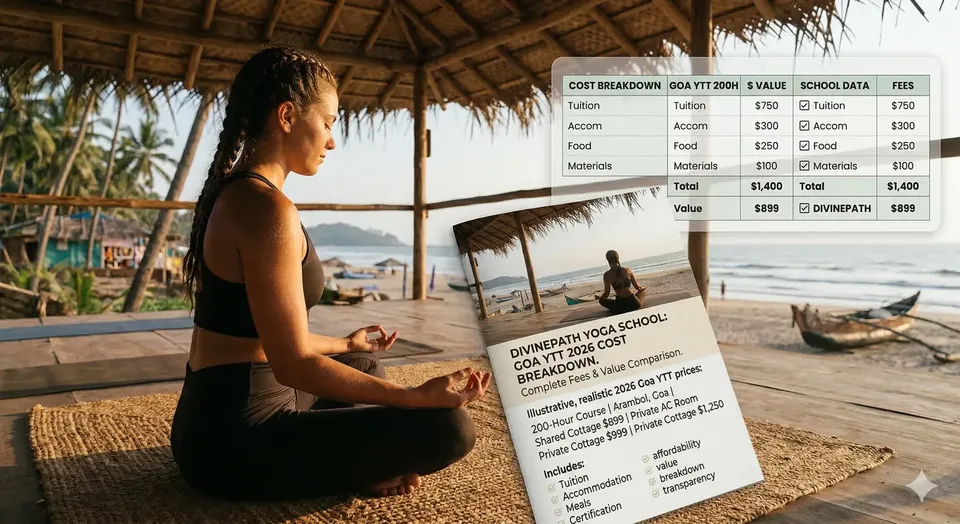
Quick answer: Yoga teacher training in Goa costs between $450 and $3,200 depending on the school, accommodation type, and program length. At Divinepath, the 200H program costs $699 for a dorm room, $899 for a shared cottage, and $1,250 for private accommodation — all including accommodation, three daily meals at our on-property restaurant, and Yoga Alliance registration support. Looking for a shorter start? See our 100-hour YTT in Goa. There are no hidden fees. The Yoga Alliance registration itself ($115) is paid directly to Yoga Alliance after graduation.
Below, we break down every cost you’ll face: course fees across all four certification levels, room-by-room comparisons, competitor pricing, hidden expenses nobody warns you about, and a realistic total budget so you can plan without surprises. For a broader school-by-school view, read our 2026 comparison of the best yoga teacher training schools in Goa.
If you’ve been researching yoga teacher training costs, you’ve probably seen prices in Goa ranging from $500 to $4,000+ for what looks like the same 200-hour certification. That’s confusing, and it’s meant to be.
Here’s what actually drives the price difference between schools in Goa:
Here are our exact prices for every course level and room type. No hidden fees, no “contact us for pricing” — just the real numbers.
| Course | Days | No Room | Dorm | Shared AC | Shared Cottage | Pvt AC | Pvt Cottage |
|---|---|---|---|---|---|---|---|
| 100 Hour | 11 | — | $450 | $599 | $750 | $699 | $899 |
| 200 Hour | 21 | $500 | $699 | — | $899 | — | $1,250 |
| 300 Hour | 27 | — | — | — | $1,299 | $1,400 | $1,800 |
| 500 Hour | 56 | — | — | — | $2,500 | $2,599 | $3,200 |
Get the complete cost breakdown, payment plans, and what is included in our 200-hour certification course — or start shorter with 100 hours.
All prices include: three Sattvic vegetarian/vegan meals daily, all yoga classes and lectures, course materials and textbooks, Yoga Alliance certification support (for 200h/300h/500h courses), and excursions on rest days. Residential prices also include accommodation for the full course duration.
Not included: flights to Goa, visa fees, travel insurance, personal expenses, laundry, and Yoga Alliance membership fee (paid directly to Yoga Alliance after graduation).
Important: The 100-hour course is not Yoga Alliance certified on its own. It’s the first half of our 200-hour programme. You train alongside the full 200-hour batch and can upgrade to the full certification by staying for the remaining 10 days.
This is where most schools get vague. At Divinepath, the 200-hour Goa course has four clear options so you can match your budget to your comfort needs:
Our honest recommendation: If this is your first YTT and you’re watching your budget, the dorm at $699 keeps the total cost low. If you want more comfort, the shared cottage at $899 is the sweet spot. You get a comfortable room, privacy with just one roommate, and access to all the same teachers and curriculum as the $1,250 private cottage. The extra $351 buys you a room to yourself — which is nice, but not essential for a good training experience.
We checked the published 2026 prices for a 200-hour YTT at several well-known schools in Goa. Here’s how they compare:
| School | Duration | Shared/Twin | Private | YA Certified? |
|---|---|---|---|---|
| Divinepath (Arambol) | 21 days | $899 | $1,250 | Yes (RYS 200/300/500) |
| Ekam Yogashala | ~24 days | $1,199 | $1,499 | Yes |
| Yoga Chaitanya (Goa) | 23 days | $1,599 | $1,900 | Yes |
| Goa Yogashala (Arambol) | ~26 days | €1,750+ | €2,200+ | Yes |
| Sampoorna Yoga (Goa) | ~25 days | €1,700+ | €2,100+ | Yes |
| Himalaya Yoga Valley | ~24 days | €2,500+ | €3,200+ | Yes |
A few things to notice. First, Divinepath’s shared cottage at $899 is significantly lower than most competitors — and that includes 21 days of accommodation, three meals a day, and Yoga Alliance certification support. We also offer a $699 dorm option and a $500 course-and-meals option without accommodation. Second, the European-run schools (Sampoorna, Himalaya Yoga Valley) price in Euros, which makes them considerably more expensive when converted to USD. Third, course duration varies. Some schools run 23–26 days; we run 21 days. Longer isn’t always better — it depends on how the contact hours are structured.
We’re not saying other schools are bad. Several of the ones listed above have been operating in Goa for years and have excellent reputations. The point is that you don’t need to spend $2,000+ to get a quality, Yoga Alliance-certified training in Goa. At Divinepath, we keep costs low because we operate locally, own our relationships with accommodation providers, and don’t have European overhead.
Every school’s headline price only tells half the story. Here’s a realistic breakdown of the other expenses you’ll face when doing yoga teacher training in Goa:
| Expense | Estimated Cost | Notes |
|---|---|---|
| Return flights (Europe/US) | $400–$900 | Book 2–3 months ahead |
| India e-Visa | $25–$80 | Most nationalities eligible |
| Airport taxi (GOX to Arambol) | $25–$40 | Divinepath arranges pickup |
| Travel insurance (1 month) | $30–$80 | Required — we recommend World Nomads |
| Personal expenses (laundry, SIM, extras) | $50–$150 | Goa is very affordable |
| Yoga Alliance registration (after grad) | $50 (initial) + $65/year | Optional but recommended |
| Extra excursions / massages | $20–$100 | Optional — not part of training |
| TOTAL HIDDEN COSTS | $575–$1,350 | On top of course fee |
So your real total budget for 200-hour YTT in Goa looks like this:
These numbers are honest. We’d rather you budget accurately and feel relaxed during training than show up expecting to spend $900 and stress about money for three weeks.
Let’s be specific about what’s included in our 200-hour course fee, because “everything included” means different things at different schools:
We believe in honest filtering. Goa is a fantastic place to train, but it’s not right for everyone. Here’s who might want to consider a different location:
We keep it simple. A 25% deposit secures your seat. For the 200-hour shared cottage option, that’s approximately $225 upfront. The remaining 75% is due on or before your arrival day.
We accept payment via our online gateway (credit/debit card, processed in USD) and bank transfer. The payment link is on our website. No hidden processing fees from our side — though your bank may charge currency conversion fees depending on where you’re based.
Batches start on the 1st of every month, so you can plan around your own schedule. We recommend booking at least 4–6 weeks ahead — our Goa batches do fill up, especially October through February.
We run schools in all three locations, so we can give you a straight answer. Here’s how the 200-hour pricing compares across Divinepath’s locations:
Bottom line: If budget is your primary concern, Goa is the best value in the Divinepath network. You can train without accommodation for $500, choose a dorm for $699, or take the shared cottage at $899 — still $100 less than Rishikesh at the shared-stay level and $551 less than Bali at the shared-stay level.
Our 200-hour YTT in Goa runs monthly, starting on the 1st. Here are the upcoming 2026 dates:
April 1–21, May 1–21, August 1–21, September 1–21, October 1–21, November 1–21, and December 1–21. The December and January batches use peak-season pricing (shared cottage jumps to $1,200).
The 200-hour certification gets you teaching-ready and Yoga Alliance-registered. But some students want to go deeper. For the full decision framework — not just Goa pricing — read our honest guide on whether a 300-hour YTT is worth it. Here’s the cost-benefit analysis for the advanced levels at Divinepath Goa:
Duration: 27 days. This is 6 days longer than the 200-hour course. You’ll cover advanced asana clinics (arm balances, inversions), advanced anatomy with therapeutic applications, sequencing and adjustment workshops, and take on a mentorship role with the 200-hour batch training alongside you.
Who it’s for: Teachers who’ve completed 200 hours and have been teaching for at least 6–12 months. If you haven’t taught a single class yet, you’re not ready for this. The advanced material only makes sense once you’ve experienced real classrooms, real students, and real challenges that theory can’t prepare you for.
Cost per day: At $1,299 for 27 days in a shared cottage, that’s about $48 per day — including accommodation, food, and advanced training. Compare that to a weekend workshop in London or New York that charges $300–$500 for two days. The value is clear.
Duration: 56 days (roughly 2 months). This combines the 200-hour foundation (Month 1) with the 300-hour advanced module (Month 2), with a 3–5 day integration break in between. Your accommodation and meals continue during the break at no extra cost.
The savings are real: If you did the 200-hour ($899) and 300-hour ($1,299) separately, you’d pay $2,198 total. The 500-hour combined costs $2,500 in a shared cottage — that’s only $302 more for the convenience of doing it all at once, with the break days and bridge sessions included.
Our honest advice: Unless you’re absolutely certain about a teaching career, do the 200 hours first. Go home. Teach for six months. Then come back for 300 hours. Yes, it means two trips to Goa and costs slightly more. But you’ll get far more value from the advanced training if you have actual teaching experience to build on.
This is the real question, and it deserves a real answer.
If you plan to teach yoga professionally — even part-time, even just a few classes a week — then yes. A 200-hour Yoga Alliance certification from a recognized school opens doors worldwide. Studios, gyms, retreat centres, and online platforms all require it. The $899–$1,250 you spend at Divinepath Goa will pay for itself within a few months of regular teaching.
If you want to deepen your personal practice without any plans to teach, it can still be worth it — but be honest with yourself. You’re spending a month in Goa, learning yoga 8–10 hours a day, eating healthy food, disconnecting from your regular routine. That experience has value beyond the certificate. But if budget is tight and teaching isn’t the goal, a 7-day retreat ($350–$600 at Divinepath Goa) might give you 80% of the personal transformation at 40% of the cost.
If you’re a beginner not sure yet, do the 100-hour course first. At $450–$899 for 11 days, it’s a low-risk way to test whether YTT life suits you. You’ll join the first half of our 200-hour batch, experience the full daily schedule, meet the teachers, try the food, and decide if you want to stay for the remaining 10 days to complete the full certification.
We’ve had students arrive convinced they wanted to teach and leave realizing they just wanted a deeper practice. We’ve had students arrive “just to try it” and leave with a teaching career plan. Both outcomes are fine. The point is to make a financially informed decision before you arrive, not after.
When you’re budgeting for yoga teacher training, it helps to understand what you’re actually buying. Here’s a typical day at our Goa campus:
That’s roughly 8–10 hours of structured learning per day, six days a week. One day per week is a rest day with an optional excursion. It’s intensive. But it’s also the reason a 21-day course can cover 200 contact hours of material — there’s no filler in the schedule.
Every minute of your course fee is going toward actual training, real food, and a clean place to sleep. That’s why we can offer a Yoga Alliance-certified 200-hour course from $500 without accommodation, or $899 with a shared cottage, and still deliver a programme that graduates walk away from feeling genuinely prepared to teach.
At Divinepath Yoga School & Retreat in Arambol, Goa, the 200-hour Yoga Alliance-certified YTT costs $500 without accommodation, $699 for a dorm room, $899 for a shared cottage, and $1,250 for a private cottage. Every option includes training, three daily meals, all course materials, and certification support; residential options include accommodation, pool, and garden access.
At Divinepath, every 200-hour course fee includes three Sattvic vegetarian/vegan meals daily, all yoga classes (Hatha, Ashtanga, Vinyasa), pranayama, meditation, philosophy lectures, anatomy sessions, course textbooks and materials, Yoga Alliance certification support, and group excursions on rest days. Residential options also include accommodation for the training duration. Flights, visa, travel insurance, and personal expenses are not included.
Yes. At Divinepath, the same 200-hour Yoga Alliance-certified course costs $899 in Goa versus $1,450 in Bali when comparing shared-cottage stays. The $551 difference is because Bali has a higher cost of living and more premium accommodation. The curriculum, certification, and teaching quality are equivalent across both locations.
At Divinepath, no. Our published price is the full course fee. However, you should budget separately for flights ($400–$900 from Europe/US), India e-visa ($25–$80), travel insurance ($30–$80), and personal expenses ($50–$150 for the month). After graduation, Yoga Alliance registration costs $50 initially plus $65 per year, paid directly to Yoga Alliance. Your realistic total budget including everything is approximately $1,475–$2,600 depending on room type and travel costs.
Yes. Our 200-hour course in Goa is designed for beginners through intermediate practitioners. You don’t need prior teaching experience or advanced flexibility. If you’re unsure about committing to the full 200 hours, our 100-hour course ($450–$899 depending on room type, 11 days) lets you experience the first half of the programme before deciding to continue. Many of our students have never done formal yoga training before arriving.
Pay a 25% deposit through our website to secure your seat. For the 200-hour shared cottage option, that’s approximately $225. The remaining balance is due on or before your arrival day. We accept credit/debit cards (processed in USD) and bank transfers. Batches start on the 1st of every month. For questions, reach us at +91-8868043473 or via WhatsApp at the same number.
You’ve read the prices. You know what’s included and what’s not. Pick your preferred month, choose your room type, and secure your spot with a 25% deposit.
View Goa YTT Dates WhatsApp Us
Ashtanga & Alignment Instructor, Divinepath Yoga School & Retreat
View Profile
Yoga Alliance Registered Yoga School — RYS 200, 300 & 500 · School ID 457520
 Yoga Alliance RYS 200, 300 & 500
School ID 457520
Verify registration →
Yoga Alliance RYS 200, 300 & 500
School ID 457520
Verify registration →
Divinepath Yoga School & Retreat © 2026. All Rights Reserved.