



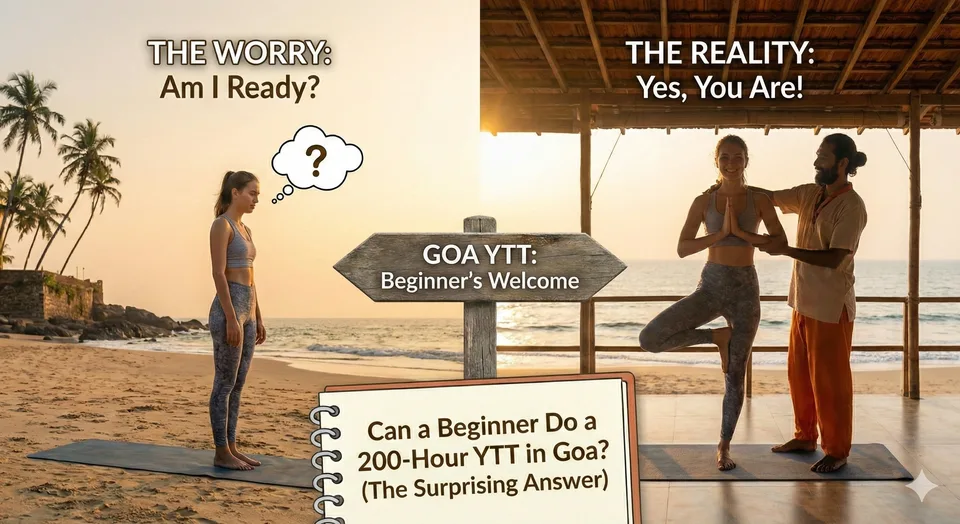
Reviewed by Yogi Saransh Ji, E-RYT 500, Goa Campus Lead
Quick Answer: Yes — a complete beginner can join a 200 hour yoga teacher training in Goa. At Divinepath, many students in every 21-day Goa batch have never done a training before, and several have practiced for under a year. You do not need advanced postures, extreme flexibility, or any Sanskrit background. Our 200 hour Goa course starts at $500 without accommodation, or $699 for a dorm room including all meals. What you do need is roughly three to six months of regular practice and the willingness to commit to a full daily schedule.
This is one of the questions we get most often. Someone emails us, usually a little nervously, and says something like: "I really want to do the 200 hour, but I've only been practicing for eight months and I can't even do a proper headstand — is this course for me, or will I be the worst person in the room?"
I want to answer that question properly here, because the honest version helps you make a better decision than the marketing version. I've watched hundreds of students come through our Goa courses, and the pattern is clear enough that I can tell you what actually happens to beginners — not what sounds reassuring.
This guide covers the real picture: whether you're ready, what the 21 days genuinely involve, who shouldn't sign up yet, what it costs in plain USD, and a few real stories from beginner graduates. By the end you'll know whether to book, wait, or start somewhere smaller first.
Already sure you want to train? For the full cost, curriculum, schedule, visa, and certification picture, start with our complete 200-hour yoga teacher training in Goa 2026 guide. For a week-by-week look at what actually happens on a Divinepath 200-hour YTT in Goa, read our companion guide: Yoga Teacher Training in Goa for Beginners: What to Expect Week by Week. If you are still comparing schools, use our 2026 guide to the best yoga teacher training schools in Goa.
Let's get the practical bar out of the way first, because it's lower than most people think.
At Divinepath, we ask for roughly three to six months of fairly regular practice before a 200 hour. By "regular" I mean two or three sessions a week, not daily perfection. What that gives you is familiarity — a Sun Salutation doesn't confuse you, basic standing poses feel like home, and you've sat for a few minutes of breathing without panicking about it.
That's the whole requirement. You'll notice what's not on the list: deep backbends, arm balances, the splits, headstands, or any ability to chant in Sanskrit. We teach all of that. If you arrived already able to do it, there'd be less for us to do.
Here's the thing experienced teachers know and beginners don't: a 200 hour course is a foundation course. The name tells you that. It is designed for the person who has a sincere practice and wants to understand it properly and learn to teach it — not for someone who's already advanced. An advanced practitioner in a 200 hour is often a little bored. A prepared beginner is exactly the target student.
The more honest readiness question isn't physical at all. It's this: can you commit to a full day, every day, for 21 days? That's the part beginners underestimate. We'll come back to it.
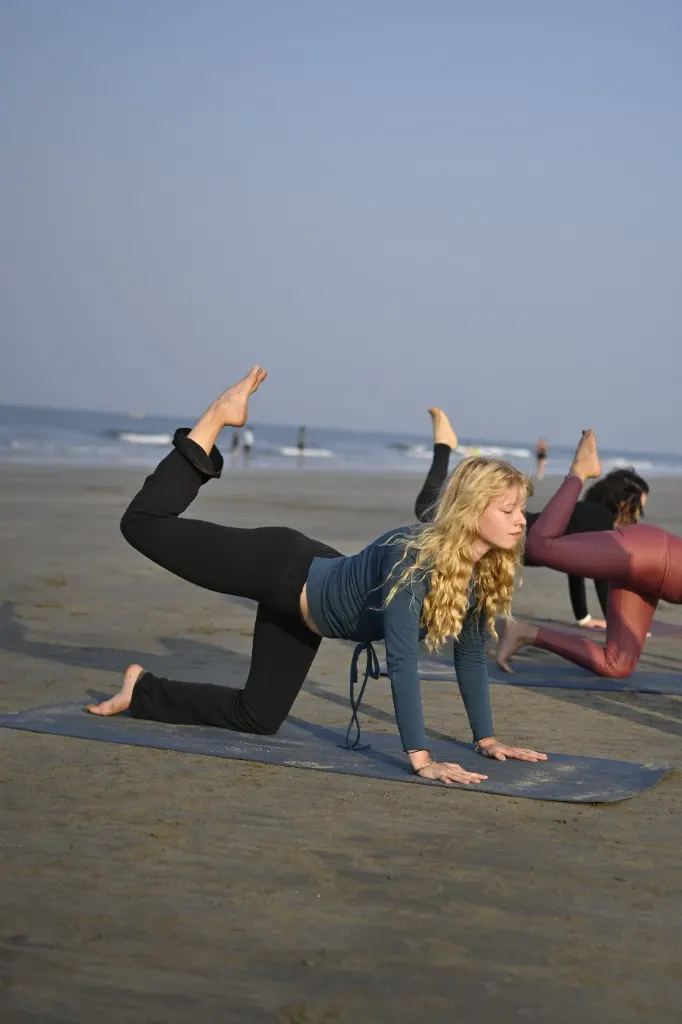
When someone tells me they're worried about being a beginner, they almost never mean they're worried about the curriculum. They mean something more human: they're afraid of being the slowest person in a room full of bendy 25-year-olds.
I understand it. But it's based on a picture of these courses that isn't accurate.
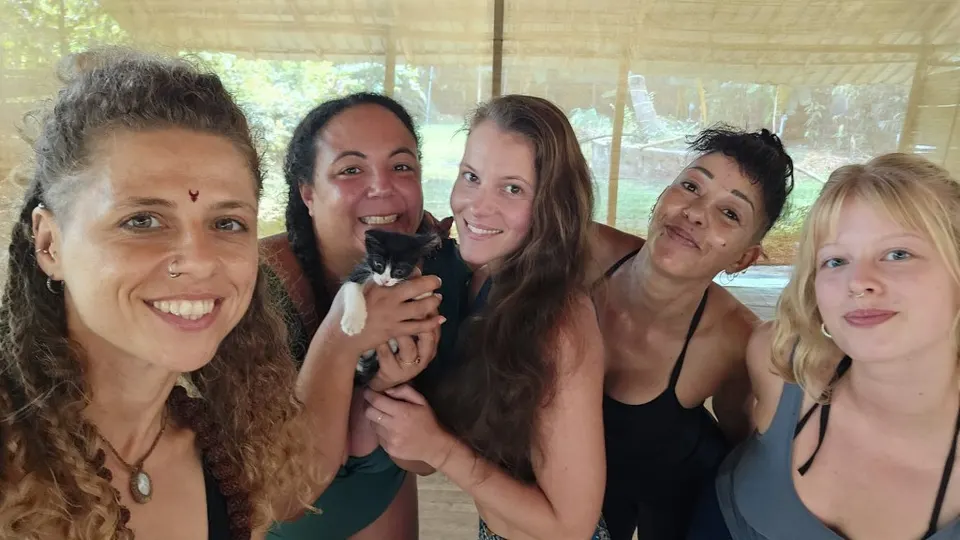
Our Goa batches are capped at 15 students. In a typical group you'll find a nurse in her fifties, a couple of recent graduates travelling Asia, someone going through a life reset, a yoga-studio regular who finally took the plunge, and two or three people exactly like you who've practiced for under a year. The "everyone is advanced" fear dissolves in about a day, because it was never true.
And the small cap matters more than any other single factor for a beginner. With 15 people, our teachers still actually see you. When your alignment is off in Warrior II, someone corrects it the same day rather than three weeks later. You can't hide, which feels uncomfortable for about 48 hours and then becomes the reason you improve so fast.
"I spent the whole flight to Goa convinced I'd embarrass myself. By day three I'd stopped thinking about it. Nobody cared that I couldn't do a backbend — half the room couldn't either." — Priya, UK, 200 hour graduate
If you want to understand the daily structure that makes this possible, our 200 hour Goa YTT page lays out the full curriculum and current dates.
Here's where I can be specific, because the schedule is the schedule whether you've practiced for one year or ten.
Days start at 6:30am with pranayama and meditation, before the heat. Then a two-hour asana practice — Hatha some mornings, Ashtanga Vinyasa others. Breakfast at 9:30. Mid-morning is theory: anatomy, philosophy, or teaching methodology. Lunch and a proper break in the afternoon, then an alignment lab or teaching practice, an evening session, and dinner at 7. Lights tend to go out early because everyone is genuinely tired.
For a beginner, the first week is a shock to the system. Your body is doing more yoga in three days than it usually does in a month. This is normal. We expect it. By the end of week one, something shifts — your body adapts, the soreness settles, and the early mornings stop feeling like a fight.
The curriculum is paced so that nobody is left behind. Anatomy starts with what a joint is and how it moves, not with advanced biomechanics. Philosophy begins with the Yoga Sutras of Patanjali explained in plain language, not a Sanskrit reading test. Teaching methodology builds from "how do you stand in front of a group and speak clearly" upward.
Here's a week-by-week breakdown of how a beginner typically progresses:
| Week | Focus | How a beginner usually feels |
|---|---|---|
| Week 1 | Foundations: alignment, breath, basic anatomy, daily practice rhythm | Overwhelmed, sore, doubting the decision. Completely normal. |
| Week 2 | Sequencing, philosophy deepens, first supervised teaching practice | Body adapts. Confidence starts. "I might actually be able to do this." |
| Week 3 | Full class planning, repeated teaching reps, final assessment | Teaching a full class. Surprised at how far they've come. |
The point of showing you this is honesty: week one is hard, and we'd rather you arrive expecting that than be blindsided by it. Almost every beginner has a wobble around day four. Almost every one of them is glad by day twenty-one that they didn't quit on day four.
This is the part that sounds impossible to people before they do it, and obvious to them after.
Yes. By the final week, every Divinepath 200 hour student plans and leads a full-length class. It's part of the assessment — not optional, not a demo, a real class. And the reason beginners can do it is that we don't save teaching practice for the end. It starts in week two, in small pieces, with feedback after every single one.
You teach a five-minute segment. Saransh Ji or one of our teachers tells you what worked and what to fix. You teach a longer segment two days later. You watch your peers and learn from their mistakes as much as your own. By the time the final assessment arrives, you've already stood in front of the group a dozen times. The full class isn't a leap — it's the next obvious step.
What you walk away with is a Yoga Alliance-eligible certificate. Divinepath is a Yoga Alliance Registered Yoga School, so on completing the 200 hour you can register as a Registered Yoga Teacher (RYT 200) directly with Yoga Alliance. That registration is what most studios worldwide recognise.
Does a 200 hour certificate make you a polished, experienced teacher on day one? No — and any school that promises that is selling you something. It makes you a safe, competent beginning teacher with the foundation to grow. The polish comes from teaching real classes afterward. But the foundation is real, and it's enough to start.
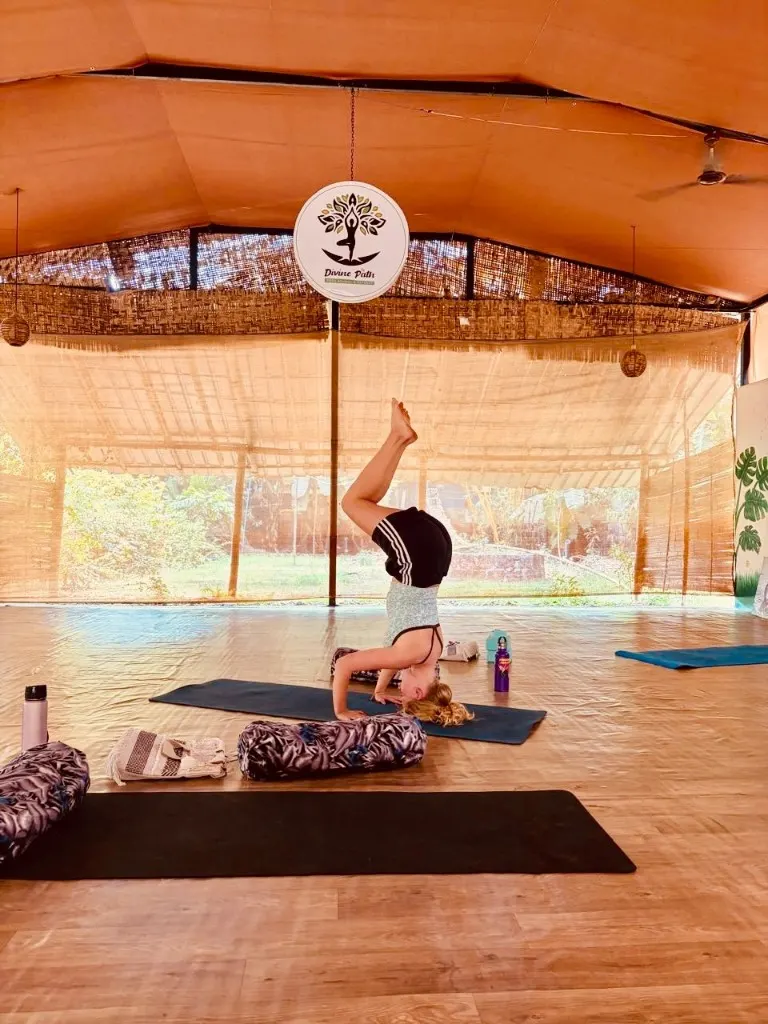
I'd rather lose a booking than have someone arrive in Goa and spend three weeks miserable. So here's the honest filter — the people who should wait or choose something else.
If you've literally never practiced yoga. Not once, not a YouTube video, nothing. A 200 hour is a foundation course, but it assumes a small base. If you're starting from absolute zero, do two or three months of classes at home first, or come to our shorter 100 hour Goa course, which moves at a gentler pace and works as a genuine introduction.
If you can't commit to the full daily schedule. If you're hoping to do half the classes and spend afternoons at the beach, this isn't the right course — and you'd be wasting a serious amount of money. A Goa yoga retreat would suit you far better and cost a lot less. Retreats are designed for rest. Teacher training is designed for work.
If you're in acute physical or emotional crisis. The course is intense. It can bring things up. If you're recovering from a serious injury or in the middle of an acute mental health episode, talk to your doctor first, and talk to us honestly — sometimes the answer is "come in six months, not now."
If you only want the certificate, not the learning. Some people want a quick RYT 200 to put on Instagram. The course will feel long and tedious to them, and frankly the students around them notice. If teaching genuinely interests you, you'll love it. If it's only a credential, reconsider.
If none of those apply to you — and for most nervous beginners, none of them do — you're ready.
People considering their first teacher training usually compare Goa, Rishikesh, and sometimes Bali. We run schools in Goa and Rishikesh both, so I have no reason to push one over the other — I'll tell you what tends to suit beginners. If Bali is on your list, read our companion guide on whether a beginner can do YTT in Bali.
For a first training, Goa is often the gentler choice. The climate is warm, the setting is coastal and relaxed, and it's easy to reach via Manohar International Airport (GOX). Rishikesh is extraordinary, but it's more austere — a Himalayan ashram town with a stricter, more traditional energy. Some beginners thrive on that; others find it intimidating for a first time. Goa softens the edges of an already demanding 21 days.
| Factor | Goa (Divinepath) | Rishikesh (Divinepath) |
|---|---|---|
| Setting | Coastal, warm, relaxed, near Arambol Beach | Himalayan foothills, on the Ganges, traditional |
| Energy for beginners | Gentle, social, international | Intense, classical, immersive |
| Best season | October–March | March–June, September–November |
| 200 hour starting price | $500 without accommodation; $699 dorm; $899 shared cottage | $950 shared cottage; $1,300 private |
| Easiest for first-timers? | Usually yes | Better as a second training |
A path many of our students take: 200 hour in Goa as their first training, then the 300 hour later — sometimes in Goa, sometimes in Rishikesh for the contrast. If you want to weigh the destinations in more detail, our yoga teacher training cost guide breaks down the full pricing picture across locations.
I'll give you exact numbers, because "contact us for pricing" helps nobody.
At Divinepath, the 200 hour Goa course starts at $500 without accommodation (training and three daily meals included). A dorm room is $699, a shared cottage is $899, and a private cottage is $1,250. Every residential option includes the full 21-day training, three sattvik vegetarian meals a day, accommodation for the whole course, and your study materials. There are no surprise add-ons.
| Room type | Price (USD) | What's included |
|---|---|---|
| Without accommodation | $500 | Full training, three daily meals, materials |
| Dorm room | $699 | Full training, meals, accommodation, pool, garden |
| Shared cottage | $899 | Full training, meals, accommodation, pool, garden |
| Private cottage | $1,250 | Full training, meals, accommodation, pool, garden |
Two costs sit outside the course fee, and I'd rather you know now: your flights, and the Yoga Alliance registration fee you pay directly to Yoga Alliance after you graduate (currently around $115 USD — check their site for the current figure). Travel insurance is also your own arrangement, and we strongly recommend it.
For comparison: a 200 hour in Bali or a Western country often runs $2,500–$4,000 for similar contact hours, frequently without accommodation and meals included. Goa's pricing is one of the genuine reasons it's become a global hub for affordable, serious training. The current dates and any seasonal offers are always on the 200 hour Goa course page.
If this is your first trip to India, the visa question can feel daunting. It's more straightforward than it looks, but there's one nuance worth being honest about.
Most international students enter on an e-Tourist Visa, available online from the official Indian government portal, in 30-day, one-year, and five-year versions. The one-year multiple-entry version is what many of our students choose, and it comfortably covers a 21-day course.
Here's the nuance: India's e-Tourist Visa officially permits short yoga programmes that do not issue a qualifying certificate. Teacher trainings technically issue a certificate. In practice, the overwhelming majority of international students attend yoga teacher trainings across Goa and Rishikesh on a tourist visa every year, declaring their trip honestly as tourism and wellness travel — which it genuinely is, alongside the study. We're not in a position to give you legal advice, so the responsible thing is to check the current rules on the official Indian e-Visa site and decide what you're comfortable with.
What we do handle: once you've enrolled, we send you a detailed arrival note covering the airport (GOX, about 45 minutes from our Arambol campus), what to pack, local SIM advice, and how to reach us. For a first-time visitor to India, that guidance removes most of the anxiety. Make sure your passport is valid for at least six months beyond your travel dates, and carry a printed copy of your e-Visa for immigration.
Numbers and schedules only tell you so much. Here are three real beginners — names used with permission — who arrived nervous and left as teachers.
Sarah almost didn't book. She'd been practicing at a studio in Portland for under a year and was convinced she was "too new." She came to a Goa 200 hour intake anyway. Her week-one message to a friend, which she later read out to the group, was basically a list of everything that hurt. By week three she taught a clean, confident Hatha class. She now teaches two community classes a week back in Oregon and is planning her 300 hour with us.
Daniel was a software project manager who'd practiced casually for about a year and wanted out of his desk job. He worried he was too old and too stiff to start. He wasn't — he was exactly the prepared beginner the course is built for. The thing he struggled with most wasn't the poses; it was learning to speak slowly and clearly while teaching. Three weeks of repeated teaching practice fixed it. He's now teaching part-time while he transitions.
Mei's worry was less about yoga and more about travelling alone to India for the first time. Our arrival guidance, the small batch, and the on-campus accommodation made it manageable. She told us the 15-student cap was the difference — she got real feedback instead of disappearing into a crowd. She graduated, travelled a little more around Goa, and went home with both a certificate and, in her words, "a lot more nerve than I arrived with."
Across our courses, the through-line is consistent: prepared beginners do well here. That's not a slogan — it's what we see after years of running these intakes. If you'd like to know more about who'll be teaching you, our lead Goa instructor Saransh Ji's profile is worth a read.
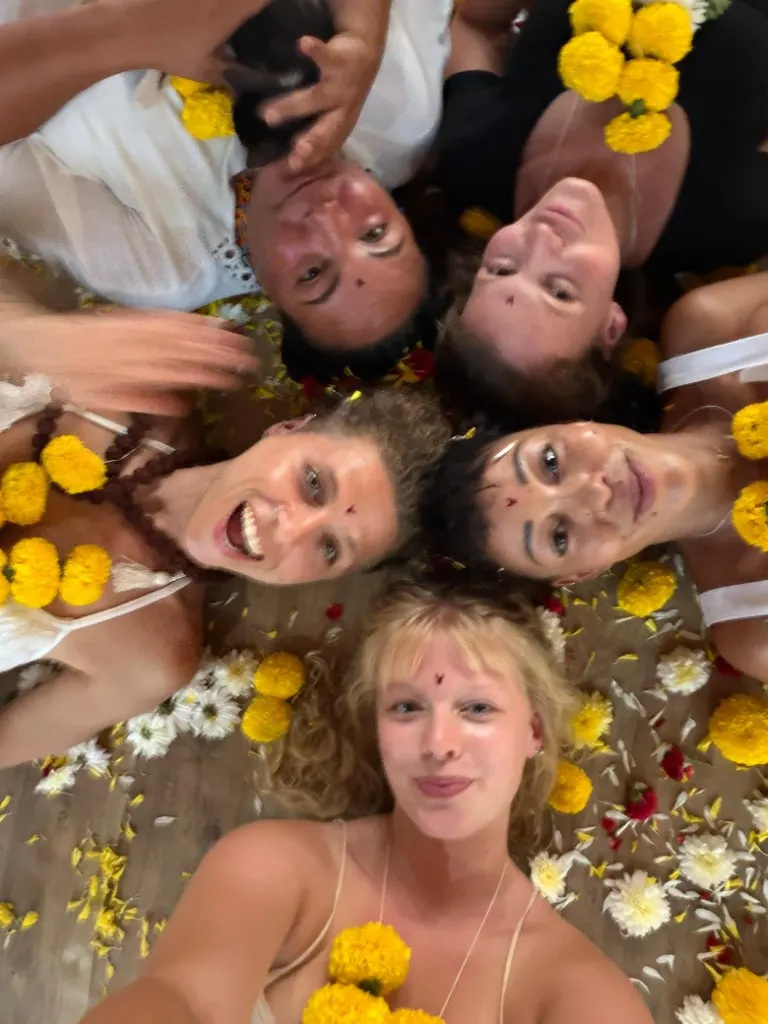
If you've practiced for a few months and you're willing to commit to the 21 days, you're more ready than you think. See current Goa dates and fees, or message us with your honest situation — we'll tell you straight whether now is the right time.
Yes. At Divinepath, many students in every 200 hour Goa batch have never done a training before, and some have practiced for less than a year. The 21-day course is built to take a sincere beginner from regular practice to teaching a full class. You don't need advanced postures or any Sanskrit background. The dorm option starts at $699 with meals and accommodation included, or $500 without accommodation.
We ask for roughly three to six months of fairly regular practice — enough that a Sun Salutation and basic standing poses feel familiar. You don't need to touch your toes or hold a headstand. If you've never practiced at all, do a few months of classes at home first, or start with our 100 hour Goa course.
It starts at $500 without accommodation, $699 for a dorm room, $899 for a shared cottage, and $1,250 for a private cottage. Every residential option includes the full training, three sattvik meals a day, accommodation for the 21 days, and course materials. The Yoga Alliance registration fee afterward is separate and paid directly to Yoga Alliance.
Yes. By the final week, every 200 hour student plans and leads a full-length class as part of the assessment. Teaching practice starts in week two with supervised feedback, so you get repeated reps before the final. Many beginner graduates teach their first paid classes within a few months of returning home.
Most students enter on an e-Tourist Visa, which covers stays well beyond 21 days. India's e-Tourist Visa officially covers short yoga programmes that don't issue a qualifying certificate, so declare your trip honestly as tourism and wellness travel. We send every enrolled student a detailed arrival and visa guidance note, and you should always check the official Indian government e-Visa portal for current rules.
For many first-timers, yes. Goa is warmer and more relaxed than Rishikesh, easier to reach, and the coastal setting makes a demanding schedule feel manageable. Beginners intimidated by a strict Himalayan ashram often find Goa a gentler first step. We run both, so you can start in Goa and go to Rishikesh later for your 300 hour.

One of the Best Yoga Teacher Training Courses & Retreats in India & Indonesia.
 Yoga Alliance RYS 200
School ID 457520
Verify registration →
Yoga Alliance RYS 200
School ID 457520
Verify registration →
Divinepath Yoga School & Retreat © 2026. All Rights Reserved.