Home Rishikesh Yoga Guide




Rishikesh has more yoga schools per square kilometre than almost anywhere else people travel for practice, and nearly every one describes itself as traditional, authentic, and rooted in ancient lineage. The words appear so often that they stop meaning much, which is a problem if you are trying to choose carefully rather than emotionally.
We run a school here, on Upper Canal Road in Tapovan. So read this the way you should read anything a school writes about its own town: with a little suspicion, and by checking what we say against the pages where we actually sell the course.
What follows is the part most guides skip: how to tell what a Rishikesh school actually is, which is a different question from how good it is.
The short version
Rishikesh sits where the Ganga comes out of the Himalayan foothills into the plains, about an hour from Dehradun and roughly six hours from Delhi by road. It is a pilgrimage town first and a yoga town second, and the two overlap less than visitors expect.
It is a dry, vegetarian city. Alcohol and meat are prohibited across Rishikesh. That is not a spa-style house rule. It is part of the town itself. If you were picturing a beer after class or a casual night out, that is a useful sign you may prefer Goa.
It is also not quiet in the simple, brochure sense. The main roads carry scooters, horns, cows, and in season large numbers of pilgrims. The quiet is real, but it lives in pockets: the riverbank before breakfast, a rooftop after sunset, an ashram courtyard, the stretch of your walk where traffic drops away and the sound shifts from engines to temple bells.
At the same time, Rishikesh is genuinely old at what it does. Swami Sivananda founded the Divine Life Society here in 1936. Parmarth Niketan still anchors one of the best-known aarti gatherings. Chaurasi Kutia, the old Maharishi site, still shapes how outsiders imagine the place even if the actual town is much messier, louder, and more ordinary than the myth.
That mix is why people usually know within the first few days whether Rishikesh suits them. Some people feel relieved by the discipline immediately. Others spend the month wishing they had chosen somewhere softer, warmer, or less devotional. Neither reaction is wrong.
That is also why the town works best for students who want study to be the centre of the trip rather than one attractive part of a larger holiday. Rishikesh gives you river walks, temple visits, and good chai breaks, but the emotional logic of the place is discipline rather than leisure. If you want the city to entertain you between sessions, it can feel limiting. If you want the city to keep narrowing your attention back toward practice, it can feel exactly right.
This is the section we would want a friend to read, and it applies to us as much as to anyone else.
Nearly every school here uses the same small set of words: traditional, authentic, Himalayan, lineage. They are not useless words, but they are often used lazily.
An ashram is not the same thing as a commercial yoga school. An ashram is a residential religious institution with a resident teacher or successor line. A yoga school may borrow language from ashram culture, but what it is actually selling is a structured course for paying students, usually with accommodation and an international certification pathway. Both can be valuable. They are not interchangeable.
"Himalayan tradition" also needs translating. Sometimes it refers to a real teacher, institution, or training stream. Often it just means the school is physically located in the Himalayan foothills. Only one of those is a precise claim.
And many schools here are much newer than their copy suggests. There is nothing wrong with that. International teacher training as a product is itself modern. But if a school founded in the last decade speaks as if its own institution has existed since the Upanishads, it is usually describing yoga's history rather than its own.
Three questions settle most of this in under a minute:
A good answer names a person, a place, and a year. A weak one drifts back into adjectives.
The honest short answer is that we are not an old monastic lineage institution. We are a small-cohort yoga school run by teachers who trained in and around Rishikesh, and who teach from that environment rather than pretending to be an ashram.
Our campus is in Tapovan on Upper Canal Road, near Lakshman Jhula. The school runs residential 100, 200, 300, and 500-hour programmes, with small batches and a course structure built around Hatha, Ashtanga Vinyasa, breathwork, philosophy, anatomy, teaching methodology, and practical teaching support.
The strongest concrete identity signals we currently publish are not vague lineage slogans but named teacher pages and named credentials. Rajesh Ji's profile states a Master's Degree in Yoga Science from Uttarakhand Sanskrit University. Jaggi Ji's profile states an M.Sc. in Yoga Science from Gurukul Kangri University. Naveen Ji's live course-page schema describes him as holding a Master's in Yoga Science, while his standalone profile still needs tighter wording elsewhere on the site. That is the honest level of certainty the current published evidence supports, and we would rather state that plainly than overclaim.
Three teachers currently anchor the Rishikesh campus:
That matters because it is one of the fairest questions you can ask any school in town: who teaches anatomy, who teaches philosophy, and who teaches methodology, by name, at the campus and in the month you are actually joining? Schools with multiple locations sometimes show a senior roster on the site while your batch is taught by someone else. Ask anyway.
If you want to vet us the same way, start with the Rishikesh teachers page and the individual profiles for Rajesh Ji, Naveen Ji, and Jaggi Ji.
At course-page level, our Rishikesh teaching is presented as Hatha, Ashtanga Vinyasa, pranayama, meditation, philosophy, anatomy, teaching methodology, and supervised teaching practice. That is the core shape of the course a student is actually paying for.
The site also references Kundalini elements in places, but not as a standalone dedicated Kundalini teacher training product at this campus. In practice, that means you should not book here expecting a full separate Kundalini certification unless the product page says exactly that.
We are not an Iyengar, Bikram, or hot-yoga school. Those are different products. A general 200-hour will not become them once you arrive.
Besides the 100–500 hour YTT path, the same Tapovan campus runs dedicated short teacher trainings. These are separate products with their own pages, prices, and syllabi — not electives inside the 200-hour.
And we are not a silent retreat. If what you really want is ten days of silence and minimal interpersonal contact, book a Vipassana course specifically. A yoga school is a different kind of container.
The two get confused constantly and they are different products.
| Retreat | Teacher training | |
|---|---|---|
| Length | 3, 5, or 7 days | 12 to 55 days |
| What it is | Rest, daily yoga, meals, a lighter routine | Full-time study, roughly dawn to evening, six days a week |
| Certification | None | RYT pathway |
| Right for you if | You want a reset or want to test whether you like the town | You want to teach, or want to go properly deep for a month |
If you are not sure, take the retreat. Nobody regrets arriving at a month-long training after first spending a few quieter days understanding the pace of the town. Start with the Rishikesh retreats hub or the 3-day, 5-day, and 7-day options: 3-day, 5-day, 7-day.
Location matters here more than in most yoga towns because the areas are genuinely different rather than just different price bands.
Tapovan and the Lakshman Jhula side is where many international yoga students end up. Cafes, ayurvedic pharmacies, practical errands, and other students are easy to find. It is convenient, sociable, and usually the easiest first landing if you want enough infrastructure to settle quickly.
Swarg Ashram and the Ram Jhula side feels more devotional and more ashram-centred. There are fewer cafes and more of the town's explicitly spiritual institutions. If the tradition itself is why you came, spend time here even if you do not stay here.
Main Rishikesh town around Triveni Ghat is ordinary Indian town life first and yoga tourism second. Markets, traffic, temples, errands, crowds. Worth seeing, less often where a month-long YTT student chooses to base themselves.
Our campus is on Upper Canal Road in Tapovan, near Lakshman Jhula. In practical terms that means most students can walk to the river, tea stalls, and useful shops without needing a scooter. It also means you wake to actual town life rather than curated retreat silence: temple sound, street movement, dogs, chai, and people already on the road before your first class. For the room setup itself, use where you'll stay in Rishikesh.
If you have never been to India before, Tapovan is usually the easiest landing point because it lets you make small mistakes cheaply. Need electrolytes, a SIM top-up, laundry, another shawl, or a quieter cafe to read in on Sunday? You can solve those within a short walk. Students who stay somewhere more devotional often love it, but they also tend to spend more of the first week figuring out logistics. That is not fatal. It is simply part of the trade-off.
Late September to November is usually the best overall window. Monsoon has eased, the river is full, mornings are cool without being punishing, and the town feels alive rather than overloaded.
December and January are cold. This matters more than glossy yoga content likes to admit. A 6am class can feel biting when the floor, room, and outside air are all carrying the same temperature. Bring more layers than your weather app suggests. Our Rishikesh packing list is the practical version of that advice.
February to April is the second strong window. Conditions are comfortable, and the town is active in a good way. If you like a little more movement and community around your training month, this is usually a safe choice.
May and June are hot. The course still runs, but the heat changes how hard effort feels, especially in the afternoon. If you already know you struggle in heat, do not treat these months as interchangeable with October.
July to September is monsoon. Green, dramatic, quieter, and not what most people imagine when they say they want "Rishikesh." Rain does not automatically ruin a course, but it changes the trip, and you should choose it deliberately rather than accidentally.
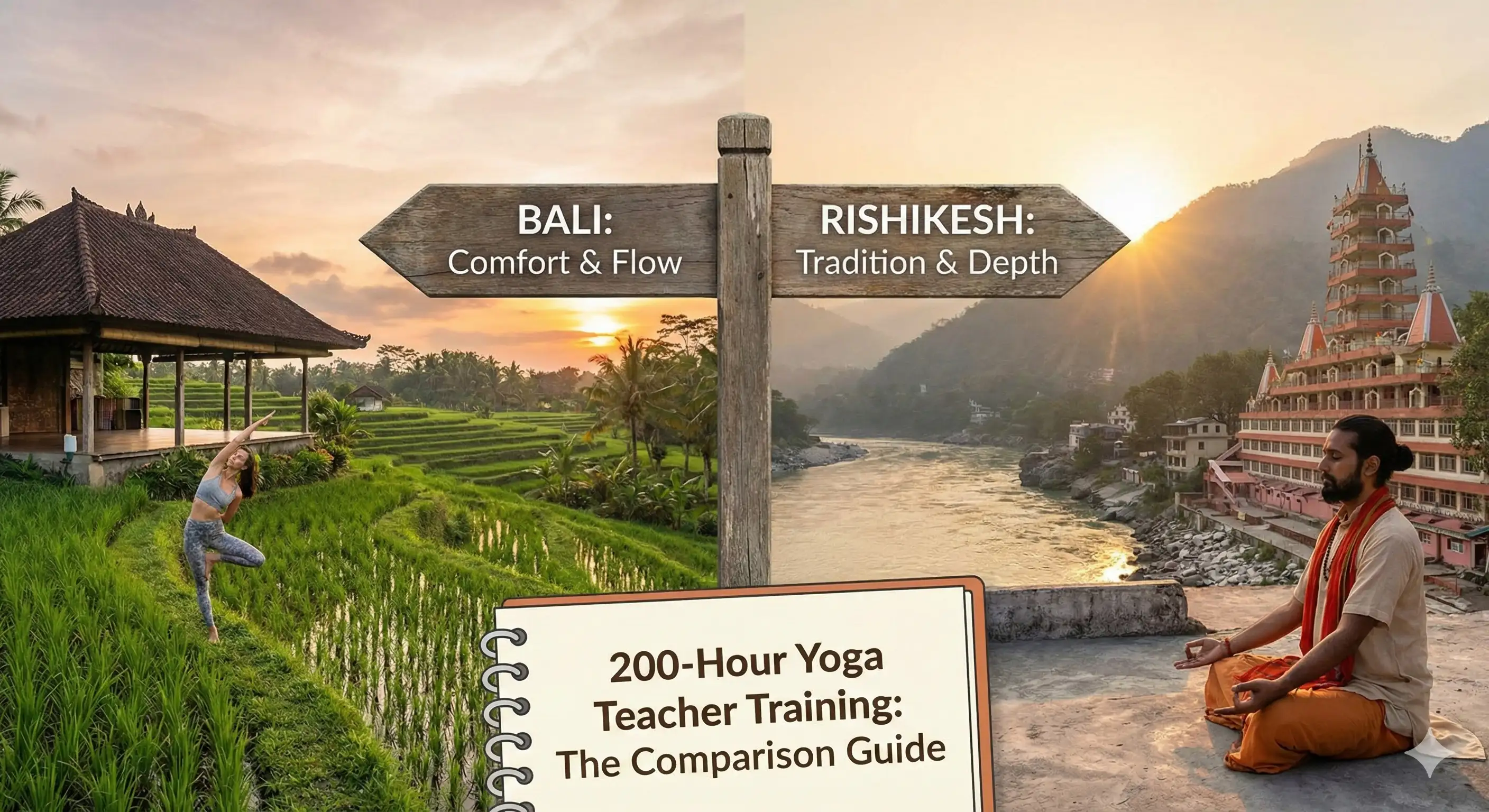
Two things many yoga guides leave out are pilgrimage traffic and seasonal crowd spikes. Rishikesh is not serving yoga visitors alone. It is also a transit and religious town. Some weeks your classes stay the same while your taxi, hotel availability, or walk through town changes completely. That is one reason month choice matters more here than it does in Bali.
A simple practical rule: if this is your first India trip and you have free choice, book October-November or February-March. If this is your second or third India trip and you care more about lower crowd pressure than postcard weather, monsoon shoulder months can still work well. The mistake is not choosing the "wrong" month. The mistake is assuming Rishikesh behaves like a neutral yoga resort all year, because it does not.
For this guide, we are using the same figure published on the live 200-hour course page and not the older conflicting numbers that still exist elsewhere: $950 USD shared or $1,300 USD private for the 25-day 200-hour in Rishikesh.
That price covers your room, meals, study materials, classes, and the residential training itself. For live dates and booking, use the canonical product page: Yoga Teacher Training in Rishikesh.
What is usually outside the core figure: your international flight, domestic onward travel if you route through Delhi, visa, insurance, and your personal spending in town. The Rishikesh course pages also refer to arrival guidance and pickup support from Dehradun or Delhi, so confirm the exact transfer arrangement for your batch before you book rather than assuming all transport is included in the base fee.
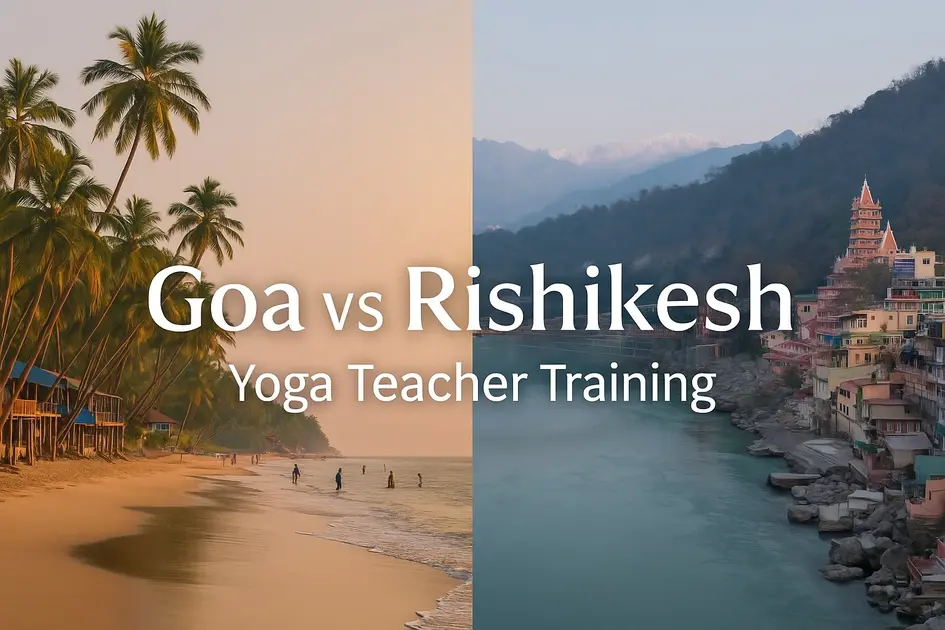
Compared with our other campuses, Rishikesh sits below Bali and in the same practical value conversation as Goa. If the qualification is what you are buying and the location is secondary, that matters. Start with Goa vs Rishikesh or all three campuses compared.
For the wider market, not just our own school, see what yoga teacher training in Rishikesh costs.
Across the town generally, the price spread is driven more by room standard, location, and how much hand-holding a school bundles in than by a measurable difference in the certificate itself. That is why we would compare named teachers, contact hours, and refund terms before we compared who uses the word "authentic" most often. If you want the school-selection framework rather than only the Rishikesh location context, read the questions that matter.
Dehradun's Jolly Grant Airport (DED) is the nearest airport and the easiest arrival point for most students. From there, Tapovan is usually around 35 to 45 minutes depending on traffic. Many international students land in Delhi first and then either take the short domestic hop to Dehradun or continue onward by road. Haridwar is the usual rail gateway if you are arriving by train.
For the full practical routing picture across campuses, use how to reach Divinepath.
Do I need experience before a teacher training here? We take beginners on the 100 and 200-hour, but regular practice before arrival helps. Not because you need advanced poses, but because a month of full-time study is heavy if you are also learning the very basics for the first time. Start with the beginner guide.
Is Rishikesh safe for a solo woman travelling? Broadly yes, and many solo women train here every month. It is also a conservative, religious town, which some people find grounding and others find restrictive. Dress modestly and use ordinary travel judgement after dark.
Can I drink or eat meat in Rishikesh? No. That is part of choosing the city, not a minor detail to discover later.
What should I pack for a winter course? More warm clothes than you think. Layering matters more than perfect activewear. See the full packing list.
What is a month here actually like? Read the week-by-week account: 25 days in Rishikesh.
Do I need a visa? Yes, in most cases. Check that the visa duration covers your full stay rather than assuming a generic tourist permission always fits.
Is the certificate from Rishikesh different from Goa or Bali? No. The registration pathway is the same school system across campuses. What changes is the town, the environment, and the teaching team.
Do you want a reset, or do you want full teacher training?

Ideal if you want rest, daily yoga, sattvic meals, and a lighter schedule before committing to a longer programme.

Best if you want curriculum depth, daily discipline, and a serious certification pathway.

Yes, if you choose a structured batch with alignment-focused teaching and clear pacing. Start with our beginner YTT Rishikesh guide.
Pick a retreat for recovery and routine reset. Pick YTT if you want a curriculum, daily discipline, and a teacher pathway.
Layer for cold mornings, bring breathable practice wear for daytime, and keep visa documents and some small rupee notes ready. The full checklist is here: What to Pack for Rishikesh YTT.
Use the commercial course hub for live dates, rooms, and payment steps: Rishikesh YTT page — 200-hour from $950 USD shared or $1,300 USD private.
Rishikesh Reality Check
At Divinepath, we see Rishikesh as a strong choice for students who want tradition, discipline, mantra, philosophy, and a more inward daily rhythm. It is not the best choice if you mainly want beach time or a soft holiday feeling.
The town can feel intense for first-time India travelers. Traffic, temple sounds, seasonal crowds, and early mornings are part of the experience. Pack for cold mornings if you train October–February — fleece and warm socks matter more here than in Goa or Bali.
Choose Rishikesh if you want to study seriously and can handle simple living. Choose Goa or Bali if your nervous system needs more space, warmth, and lifestyle comfort around the study.
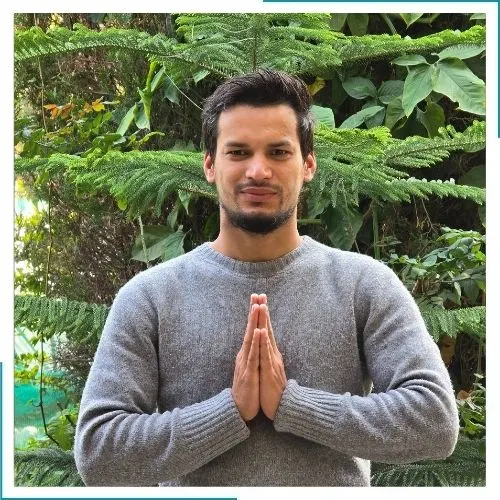
Ashtanga & Alignment Teacher, Divinepath Rishikesh
Reviewed by Rajesh Ji. Accreditation verified: Yoga Alliance public profile.

One of the Best Yoga Teacher Training Courses & Retreats in India & Indonesia.
 Yoga Alliance RYS 200
School ID 457520
Verify registration →
Yoga Alliance RYS 200
School ID 457520
Verify registration →
Divinepath Yoga School & Retreat © 2026. All Rights Reserved.