



Quick Answer
Goa and Rishikesh are India's two most popular destinations for yoga teacher training, and they suit very different students. At Divinepath, Rishikesh 200H costs $950 for shared cottage and $1,300 for private accommodation — traditional ashram culture, Himalayan setting, cooler climate, October to May season. Goa 200H costs $500 course-only, $699 dorm, $850 shared, or $999 private — beachside property with swimming pool, multi-style curriculum covering Hatha, Vinyasa, Ashtanga, and Yin, warm climate year-round (except June–July monsoon).
Both locations award the same Yoga Alliance RYT 200 certification. The right choice depends on whether you want a traditional spiritual setting or a modern beach-based training environment.
Compare dates: the Goa course · the Rishikesh course · our India campus comparison
At Divinepath, we run yoga teacher training programs at both locations. This guide is written from that direct experience — not from a search result. We will tell you honestly what each location is like, what each costs, and who each one suits.
Goa and Rishikesh are India’s two most popular yoga destinations — people compare them to choose between Goa’s relaxed beaches and Rishikesh’s traditional spiritual setting.
India remains the first choice for many yoga students because the training is connected to living traditions: asana, pranayama, meditation, Sanskrit terms, philosophy, vegetarian food culture, and daily practice. Many students come here specifically for a Yoga Alliance-certified TTC in the country where yoga developed.
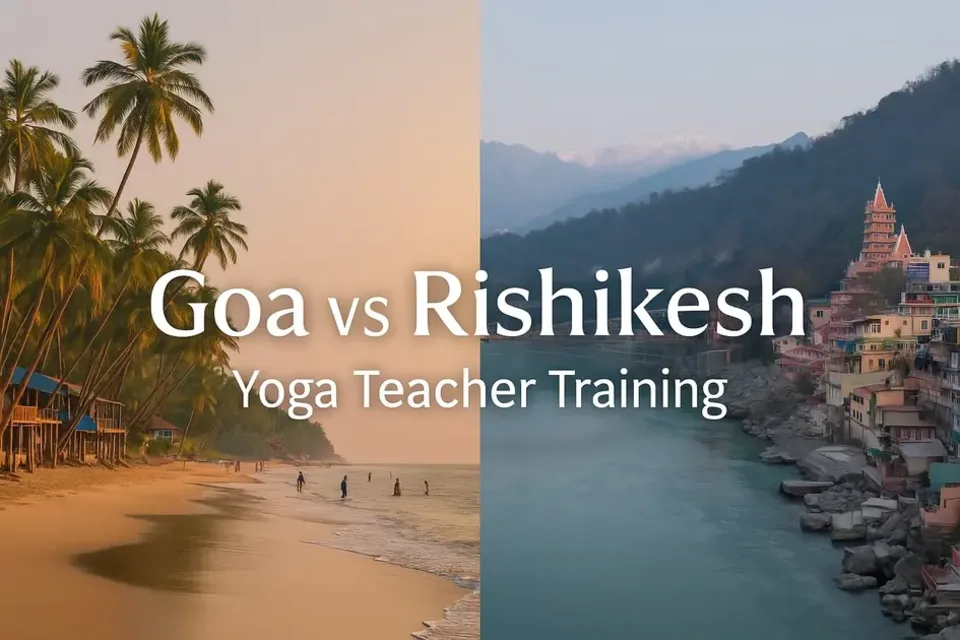
Among all the options available, Rishikesh and Goa are two of the most compared locations for yoga teacher training in India. Rishikesh sits near the Himalayan foothills beside the Ganges, with temples, ashrams, chanting, and a stronger traditional yoga atmosphere.
Goa feels more coastal, open, and modern. Students usually compare these locations because they want to know what daily life will feel like outside class: quieter ashram-style discipline in Rishikesh, or beachside study with more comfort and social space in Goa.
For full course details, see our 200 hour yoga teacher training in Rishikesh and 200 hour yoga teacher training in Goa.
Rishikesh is widely known as the yoga capital of the world because of its long ashram tradition, Ganges-side setting, philosophy classes, pranayama culture, and teachers rooted in classical yoga practice.
Rishikesh is in Uttarakhand in northern India, beside the Ganges River and close to the Himalayan foothills. The setting is not resort-like; it is a busy yoga town with temples, ashrams, local markets, river walks, and a steady flow of pilgrims and students.
Divinepath's Rishikesh 200H costs $950 for shared cottage and $1,300 for private accommodation — accommodation, three daily meals, and Yoga Alliance registration support included. View the Rishikesh 200H program and dates.
Rishikesh earns its reputation through daily spiritual life you can actually see and hear: temple bells, Ganga aarti, Sanskrit chanting, meditation gatherings, and students walking between yoga schools, ashrams, and philosophy classes.
Your yoga teacher training here often feels immersive and disciplined, with a strong focus on practice and philosophy. You will be surrounded by ashrams, temples, and a community supporting and encouraging you towards a deeper, more traditional way of living. If you are seeking to experience the ancient roots of yoga, this is the place to be.
Life in Rishikesh is simple and study-focused. The town is vegetarian and alcohol-free, which supports a sattvic training routine. Most of your energy goes into class, practice, meals, rest, and homework, but on lighter days you can visit local markets, walk near the Ganges, attend Ganga aarti, or sit quietly by the river.
You will have access to courses that are emphasized in traditional styles of yoga such as Hatha and Ashtanga. The majority of your teachers will most likely be experienced gurus, or swamis, who have dedicated their lives to yoga and philosophy. The teachers bring a depth of understanding of the scriptures, discipline, and alignment to their classes.
In addition to the asanas (poses), you will learn about meditation, pranayama (systematic breathing), and ancient philosophy—often from instructors who have historically passed down their knowledge through the years.
Goa is ideal for yoga teacher training if you want a relaxed beach atmosphere, modern comforts, and an international yoga community in a coastal setting.
See upcoming dates and inclusions for the Goa 200 hour YTT or try a short Goa yoga retreat.
Divinepath's Goa campus is in Arambol, North Goa — a cottage-style property within a 10-minute walk of Arambol Beach, with a swimming pool, private garden, and an in-house restaurant. The 200H program costs $699 for dorm, $850 for shared room, $999 for private room, or from $1,050 for a wooden cottage — plus a $500 course-only tier if you arrange your own lodging. See the live Goa 200-hour page for current batch pricing.
In Goa, the day usually feels warmer and more open. At our Arambol campus, students stay within walking distance of the beach, so morning or evening beach walks can fit around the class schedule when there is free time.
The atmosphere is more relaxed than Rishikesh, but the course is still structured. Students often like Goa because the campus, garden, pool, and beach access make recovery easier after long practice, anatomy, philosophy, and teaching-methodology sessions.
Goa is a good balance for in-depth yoga study and leisure. Even though your time will be filled with classes, you will have the chance to go out to cafes, markets, or the beach. Goa has a lively and multicultural atmosphere, unlike Rishikesh, which has a more traditional atmosphere. You may expect to meet a combination of international students, instructors, and travelers creating a truly global community. This is a great option to choose for your yoga practice if you have in mind to explore your balance and learn in a more casual, resort-style atmosphere.
Goa generally has a wider range of styles offered at yoga schools than Rishikesh. You will see not only traditional Hatha and Ashtanga studios, but also Vinyasa, Yin, Aerial, and Acro Yoga. The instructors are also made up of both highly skilled Indian teachers and international yogis who have decided to make Goa their home.
Teaching style in Goa is often more contemporary, with attention to sequencing, alignment, class planning, and practice teaching. The community is also easier for many international students because cafes, beach walks, and shared rest time make conversation feel natural after class.
Choose Goa if you prefer a relaxed coastal vibe, and Rishikesh if you want a traditional spiritual setting — both offer quality yoga teacher training.
To help assist you in visualizing the differences, here is a quick side-by-side comparison.
| Feature | Rishikesh | Goa |
|---|---|---|
| Location | Himalayan foothills, on the Ganges River | West coast, on the Arabian Sea |
| Cost | No dorm option listed | Dorm option available |
| Divinepath 200H (all-in) | $950 shared cottage; $1,300 private, meals & Yoga Alliance support | $699 dorm; $850 shared; $999 private; cottages from $1,050 |
| Divinepath room tiers | $950 shared cottage; $1,300 private | $500 course-only; $699 dorm; $850 shared; $999 private |
| Batch size at Divinepath | Max 10 students | Max 10 students |
| Lifestyle | Traditional, spiritual, and simple | Relaxed, modern, and social |
| Yoga Styles | Hatha, Ashtanga, Traditional | Hatha, Vinyasa, Ashtanga, Yin |
| Crowd | Pilgrims, spiritual seekers, backpackers | International yogis |
| Weather | Cooler (can be cold in winter) | Warm, best Oct-Mar |
| Food | Strictly vegetarian and alcohol-free | Varied food options |
Coastal Goa for a gentler pace, or Rishikesh for classical ashram energy.
So now the real question: which is right for you? The answer really lies in your personality, your goals, and your budget.
Both places can prepare you for a Yoga Alliance 200-hour certificate. The important part is choosing the setting where you can follow the schedule, rest properly, and stay mentally present for the full training.
Still unsure? Read our guide to yoga teacher training costs or compare 200 vs 300 vs 500 hour YTT.
In Goa we offer beginner to advanced yoga teacher training courses, with peaceful beach surroundings, comfortable stays, and guidance from experienced teachers.
Our Goa courses are built around a balanced residential routine: morning practice, philosophy, anatomy, teaching methodology, alignment work, meals on campus, and enough rest time to recover between sessions. The beach setting supports the training, but the course remains structured.
If you are unsure about a full teacher training, you can begin with a short yoga retreat in Goa to experience the campus, meals, teachers, and daily rhythm. Students drawn to a more traditional setting can compare that with our Rishikesh teacher training programs.
Looking for an intensive? Check the Goa 300 hour YTT or start small with a 200 hour YTT in Goa.
Both Goa and Rishikesh can work well for yoga teacher training, but they serve different student needs. Choose Goa for a warmer coastal routine; choose Rishikesh for a stricter traditional setting near the Ganges.
Rishikesh gives you a closer look at the roots of yoga through ashram culture, philosophy, Ganges-side rituals, and a more disciplined schedule. Goa gives you a modern residential training environment with beach access, warmer weather, and more space to rest between classes. The better choice depends on the routine you can sustain.
If you are still unsure, compare your budget, preferred room type, weather window, and daily rhythm before booking. You can also contact us with your dates and we will explain which campus fits your needs better.
Explore courses in Goa and Rishikesh to find your best fit.
Neither is universally better. Rishikesh suits students who want a traditional, spiritual, disciplined learning environment. Goa suits students who want a relaxed beach setting, modern comforts, a social international community, and more variety in yoga styles.
At Divinepath, Rishikesh 200H costs $950 for shared cottage and $1,300 for private accommodation. Goa 200H costs $500 course-only, $699 dorm, $850 shared, or $999 private. For a wider budget comparison, read our YTT cost guide.
Yes. Both Goa and Rishikesh accept beginners into 200-hour yoga teacher training programs. The course is designed to give a strong foundation in asana, pranayama, anatomy, philosophy, teaching methodology, and practice teaching.
Yes. If the school is a Registered Yoga School with Yoga Alliance, the location does not limit the value of your certificate. Divinepath supports Yoga Alliance registration documentation for both Goa and Rishikesh graduates.
Goa is best from October through March, when the weather is sunny and mild. Rishikesh is best from September through November and February through May. June to August monsoon and very cold winter periods are less comfortable for intensive training.
Not sure which campus fits your goals? Ask us about schedule, weather, rooms, and teaching style before you book.

One of the Best Yoga Teacher Training Courses & Retreats in India & Indonesia.
 Yoga Alliance RYS 200
School ID 457520
Verify registration →
Yoga Alliance RYS 200
School ID 457520
Verify registration →
Divinepath Yoga School & Retreat © 2026. All Rights Reserved.