



We run two campuses in India. One sits five minutes' walk from Arambol beach in North Goa. The other is in Rishikesh, in the foothills of the Himalayas, on the Ganga.
Same school, same Yoga Alliance registration, same 10–15 student cap, same certificate at the end. Very different month, very different mornings, very different version of you at week three.
Most people arrive at this page thinking they need to decide between two philosophies. Usually they just need to look at a calendar. Start there. For the long editorial read — campus culture, daily rhythm, and student stories — see our Goa vs Rishikesh YTT guide.
| Goa (Arambol) | Rishikesh | |
|---|---|---|
| Best months | Mid-Oct to mid-March | Feb–April, Sep–Nov |
| Avoid | June–Sept (monsoon) | Dec–Jan (cold), May–June (very hot), July–Aug (heavy rain) |
| Setting | Beach, palm, sea air | River, hills, temple bells |
| Alcohol & meat | Freely available | Banned — dry, vegetarian city |
| Atmosphere | Relaxed, social, international | Quieter, more devotional, more disciplined |
| 200-hour from | $500 course-only · $699 dorm · $850 shared · $999 private · from $1,050 cottage | $950 shared · $1,300 private (all-inclusive) |
| Nearest airport | Manohar (GOX), ~90 min | Dehradun (DED), ~1 hr |
| Levels we run | 100 · 200 · 300 · 500 | 100 · 200 · 300 · 500 |
This is the part people skip and then regret.
Goa is a winter destination. The monsoon shuts North Goa down from June to September — heavy rain, rough sea, most of the beach infrastructure closed. Things reopen unevenly through October; the good stretch runs from roughly mid-October to mid-March. Come in December and you get warm dry days and everything open. Come in July and you get a very quiet, very wet month.
Rishikesh runs on a different calendar. It sits at the foot of the Himalayas, so altitude and season behave differently. February to April is beautiful — warm days, cool nights, the river high and clear. September to November is the other good window, after the rains clear. December and January get genuinely cold, especially early mornings, and a 6am practice in an unheated hall in January is a specific kind of commitment. May and June are hot. July and August bring serious rain.
So if you can only travel in January, book Goa. If you can only travel in April, book Rishikesh. If you are free in October or November, both work and the rest of this page matters.
Rishikesh is a holy city. Alcohol and meat are banned across the whole town — not a rule we impose, the law. That single fact shapes everything else. Evenings are quiet. The Ganga aarti happens most nights on the ghats. There are ashrams and temples on every road and a permanent population of people who came for two weeks in 1998 and stayed. Practice tends to be more traditional here, with more weight on philosophy, pranayama and chanting.
It is not a resort town. The main roads are noisy with traffic and cows. Accommodation is simple. Hot water is sometimes a negotiation. People either fall in love with Rishikesh in the first three days or spend the month wishing they had gone somewhere with a beach.
Arambol is the opposite in almost every respect. It is the northernmost of Goa's well-known beaches and has been the centre of its alternative scene for decades — drum circles at sunset, cafés that run on their own schedule, people playing music on the sand. Warm sea. Fish curry. A beer if you want one.
The trade-off is honest: there is more to distract you in Goa. A 200-hour course is 3–4 weeks of full-time study, and in Arambol the beach is right there. Some students find that balance is exactly what keeps them going. Others realise in week two that they would have done better somewhere with fewer options.
Goa is cheaper to start. Rishikesh runs longer.
Compare those carefully. Goa has the lower entry price and two budget tiers Rishikesh doesn't offer. Rishikesh costs more in total, but the course is four days longer — so on a shared room it works out slightly cheaper per day, $38 against $40. On a private room Goa is better value either way.
Goa, 200-hour: $500 course and meals only if you arrange your own room · $699 dorm · $850 shared · $999 private · from $1,050 for a wooden cottage. Goa 200-hour details and dates →
Rishikesh, 200-hour: $950 shared cottage · $1,300 private — all-inclusive for 25 days. Rishikesh 200-hour details →
Both include tuition, materials, meals and your room at the tier you pick (Goa course-only excepted). Neither includes flights or airport transfer.
One thing worth checking wherever you book, us included: a lot of "from $499" pricing in India is course-only. Ask for the number that includes your room and your food, and compare that.
Go to Rishikesh if you want the traditional version — philosophy, chanting, early mornings, a town built around practice. If you are travelling February to April or September to November. If you want the longest course for the money — 25 days against Goa's 21. If you already know you concentrate better without a beach nearby.
Go to Goa if you are travelling November to February. If it is your first long trip to India and you would like the softer landing — Arambol is easier to arrive into alone than Rishikesh is. If you want to swim. If four weeks of full immersion sounds better with sea air in it.
Pick either if you mainly care about the certificate, the teaching hours and the cohort size. Those are identical.
Consider Bali instead if you want a bigger international wellness scene rather than either Indian campus — same school, different country, and a rhythm that suits some people better than Goa or Rishikesh. See our Bali campus or the three-way comparison.
Not sure which level you need? The 200-hour is the standard teaching qualification — that's the one most people want. The 100-hour is a shorter immersion and doesn't qualify you to teach on its own. The 300-hour is for people who already hold a 200. The 500-hour is the combined pathway. Compare campuses on the 200-hour hub, 300-hour hub, and 500-hour hub — then open the campus course page for live fees and dates.
Goa. Manohar International (GOX) in North Goa is closest — about 90 minutes by taxi to Arambol. Dabolim (GOI) is roughly two and a half hours. We can arrange pickup from either.
Rishikesh. Dehradun (DED) is about an hour away and the easiest option. From Delhi it is a six-hour drive, or a train to Haridwar and 45 minutes onward by road. Many students fly into Delhi and take the domestic hop to Dehradun.
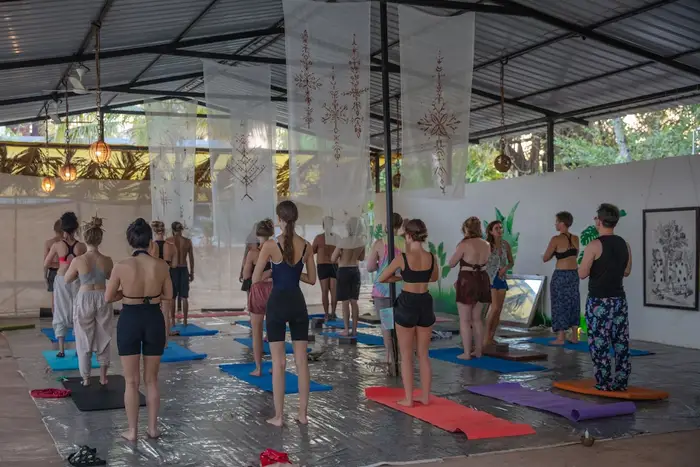
Beachside residential campus five minutes from Arambol sand. Best November–February. 100 · 200 · 300 · 500 hour courses.
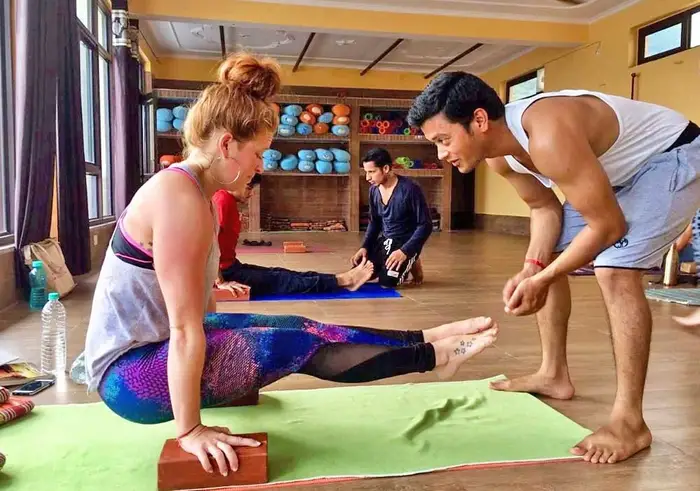
Ganga-side campus in Tapovan. Traditional, devotional, dry town. Best Feb–Apr and Sep–Nov. 100 · 200 · 300 · 500 hour courses.
I did my 200 hour in Rishikesh having practiced for just over a year. The small group meant the teachers actually knew my name by week one. Came home and started teaching two months later.
Hannah K. · UK · 200hr Rishikesh
Chose Goa over Rishikesh because I wanted the beach and a slightly gentler first experience of India. The training itself was not gentle — full days, real teaching practice, proper anatomy.
Marco D. · Italy · 200hr Goa
Did the full pathway across both campuses — 200 in Goa, 300 in Rishikesh. Same standards, very different feel. I'd recommend the split to anyone serious about teaching long term.
Sofia R. · Spain · 500hr (Goa + Rishikesh)
Upper Canal Road, Laxman Jhula, Rishikesh, Uttarakhand 249192
Plot No 81/1, Moddlo Waddo, Arambol, Pernem, North Goa, 403512

Yes. We take beginners on both the 100 and 200-hour. What we do ask for is some regular practice beforehand — not for flexibility, but because four weeks of full-time study is heavy going if you are also learning the basic shapes.
Yes. Same registration, same syllabus, same RYT 200 eligibility. Nobody will ever ask which campus.
Yes, almost every nationality does. An e-Tourist visa commonly covers a yoga holiday or training course, but rules change — check the current Indian government e-visa guidance for your nationality before you book flights.
Both work and we host plenty of solo travellers at each. Rishikesh is quieter and more conservative, which some people find more comfortable. Arambol has a large, long-established travelling community and is very easy to be alone in without feeling alone. We have written more on Goa in our solo female travel guide.
Yes, and a fair number of people do exactly that. It is a good way to see both campuses on the same certification path.
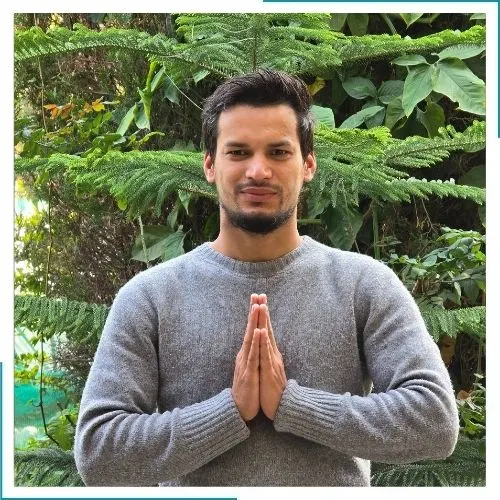
Certified Yoga Teacher & Alignment Expert, Divinepath Yoga School & Retreat — last updated 1 September 2026

One of the Best Yoga Teacher Training Courses & Retreats in India & Indonesia.
 Yoga Alliance RYS 200
School ID 457520
Verify registration →
Yoga Alliance RYS 200
School ID 457520
Verify registration →
Divinepath Yoga School & Retreat © 2026. All Rights Reserved.