



Reviewed by Yogi Rajesh Ji (Lead Hatha & Vinyasa Teacher, DivinePath Rishikesh)
Quick answer: DivinePath's 200-hour YTT in Rishikesh is 25 days, 1st to 25th of every month, fully residential at our Tapovan campus near Lakshman Jhula, from $950 USD shared cottage ($1,300 private) all-inclusive. Week one is disorientation and sore hamstrings. Week two is the wall — sore, homesick, and asked to teach for the first time. Week three is when it clicks and you stop counting days. Week four is competence, then graduation on the Ganga. Almost everyone wants to leave once, around day 11. Almost nobody actually does.
Before you book, the hour-by-hour day is on the 200-hour Rishikesh course page (wake 6:00 AM through dinner at 7:30 PM). Our companion guide covers the structural detail — curriculum, campus specifics, and school comparisons — so this account can stay focused on how the 25 days actually feel: 200-Hour Yoga Teacher Training in Rishikesh: The Complete 2026 Guide.
I'm Naveen Ji. I've led the Ashtanga and alignment sessions at DivinePath Rishikesh for years, and I've watched close to forty batches move through the same 25-day arc — arrival, the week-two wall, the moment it clicks, and graduation by the river. This account isn't a marketing version of that arc. It's what I actually see happen, week by week, including the parts nobody puts in a brochure.
What I keep noticing, batch after batch, is how similar the emotional shape of the 25 days is even when the individual students couldn't be more different. A 24-year-old backpacker from Germany, a 51-year-old physiotherapist from Melbourne, and a first-time flyer from Manila will land in Rishikesh with almost nothing in common — and by day 25, they will describe the exact same three or four turning points, almost in the same words. That consistency is the reason I trust this account enough to put my name on it, rather than writing something safer and vaguer that would apply to any yoga course anywhere.
Most students land at Dehradun's Jolly Grant Airport or take the overnight Volvo bus up from Delhi, and the last 45 minutes of that journey — the road narrowing, the air cooling, the first glimpse of the Ganga running fast and green below the road — is when Rishikesh actually starts, before you've unpacked a single bag. Our driver meets you either way and brings you to the campus on Lakshman Jhula Road, a few minutes' walk from the suspension bridge and close enough to the river that you can hear it from your room at night.
Day 1 is deliberately light: room allocation, a walkthrough of the 25-day syllabus, meeting the teaching team, and a short introductory sit by the river before dinner. We don't put you straight into a full asana session on day one. Most students are jet-lagged, a little overwhelmed by how different the sound and smell of the place is from wherever they flew in from, and the single most useful thing you can do on day 1 is sleep early rather than explore Lakshman Jhula market until midnight.

Day 2 begins the real rhythm: wake at 6:00 AM, then the morning practice block (pranayama/meditation and a gentle Hatha asana session), breakfast, and the first orientation-level anatomy and philosophy talks so the vocabulary isn't entirely new once the full schedule starts on day 3. By the end of day 2, almost everyone has said some version of the same sentence to a stranger who is now a batchmate: "I didn't expect it to feel this different from home already." That's the honest starting point for the 25 days that follow.
What surprises most students in these first 48 hours isn't the yoga at all — it's how quickly the outside noise falls away. There's no queue of notifications to answer, no obvious bar strip to be tempted by after dinner, and the wifi is reliable enough for a check-in call home but not much more. A handful of students arrive nervous about the sattvic, no-caffeine kitchen; almost all of them say by day 2 that the simplicity of dal, rice, roti and fresh fruit three times a day is a relief rather than a deprivation, mostly because nobody is negotiating what to eat. The decision has already been made for you, and that turns out to free up a surprising amount of mental space for everything else that's about to be asked of you.
Week 1 is where the schedule becomes real, and where the thing nobody quite prepares you for arrives on schedule: Shatkarma. The classical cleansing practices — Jala Neti first, then Kapalabhati at pace — are introduced early with the morning practice block, deliberately, before you've had time to build up a story about how hard they'll be. Most students describe the first Jala Neti session (warm saline water through one nostril, out the other) as the single strangest five minutes of their week, closely followed by the specific discomfort of doing it soon after a 6:00 AM wake-up, before coffee, breakfast, or full consciousness.
That early-morning shock is real: DivinePath's wake-up is 6:00 AM, then pranayama/meditation, then asana — before coffee, breakfast, or full consciousness. Yogi Naveen Ji leads the morning Ashtanga-influenced asana sessions this week (after pranayama/meditation), building the standing postures slowly enough that beginners aren't lost, while Yogi Rajesh Ji takes the afternoon Hatha asana block, focused on precise alignment rather than speed. Between the two styles and the Shatkarma introduction, week 1 asks your body to learn several new languages simultaneously. For the exact hour-by-hour day, see the 200-hour course schedule.

By days 6-7, the evening philosophy block (6:00–7:00 PM on the daily schedule) starts to feel conceptually hard — not physically hard, but unfamiliar in a way that catches Western students specifically off guard. Yogi Jaggi Ji, our philosophy and pranayama teacher, has a habit of pairing a sutra with a completely ordinary example from daily life, which is the only reason most students retain any of it in week 1 rather than writing it off as too abstract to use.
There's also a quieter shift happening underneath the visible schedule: the group is forming. Fourteen or fifteen strangers, most of whom didn't know a single other person before arrival, are suddenly sharing a 6am wake-up bell, a laundry system, and the specific discomfort of Jala Neti on the same morning. By day 5 or 6, small groups have already formed around shared meals and evening walks to the ghats, and those groupings tend to matter more for how week 2 goes than anything in the syllabus. Students who arrive expecting to keep to themselves are often the ones most surprised by how quickly that changes here — there isn't much room for a stranger to stay a stranger for 25 days in a batch this size.
| Days | What tends to go wrong | What actually helps |
|---|---|---|
| 3-4 | Jet lag collides with a 6am wake-up; students skip breakfast to sleep 20 extra minutes | Eat anyway — the 2pm energy crash is worse without it, and sattvic breakfast is light enough to not weigh you down |
| 5 | First Jala Neti session — genuine discomfort and a few students opt out entirely | Try it once properly before deciding. Almost everyone who pushes through the first attempt says the second is easier |
| 6 | Muscle soreness peaks from two asana sessions daily after months of irregular practice | Say something to Naveen Ji or Rajesh Ji directly — modifications exist for exactly this and nobody is penalised for using them |
| 7 | Philosophy vocabulary (prana, nadis, koshas) feels abstract and hard to retain | Journal the day's terms in your own words that evening — it sticks better than re-reading notes |
| 8-9 | First rest period; some students fill it with sightseeing instead of actually resting | Rest first, explore Lakshman Jhula second — the accumulated fatigue by day 10 rewards whoever actually rested |

If you ask past Rishikesh graduates which days broke them, the answer is almost always somewhere between day 10 and day 13. The novelty that carried week 1 is gone. Your body has moved past soreness into genuine accumulated fatigue. The daily Shatkarma routine, which felt like a strange experiment in week 1, is now simply part of the morning you have to get through before breakfast. And the curriculum load increases precisely when your energy is lowest: teaching methodology becomes demanding in a new way, because you're no longer just doing postures, you're learning to describe them out loud, correctly, to a room.
This is also the week the cold really starts to register for anyone training outside the October-March high season — mornings by the Ganga are genuinely cold even when the daytime sun is strong, and the discipline of getting out of a warm blanket for a 6am practice becomes its own small daily test. Add in a diet that's entirely sattvic (no meat, no eggs, no caffeine at most sessions), and week 2 is where a lot of quiet homesickness surfaces — usually not about missing people specifically, but about missing the small conveniences of home you didn't know you'd notice the absence of.

What gets people through it is almost never willpower. It's the small batch size. DivinePath caps Rishikesh intakes at around 15 students specifically because week 2 is when a teacher noticing you've gone quiet at breakfast matters more than any syllabus content. Days 12-13 bring the alignment and adjustment module — learning to physically and verbally correct another student's pose, safely — and for most people this is the actual turning point inside week 2: the first time you help a batchmate find a better Warrior II is the first time the course stops feeling like something you're surviving and starts feeling like something you're building toward.

By days 14-16, the week softens slightly: a rest day, often a group walk to a nearby waterfall or the evening Ganga Aarti ceremony at Parmarth Niketan, which lands at exactly the right psychological moment. Nobody plans it as therapy, but sitting on the ghat watching firelight and chanting after the hardest four days of the course does something for morale that no syllabus revision could.
I'd rather be honest about this than gloss over it: not everyone finishes week 2 in a straight upward line. A few students each batch have a genuinely difficult conversation with themselves around day 11 about whether to continue, usually triggered by a bad night's sleep, a stomach upset from the change in diet, or simply the accumulated tiredness catching up all at once. What I tell them is the same thing I'm telling you now — this specific dip is common enough that we plan for it, and it is very rarely a sign that Rishikesh or the course itself was the wrong choice. It is far more often a sign that week 2 is doing exactly what week 2 does. Almost nobody who pushes through days 11-13 regrets having stayed.
Week 3 is where the 25 days starts to feel worth it, and the shift is usually sudden rather than gradual. Teaching methodology moves from theory and small verbal drills to actually leading segments of a real class in front of your batchmates. The first time you cue a full Surya Namaskar sequence out loud, without freezing, without your voice shaking as much as you expected — that's the moment most students point to afterward as when it clicked. It rarely happens because you've become a stronger practitioner in a physical sense. It happens because your relationship to the practice has quietly shifted from doing it to understanding it well enough to hand it to someone else.

The philosophy sessions with Yogi Jaggi Ji deepen this week too, moving from the eight limbs into more specific discussion of the Hatha Yoga Pradipika and how the Shatkarma you were nervous about in week 1 actually connects to the pranayama you're now doing with real competence. Several students have told me this is the week the whole 25-day structure finally reads as a single coherent thing rather than a list of separate modules.

Physically, week 3 also brings the most visible progress in the Ashtanga standing sequence and in Hatha alignment — not because week 3 trains harder than week 2, but because your body has finally stopped treating the daily two-asana-session rhythm as an emergency and started treating it as normal. That's usually when people say the practice starts to feel good again rather than simply demanding.
Days 20-21 also mark a shift in how the group treats each other. By now, everyone has watched everyone else fumble through a first teaching attempt, and the atmosphere in practicum sessions changes from quiet self-consciousness to something closer to a shared project. Students start giving each other feedback unprompted between sessions, swapping cueing phrases that worked, and rehearsing sequences together on the rooftop after dinner instead of retreating to their rooms. If week 2 is where the group bonds through shared difficulty, week 3 is where that bond starts actively working in your favour — the confidence you're building isn't only your own, it's borrowed from watching thirteen other people build the same thing at the same time.
The final two days carry disproportionate weight for their length. Day 24 is the written assessment and individual teaching evaluation — the part almost everyone dreads in week 1 and is quietly ready for by week 4, because three weeks of daily teaching practice has already prepared you more than the anxiety admits. Evaluations are conducted by the full teaching team, and the feedback is specific rather than generic: what your cueing did well, where your sequencing could tighten, how your voice carried (or didn't) across the room.

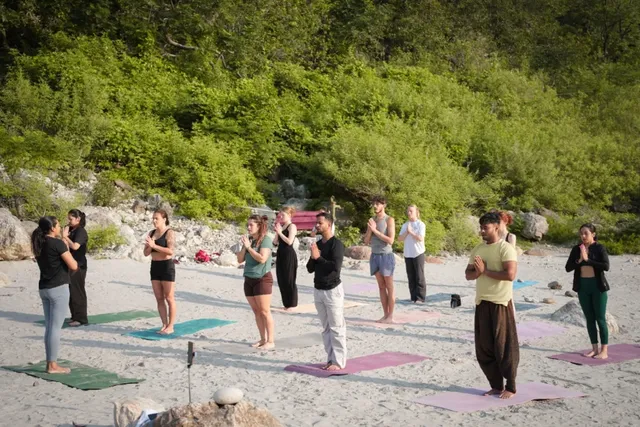
Day 25 is graduation, and it happens by the river. RYT 200 certificates are handed out in the morning, followed by a closing ceremony on the ghat — flowers, chanting, and, weather permitting, one last group practice with the Ganga running past a few feet from your mat. It is not staged for photographs, though the photographs that come out of it are usually the best of the whole course. What surprises most graduates isn't the certificate itself; it's how emotional it is to say goodbye to fourteen strangers who, twenty-five days earlier, you'd never met, and who are now the people who watched you cry during a philosophy class in week 2 and cheered when you led your first full Sun Salutation in week 3.

Most graduates don't fly out the same day. A day or two of decompression in Rishikesh, or a short trip onward to Delhi or Haridwar, tends to matter more than people expect — the 25 days are more intense than most students anticipate going in, and arriving home the same evening you graduate rarely feels like enough of a buffer. Full programme details, live batch dates, and booking: 200-Hour YTT — Rishikesh.
A handful of practical details don't fit neatly into a week-by-week narrative but genuinely shape how the 25 days feel once you're living them. Cash matters more than cards for the first week or two — small denomination rupees are useful for the market near Lakshman Jhula, for chai between sessions on a rest day, and for the odd rickshaw ride, since card acceptance away from the main road is patchy. Laundry is available on campus for a small fee and most students use it roughly weekly rather than daily, which is one more reason to pack lighter than you think you need to.
Wifi is reliable enough for messaging and the occasional video call home, but not dependable enough to rely on for work during the day — the rest period after lunch is the realistic window for anything time-sensitive. Mosquito repellent, a basic first-aid kit, and layers for the cold mornings (a fleece and a proper pair of socks matter more than most students expect before they arrive) are worth packing rather than sourcing locally. And if you're travelling solo, you genuinely won't be alone for long: the batch size is small enough, and the shared 6am-to-9pm rhythm consuming enough, that friendships form inside the first week almost regardless of how introverted you arrived.
DivinePath's Rishikesh 200-hour course is priced simply, with no seasonal surcharge and no hidden accommodation tier. Every dollar figure in this account and in the table below is USD — we don't quote this course in rupees for international students, and the price is the same whether you book in October's high season or during the quieter monsoon months.
| Room type | Price (USD) | Includes |
|---|---|---|
| Shared cottage | $950 | 25 nights, 3 sattvic meals daily, course materials, weekend excursions, RYT 200 pathway |
| Private room | $1,300 | Same inclusions, private accommodation |
Not included: international flights, the Indian e-Tourist Visa (~$25 USD), airport transfer from Dehradun (available on request), and personal spending. For the full budget picture — flights, visa, insurance, and what past students actually spent beyond the course fee — see our dedicated Rishikesh YTT cost guide. If you're still deciding on the destination itself and want the structural planning detail (curriculum breakdown, full daily schedule, campus specifics), our 2026 Rishikesh planning guide covers that ground. And if you want to see how DivinePath's price and batch size compare to the five or six other well-known Rishikesh schools, read our best yoga teacher training in Rishikesh guide — we published it with verified competitor numbers rather than vague claims.
All three DivinePath locations award the identical Yoga Alliance RYT 200 certificate, taught to the same contact-hour standard, so the question is never really "which certificate is worth more." It's "which 25 (or 23, or 20) days of your life do you actually want." A Himalayan winter morning, a rice-paddy village in east Bali, and a beach town in Goa produce genuinely different training experiences even when the syllabus on paper is nearly identical, and the table below is meant to help you choose honestly rather than by price alone.
| Factor | Rishikesh | Bali (Klungkung) | Goa (Arambol) |
|---|---|---|---|
| Shared price | $950 | $1,450 | $899 |
| Duration | 25 days | 23 days | 20-23 days |
| Setting | Himalayan foothills, Ganga-side | Rural rice-paddy village | Beach residential |
| Climate | Cold mornings, seasonal | Warm, tropical year-round | Warm, tropical, coastal |
| Food | Sattvic vegetarian, no caffeine at sessions | Vegetarian, herbal teas and juices | Vegetarian, coastal café culture nearby |
| Distinct daily feature | Daily Shatkarma cleansing, Ganga Aarti evenings | Balinese massage included, Saturday kirtan | Sunset beach walks after evening asana |
| Best for | Students drawn to the classical Himalayan lineage | Students wanting quiet, tropical immersion | Students wanting beach energy and the lowest price |
If you're weighing Rishikesh specifically against Bali's version of this same week-by-week arc, our Bali week-by-week account covers the equivalent 23 days in Klungkung — useful reading if the deciding factor for you is climate and setting rather than tradition.
Every batch I've taught has been roughly two-thirds first-time students who have never taught a class and, in many cases, never held a headstand. The 200-hour standard is a curriculum requirement, not a fitness test — Yoga Alliance specifies contact hours across technique, anatomy, philosophy and teaching methodology, not a minimum flexibility level. What actually predicts whether a beginner has a good 25 days isn't their current asana ability; it's whether they arrive willing to be a genuine beginner at Shatkarma, at teaching out loud, and at sitting still for an hour of pranayama without deciding it isn't working after day 3.
The honest exceptions are worth naming too. If you have an unmanaged injury that two daily asana sessions would aggravate, heal first and come later — the schedule is intensive enough that "easing into it" isn't really available as an option once week 1 starts. And if a beach holiday with some yoga on the side is closer to what you actually want, Rishikesh's cold mornings and sattvic kitchen will disappoint you in ways that have nothing to do with the quality of the teaching; that expectation fits Goa far better than it fits us.

If you want the longer, dedicated answer — including how the cold mornings and sattvic food specifically affect first-timers, and what to do about it before you arrive — read our beginner's guide to Rishikesh YTT. It's written by Yogi Rajesh Ji, who reviewed this account, and it goes deeper on readiness than this week-by-week piece has room for.
Ready to see live dates?
After you graduate, the RYT 200 is the credential — what you do with it is a separate, worthwhile decision. Our honest after-YTT career guide is worth reading before you assume the answer.
The course itself runs 25 days, batch dates 1st to 25th of every month at DivinePath's Rishikesh campus on Lakshman Jhula Road. Most students arrive a day early to recover from the flight and adjust before day one, and many stay 1-2 extra days after graduation before flying home. Budget 27-28 days total away from home once you include arrival and departure buffer.
Week 2, roughly days 10 through 14. The novelty of arriving in Rishikesh has worn off, the early Shatkarma practice after the 6am wake-up and cold mornings have accumulated real fatigue, and the academic workload compounds on top of two daily asana sessions. Most students describe a genuine low point around day 11-12 that lifts once teaching practice begins in week 3.
No. DivinePath's Rishikesh course is built for beginner-to-intermediate practitioners and every asana session includes modifications. Three to six months of consistent practice is the practical minimum. What matters more than flexibility is a willingness to show up at 6am after a hard week and sit through Shatkarma even when it feels strange the first time.
Almost all international students use the Indian e-Tourist Visa, applied for online at indianvisaonline.gov.in. A 30-day single-entry e-visa costs approximately $25 USD and comfortably covers the 25-day course plus arrival and departure days. Apply at least a week before departure. The training is classified as tourism/cultural, so no student or yoga-specific visa is required.
The curriculum hours are the same 200-hour RYT 200 standard everywhere, but Rishikesh's texture is distinct: sattvic ashram-style food, cold mountain mornings, daily Shatkarma cleansing, and a Ganga-side setting most students describe as spiritually heavier than the beach energy of Goa or the resort feel of Bali. Rishikesh also runs two extra days (25 vs 23 in Bali), which most graduates say matters most in week 3 and 4 rather than at the start.
Yes. Graduation on day 25 includes RYT 200 certificate distribution followed by a closing ceremony by the Ganga River — flowers, chanting, and a final group practice on the ghat if weather permits. It is not staged for photographs; DivinePath's teachers have closed every batch this way for years, and most graduates say it is the single most emotional hour of the entire 25 days.

Yoga Alliance Registered Yoga School — RYS 200, 300 & 500 · School ID 457520
 Yoga Alliance RYS 200, 300 & 500
School ID 457520
Verify registration →
Yoga Alliance RYS 200, 300 & 500
School ID 457520
Verify registration →
Divinepath Yoga School & Retreat © 2026. All Rights Reserved.