



Reviewed by Ashish Ji, Lead Trainer (Hatha, Shatkarma & Pranayama), Klungkung campus
Quick answer: Divinepath's 200-hour YTT in Klungkung, Bali runs 23 days, batch dates 1st–23rd monthly, from $1,450 USD shared accommodation ($1,950 USD private). Week 1 is disorienting but exciting. Week 2 is the hardest — sore body, heavy workload, a low point around day 9–10. Week 3 is where it clicks: teaching practice, exams, and a confidence that surprises most students. This guide walks through what actually happens, day by day, so you arrive prepared instead of guessing.
Planning context: Part of our wider Ultimate Guide to Yoga in Bali. Compare campuses in our Goa vs Bali and Bali vs Rishikesh guides before you book.
Before you book, also see our Bali visa guide and can a beginner do YTT in Bali if you're still deciding whether you're ready.
23-day map
| Days | What Happens | How You'll Feel | Advice |
|---|---|---|---|
| 1–2 | Arrival, orientation, syllabus walkthrough, first gentle asana session | Excited, a little jet-lagged, slightly overwhelmed by the schedule | Don't unpack your whole suitcase the first night — sleep first |
| 3–5 | Daily rhythm sets in: pranayama, Hatha-led morning asana, anatomy basics | Sore in new places, but riding the novelty | Ask questions in anatomy class even if they feel basic — everyone has them |
| 6–7 | First philosophy sessions, first Shatkarma (cleansing) practice | Mentally stretched — philosophy is denser than expected | Journal in the evening; it helps process the volume of new material |
| 8 | Sunday — first day off | Tired but grateful | Don't fill it with sightseeing; rest |
| 9–11 | Teaching methodology begins, evening asana shifts to Vinyasa/flow | This is the low point — fatigue compounds with workload | This is normal. It passes by day 13. Talk to a teacher, not just classmates |
| 12–13 | Alignment & adjustment module, first small-group teaching practice | Nervous but a flicker of "I can actually do this" | Practice teaching out loud in your room, even alone |
| 14 | Saturday kirtan and campfire night | Bonded, lighter, social | Let yourself enjoy it — this is part of the curriculum, not a break from it |
| 15 | Sunday — second day off, often a group excursion | Rested, reflective | Use the excursion to talk to teachers outside the classroom — you'll learn things that don't come up in session |
| 16–18 | Full teaching methodology load, mock classes, Tantra and Ayurveda philosophy sessions | Busy but increasingly confident | This is where the 23 days starts to feel worth it |
| 19–20 | Written assessment, individual teaching evaluations | Nervous the night before, relieved after | Sleep is more useful than last-minute cramming |
| 21–22 | Final asana refinement, graduation rehearsal, complimentary Balinese massage | Proud, a little sad it's ending | Exchange contact details with your cohort now — most people forget on the last day |
| 23 | Graduation ceremony, RYT 200 certificates issued | Accomplished, often emotional | Plan your onward travel for at least a day after graduation, not the same day |
You'll likely land at Ngurah Rai Airport (DPS) and be met by Divinepath's driver for the transfer to the Klungkung campus at Jalan Pura Dalem, Satra — about 90 minutes from the airport, away from the Canggu/Seminyak tourist strip. That distance is intentional: it removes the temptation to spend your evenings in bars instead of in bed.
Day 1 is orientation — syllabus walkthrough, meeting the teaching team, settling into your shared or private room. Day 2 begins the real schedule: wake at 06:00, pranayama and meditation from 06:30–07:30, then a Hatha-focused morning asana session from 08:00–09:30 led primarily by Yogi Ashish Ji.
By day 3, the rhythm becomes the surprise. Breakfast at 09:30. Teaching methodology, anatomy, and alignment work from 11:00–13:00. Lunch. A genuine rest block from 14:00–15:30 — most students nap. Philosophy from 15:30–16:30. A second asana session, this one Vinyasa/flow-focused, from 16:30–18:00, often led by a lead instructor from the teaching team. Yoga nidra or sound healing from 18:10–18:30. Dinner at 19:00.
Days 4–5 are when soreness peaks — not from any single session, but from the accumulation of two asana classes a day, every day, after months (or years) of irregular practice for most students. This is also when the anatomy and physiology module starts in earnest, and the density of new vocabulary (origin, insertion, contraindication) can feel like learning a second language on top of a physical workload.
Days 6–7 introduce the first Shatkarma (yogic cleansing) practices and deeper philosophy sessions. This is genuinely the first emotionally challenging content of the course — not physically hard, but conceptually unfamiliar for most Western students. Day 8 is the first Sunday off. Almost everyone sleeps until 9am.
If you ask Divinepath graduates which days were hardest, the answer is almost always days 9 through 12. Here's why: the novelty that carried you through week 1 is gone, your body has accumulated genuine fatigue rather than just soreness, and the curriculum load increases right when your energy dips. Teaching methodology becomes more demanding — you're not just learning to do poses, you're learning to cue them out loud, in front of people, in a second language for many international students (English is the instruction language, but it's not everyone's first language).
Day 10 is the day Yogi Ashish Ji watches for most closely. Breath and alignment work exposes habits quickly — and by day 10, the habits being exposed aren't just physical. Doubt about whether you can finish, whether you're "good enough" to teach, whether you made the right choice booking this — that's the week 2 wall, and it is almost universal.
What gets people through it: the small group size. At 10–15 students, the teaching team notices. If you're struggling, someone says something — not as a formality, but because the model genuinely depends on a low student-to-teacher ratio.
Days 12–13 bring the first small-group teaching practice and the alignment & adjustment module — learning to physically and verbally correct another student's pose, safely. This is the turning point for most people: the first time you successfully cue someone else into a better Warrior II is the first time the course stops feeling like survival and starts feeling like training.
Day 14 is the Saturday kirtan and campfire night — chanting, community, no academic content. It lands at exactly the right moment in the arc. Day 15 is the second Sunday off, often built around a group excursion (temple visits, a Balinese cultural site).
The final week is where the 23 days earns its price tag. Teaching methodology moves from small groups to mock full classes. Tantra philosophy and Ayurveda (taught by Wayan Muliarta, drawing on local Balinese tradition) round out the philosophical curriculum. Asana sessions shift toward refinement — less "learn the pose," more "teach the pose well."
Days 19–20 bring the written assessment and individual teaching evaluations — the part most students dread in week 1 and barely notice by week 3, because the daily teaching practice has already prepared them more than they realized. Days 21–22 are lighter: final asana polishing, graduation rehearsal, and the complimentary one-hour Balinese massage included in the course fee — timed deliberately for the body's last stretch of fatigue.
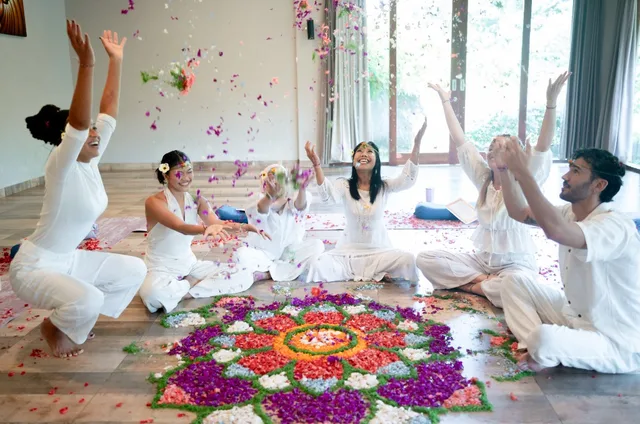
Day 23 is graduation: RYT 200 certificates issued, photos, flower-mandala celebrations in the shala, and — almost every cohort report this — genuine emotion at saying goodbye to people who were strangers three weeks earlier. Full programme details and dates: 200-hour YTT — Klungkung campus.
See live batch dates, room options from $1,450 USD shared, and what is included on the official course page.
Typical day
It's worth slowing down on the actual daily schedule, because most of the "what is it really like" question is answered by understanding how a single day is structured, repeated with small variations for 23 days straight.
Wake up. The Klungkung campus doesn't have an alarm-bell tradition like some ashram-style schools; the team relies on students building their own discipline, which is itself part of the training.
Pranayama and meditation, usually led by Yogi Ashish Ji. This is the part of the day most Western students find hardest to take seriously in week 1 and most valuable by week 3. Sitting still for an hour, working through specific breath techniques (Nadi Shodhana, Kapalabhati, Bhramari), is a different kind of difficulty than the physical asana sessions — it's attention training, not flexibility training.
Morning asana, Hatha-focused, led primarily by Yogi Ashish Ji. This session sets the tone for the whole day; it's deliberately slower and more alignment-focused than the evening session.
Breakfast. Simple, plant-based, repetitive in the best way — your body adjusts to a consistent eating rhythm within the first week, which several students report helps with sleep quality almost immediately.
The academic block: teaching methodology, anatomy and physiology, and alignment and adjustment work, rotating through the week. This is genuinely the densest part of the day intellectually.
Lunch.
Rest. Not optional in any meaningful sense — your body needs it, even if you don't think you do on day 2.
Philosophy. Early in the course this covers foundational texts and concepts; later weeks move into Tantra and Ayurveda from a Balinese lens (taught by Wayan Muliarta).
Evening asana, Vinyasa/flow-focused, led by the teaching team. By week 2 this session becomes the one many students look forward to most — it's more dynamic and social than the quieter morning session.
Yoga nidra or sound healing. A short wind-down before dinner.
Dinner, then free time. Most students are in bed by 21:30–22:00 for most of the course — not because of a rule, but because the schedule genuinely tires you out in a way that makes early sleep the obvious choice.
Divinepath doesn't manufacture testimonials for this guide — but a consistent pattern shows up across cohort feedback and the teaching team's own observations over multiple batches: almost nobody says the asana itself was the hardest part. The two things that come up again and again are the sheer volume of new information delivered every day, and the discomfort of teaching out loud for the first time in front of strangers. Both are temporary, and both are exactly what the 23 days is designed to build competence in — if it weren't uncomfortable at first, it wouldn't be training you in anything new.
A few practical details that don't fit neatly into the day-by-day narrative but matter once you're actually there. Bring cash in small denominations (IDR) for the first few days — card access near Klungkung is less reliable than in Canggu or Seminyak, and you'll want pocket money for the optional excursions and any personal items. Laundry is typically available on-site for a small additional fee; most students use it weekly rather than daily. Wifi is reliable enough for messaging family but not for heavy video calls during the academic block hours — plan check-ins for the 14:00–15:30 rest period or evening free time. Mosquito repellent and a basic first-aid kit are worth packing; the campus is rural, and while this isn't a health risk in itself, it's a different environment than a beach resort.
If you're traveling solo, you will not be alone for long — the small batch size means friendships tend to form quickly, often within the first 4–5 days, partly because the shared schedule leaves little room for cliques to form along nationality or language lines the way they sometimes can at larger schools.
Twenty-three days, even structured well, can't make you an expert in every yoga style or every body type's needs. The course gives you a solid, broad RYT 200 foundation — enough to teach safely and competently, with the alignment and anatomy knowledge to keep students safe. It does not turn you into a specialist in prenatal yoga or advanced therapeutic yoga. Those are genuinely separate certifications. Divinepath’s dedicated Prenatal & Postnatal TTC runs in Rishikesh (85 hours, from $899), not inside this Bali 200-hour. Knowing this going in helps calibrate expectations: the goal of these 23 days is competent, safe, well-grounded teaching — not mastery of every possible yoga niche.
Build a basic daily practice in the 4–6 weeks before you fly — even 20 minutes of asana and 10 minutes of seated breathing most days will blunt the week-1 soreness considerably. Read the syllabus modules in advance if Divinepath provides them (Asanas, Pranayama, Meditation, Mantra Chanting, Anatomy & Physiology, Alignment & Adjustment, Philosophy, Shatkarmas, Teaching Methodology) so the vocabulary isn't entirely new on day 6. Sort your visa (see our Bali visa guide — the e-VOA at $35 is the right choice for almost everyone on this 23-day course), pack using our Bali YTT packing list, and arrange travel insurance before you land — not during week 1 when you have no time.
| Option | Price (USD) | Includes |
|---|---|---|
| Shared cottage | $1,450 | 22 nights accommodation, 3 meals/day, airport transfer, materials, massage, excursions |
| Private room | $1,950 | Same inclusions, private accommodation |
| Course-only (no room/food) | $1,100 | Tuition, materials, certification — for students arranging their own stay |
A 5% early-bird discount applies for bookings made 6+ months in advance. The course does not include flights, visa fees, personal expenses, laundry, or optional paid excursions beyond the included Sunday trips. Full details and live batch dates: Bali 200-Hour YTT — Klungkung campus.
Most graduates leave with an RYT 200 credential through Yoga Alliance and a decision to make: teach immediately, travel before committing, or pursue the 300-hour program (also offered at Klungkung, from $2,300 shared, 28 days) toward RYT 500. Several past students extend their Bali trip by a few days post-graduation using the e-VOA's extension option specifically to decompress before flying home — the course is more intense than most people expect, and a buffer helps.
Functionally, the curriculum hours are comparable across all three Divinepath locations — the core requirement is 200 hours regardless of campus. What differs is the texture: Bali's Klungkung campus runs slightly longer (23 days vs. Goa's 20–23 and Rishikesh's 25) with a similar daily structure, and the rural, away-from-nightlife setting in Satra produces a more contained, slightly more intense bonding experience among the small student group than what some Goa students describe of the more social Arambol beach setting. See our Goa vs Bali comparison and Bali vs Rishikesh comparison for a full breakdown.
If you have an unmanaged injury that two asana sessions a day would aggravate, this is not the moment — heal first, then come. If you cannot be without reliable internet/phone access for stretches of each day for work reasons, the 11:00–18:00 core teaching block will conflict with that, repeatedly, for 23 days. And if your primary goal is a beach holiday with some yoga on the side, Klungkung's quieter, more rural setting will disappoint — that expectation fits the Ubud campus, a short Bali yoga retreat, or our wider Bali yoga planning guide better than this 200-hour program.
The course itself runs 23 days, batch dates 1st to 23rd of each month. Most students arrive a day early and many stay 2–3 days after graduation, so budget 26–28 days total away from home.
Week 2, specifically days 9–12. The novelty of week 1 has worn off and the workload compounds with physical fatigue. Most students hit a low point around day 10 that lifts by day 13–14.
No. The course is built for beginner-to-intermediate practitioners with modifications offered in every asana session. Basic physical health and willingness to show up tired matter more than flexibility.
The e-VOA ($35 USD) is recommended — it gives 30 days and can be extended once, comfortably covering the 23-day course plus buffer. Full steps in our Bali visa guide.
Klungkung is the original campus — quieter, rural, 10–15 students, 23 days, $1,450 shared. Ubud runs a separate 20-day program at $1,299 shared in a more touristed setting. Both award the same RYT 200 certification.
Minor illness in week 1 is common and the teaching team adjusts your load without penalizing genuine illness. Divinepath recommends travel insurance covering YTT specifically, since the course fee does not include medical costs.
Confirm dates, room type, and deposit on the official Bali 200-hour page.

One of the Best Yoga Teacher Training Courses & Retreats in India & Indonesia.
 Yoga Alliance RYS 200
School ID 457520
Verify registration →
Yoga Alliance RYS 200
School ID 457520
Verify registration →
Divinepath Yoga School & Retreat © 2026. All Rights Reserved.