



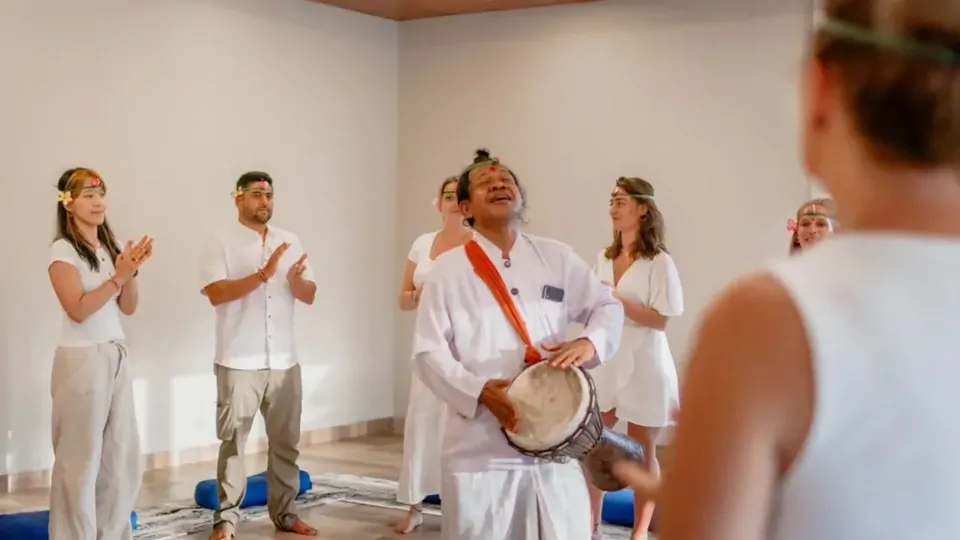
Fact-checked by Yogi Ashish Ji, Lead Trainer (Hatha, Shatkarma & Pranayama), DivinePath Bali
Why this guide is current: Verified against live 2026 pricing for Klungkung ($1,450 shared) and Ubud campus, 23-day batch schedule, visa rules, and beginner readiness criteria — written by the teacher who runs the course.
A beginner can absolutely complete a 200-hour Yoga Teacher Training in Bali with 3–6 months of consistent practice behind them. At DivinePath's Bali campus — in Klungkung, from $1,450 USD all-inclusive for 23 days — roughly 35–40% of students in each batch arrive as relative beginners. They don't just survive the training: many of our most effective new teachers come from that group, precisely because they know what it's like to learn something from scratch.
This guide explains exactly what you need before arriving, why Bali's environment suits beginners particularly well, and the specific ways DivinePath structures training to set first-timers up for success. Still comparing schools? See our verified best yoga teacher training schools in Bali 2026 price table first.
People with 3 months to 2 years of yoga practice wondering if they're "ready" for Bali YTT
Students comparing Bali vs Goa for their first teacher training
Anyone who's been told they need to be "advanced" before doing a 200-hour course
International travelers (UK, Australia, US, Europe) planning a month in Bali for YTT — see our visa guide
The word "beginner" gets used loosely. Let's be specific about what level is genuinely ready for Bali YTT — and what isn't.
| Level | Experience | Ready? | Notes |
|---|---|---|---|
| Complete novice | Never taken a class | ❌ Not yet | Get 2–3 months of classes first |
| Early beginner | 1–2 months, occasional practice | ❌ Too soon | Body needs more time to adapt |
| Ready beginner | 3–6 months, 2–4× weekly | ✅ Yes | Ideal stage: enough foundation, open mind |
| Intermediate | 1–3 years regular practice | ✅ Yes | Strong base, ready to go deeper |
| Experienced | 5+ years | ✅ Yes | May need patience with foundational pacing |
The "ready beginner" zone — three to six months of regular practice — is our sweet spot at DivinePath Bali. Enough foundation to practice safely. Not so much experience that you arrive with rigid habits that need unlearning.
At DivinePath Bali, we've tracked student outcomes for several years. The pattern that surprises most people: beginners with 3–6 months of practice tend to have comparable graduation rates and satisfaction scores to experienced practitioners. Here's why.
The blank slate advantage. Students with years of practice sometimes struggle to unlearn ingrained habits. When teachers break down standing sequences, a student with five years of one particular teacher's approach may find it difficult to adopt different alignment cues. Beginners absorb the curriculum as presented.
Better retention of teaching methodology. Because beginners are learning poses at the same time as they're learning to teach them, they build teaching instincts from the ground up. They naturally remember what confused them, which creates immediate empathy for future students.
Openness in philosophy and meditation classes. Yoga philosophy, pranayama theory, and meditation practice are often the sections where long-term practitioners struggle most — they think they already know. Beginners arrive without that assumption.
A typical day at DivinePath Klungkung runs like this:
| Time | Session |
|---|---|
| 6:30 AM | Wake-up, optional morning walk |
| 7:00–8:00 AM | Pranayama and meditation |
| 8:30–10:00 AM | Asana practice |
| 10:00–11:00 AM | Breakfast (sattvic vegetarian) |
| 11:00–12:15 PM | Alignment and adjustment workshop |
| 12:15–1:00 PM | Teaching methodology class |
| 1:00–2:00 PM | Lunch and rest |
| 2:00–3:30 PM | Self-study or anatomy review |
| 3:30–5:00 PM | Asana (second session) |
| 5:00–6:00 PM | Yoga philosophy |
| 7:00 PM | Dinner |
Week one is the hardest week for almost every student regardless of experience level. Your body is adapting to daily practice. Your mind is absorbing a lot. By day seven, the rhythm becomes familiar.
We do not expect perfect poses in week one. We expect consistent effort and presence.
Bali's landscape — rice terraces, temple ceremonies, incense smoke, the sound of gamelan in the morning — has a particular quality that helps beginners settle into an unfamiliar intensity. Unlike ashram settings that can feel pressure-laden, Bali's blend of spiritual culture and natural beauty creates an environment where students naturally breathe deeper and worry less about performance.
Our Klungkung campus sits amid rice paddies, away from tourist crowds. You are not distracted by Canggu's party scene or Ubud's Instagram traffic. If you want more urban energy, DivinePath also has an Ubud campus — but for beginners who want full immersion, Klungkung provides fewer distractions and more community cohesion.
Bali attracts yoga practitioners from all over the world. In a typical DivinePath Bali batch, students come from Australia, UK, Germany, Netherlands, Canada, and the US. When you're surrounded by people from 8 different countries who are also learning, the social pressure of "being good enough" dissolves quickly. No one expects you to be the best in the room because the room contains too much variety for any single standard.
Bali is Hindu, and its daily rituals — temple offerings, full moon ceremonies, the constant sound of prayer — create an immersive backdrop for yoga philosophy classes. When you study the Bhagavad Gita or the Yoga Sutras while living in a place where spirituality is visibly woven into everyday life, the content lands differently than it would in a studio back home.
We cap every Bali batch at 15 students. This is a non-negotiable limit, not a marketing claim. With 15 people, our teachers know your name, your limitations, and your goals by end of day two. Yogi Ashish Ji (Hatha, Shatkarma & Pranayama) and Yogi Sunil Ji (Vinyasa) work in tandem so there's always a teacher free to work individually with anyone struggling.
From day one, every pose is taught with three versions: standard, easier modification, and deeper variation. The modification is not presented as the "beginner version" — it is presented as the intelligent option for that body on that day. This framing matters. Students stop thinking of modifications as signs of inadequacy and start thinking of them as appropriate skill.
Around day 8–10, students begin teaching each other. We start with two to five minutes — guiding a single breathing exercise or one pose with cues. The progression is gradual: week one, observe; week two, brief practice teaching; week three, lead a 30-minute segment. Beginners consistently report that the small-step teaching approach was what gave them confidence they didn't expect to feel.
We handle all pre-arrival logistics for international students. Airport transfer from Ngurah Rai International Airport (DPS) is included. We send a pre-arrival checklist covering:
For full visa details, see our Bali visa guide for yoga teacher training.
| Campus | Room Type | Course Fee | Duration | What's Included |
|---|---|---|---|---|
| Klungkung | Shared | $1,450 USD | 23 days | Accommodation, 3 meals/day, DPS airport transfer, course materials, Yoga Alliance cert |
| Klungkung | Private | $1,950 USD | 23 days | Same inclusions, private room |
| Ubud | Check live page | See Ubud YTT page | 23 days | Same inclusions, Ubud campus |
| School | Location | 200h Price (Approx) | Room Type | Notes |
|---|---|---|---|---|
| DivinePath | Klungkung | $1,450 | Shared | Monthly batches, small groups (15 max) |
| DivinePath | Ubud | See site | Shared | Same curriculum, different campus |
| The Practice | Canggu | $2,500–$3,200 | Shared | Larger groups |
| Radiantly Alive | Ubud | $2,800–$3,500 | Shared | Multiple styles |
| Yoga Barn | Ubud | $2,200–$3,000 | Shared | Well-known brand |
| Zuna Yoga | North Bali | $2,300–$2,800 | Shared | Remote location |
DivinePath consistently offers the lowest all-inclusive price in Bali while maintaining the small group cap that beginners benefit from most. For the full budget picture, see our Bali YTT cost guide.
If you're undecided between Bali and Goa, here is the clearest comparison:
| Factor | Bali (DivinePath) | Goa (DivinePath) |
|---|---|---|
| Cost (200h shared) | $1,450 USD | $899 USD |
| Duration | 23 days | 20–23 days |
| Environment | Rice paddies / Hindu culture | Arambol beach / coastal India |
| Visa (UK/AU/US) | Free 30-day or $35 e-VOA | Indian e-visa ($25–$80 depending on nationality) |
| Flight time (from London) | ~12–14 hours | ~9–10 hours |
| Language | Balinese/Indonesian + English | English widely spoken |
| Best for | Students drawn to Southeast Asia, spiritual culture, tropical immersion | Students on tighter budget, closer to Europe, want India experience |
For a detailed comparison, see Goa vs Bali for Yoga Teacher Training.
YTT in Bali is not right for you right now if:
Practiced with a YouTube channel for eight months, never attended a live class. Booked our Klungkung training with significant self-doubt. "I told the lead teacher on day two that I thought I'd made a mistake. He said the people who think they've made a mistake are usually the ones who gain the most. He was right." Now teaches corporate yoga in Amsterdam.
Former personal trainer who'd taken maybe 20 yoga classes total. "I thought my fitness background would help but yoga is completely different from gym training. Week one humbled me. By week three I was teaching flows I'd never have attempted at home." Now runs Bali yoga retreats annually.
Came to deepen personal practice with no intention of teaching professionally. The teaching methodology sections changed her mind. "I realised I'd been teaching fitness classes for six years with no idea how to properly explain movement to someone. The YTT changed everything about how I communicate." Now teaches yoga alongside her existing fitness career.
None of these students would have described themselves as "ready" when they booked. All three completed training and left with RYT 200 credentials.
Yes. With 3–6 months of consistent practice, a beginner can successfully complete a 200-hour YTT in Bali. DivinePath accepts beginners in every monthly batch and modifies all practice for varying levels. The graduation rate for beginners with adequate preparation (3–6 months practice, 2–4× weekly) is comparable to experienced practitioners.
You modify them. Modifications are taught as the intelligent option for that body on that day, not as a fallback. Within your batch of 15 students, multiple experience levels coexist naturally — this is by design.
Klungkung's heat (28–33°C) is managed through scheduling: early morning and late afternoon practice sessions, rest in the hottest hours. The heat actually helps beginners soften their effort rather than force — a useful instinct to develop. We provide filtered water throughout the day and emphasise hydration.
Yes. Your RYT 200 certificate is issued by Yoga Alliance and is internationally recognised regardless of your starting experience level. The certification reflects the hours and curriculum completed, not your prior ability. See our RYT 200 Bali certification guide.
We recommend booking 3–6 months ahead. Batches fill — particularly October to April (peak season for international students). Early booking also qualifies for a 5% discount.
Missing one to two days does not prevent graduation provided you complete the required contact hours. We have a system for scheduling makeup sessions with teaching staff. We recommend bringing comprehensive travel insurance that covers the course fee in case of extended illness or medical evacuation.
You're probably ready. The gap between "not ready" and "ready" for most beginners asking this question is fear, not ability.
If you have 3–6 months of practice, genuine curiosity about yoga beyond fitness, and the ability to commit fully for 23 days — that is enough.
DivinePath's Bali training runs monthly, year-round. The Klungkung campus starts from $1,450 USD shared, all-inclusive. The Ubud campus offers a different Bali setting at its own pricing.
Explore 2026/2027 dates and fees at Klungkung or view the Ubud campus YTT.
For questions specific to your readiness level, email divinepathretreat@gmail.com or WhatsApp +91 8868 043 473. Yogi Ashish Ji responds to pre-enrollment queries personally.
If you have 3–6 months of practice and can commit to 23 days, you are likely more ready than you think. See current Klungkung dates and fees, or message us with your honest situation.
Yes. Most Yoga Alliance registered schools in Bali, including DivinePath, accept beginners with 3–6 months of consistent practice. You do not need to master advanced poses. What matters is daily commitment and genuine curiosity about yoga beyond the physical.
Three to six months of regular practice (2–4 times weekly) is the practical minimum. You should be comfortable in basic poses like downward dog, warrior, and child's pose, and able to practice for 90 minutes without injury. Flexibility level does not matter.
DivinePath's 23-day 200-hour YTT in Klungkung, Bali starts at $1,450 USD for a shared room, fully all-inclusive (meals, accommodation, airport transfer, Yoga Alliance certification). The Ubud campus has separate pricing. Competitor schools in Canggu and Ubud typically charge $2,000–$3,500.
Both are excellent. Goa is lower cost ($899 USD at DivinePath vs $1,450 USD in Bali) and suits students on tighter budgets. Bali offers a distinct Hindu-Balinese spiritual atmosphere, lush jungle or rice terrace settings, and strong international yoga community. Your decision should be based on budget, environment preference, and travel logistics.
Most nationalities enter on a free 30-day visa-on-arrival (for stays up to 30 days) or pay $35 USD for an e-VOA (30 days, extendable once to 60 days). A 23-day YTT fits within the free visa for most passport holders. Check our full Bali visa guide for details by nationality.
It is intensive — expect 2–4 hours of daily practice plus lectures on anatomy, philosophy, and teaching methodology. Week one is the hardest as your body adjusts. However, DivinePath modifies all poses and provides individual attention in small groups (max 15–18 students). Most beginner graduates say it was challenging but completely manageable.
Courses, costs, visa, comparisons, and campus guides — everything before you book.
Live dates, fees from $1,450, syllabus, booking.
Central Ubud setting, same certification pathway.
All courses and campuses at a glance.
Budget alternative from $899.
Companion guide if weighing India vs Bali.
e-VOA, extensions, nationality rules.
Rainy-season gear, temple dress, campus essentials.
Week-by-week honest account from Klungkung.
Culture, best time, where to practice.
Seasons, weather, peak batch months.
Full budget beyond the course fee.
Advanced training pricing.
Yoga Alliance registration after graduation.
Post-course registration walkthrough.
Verified prices for 7 schools from $1,299–$4,500.
Both campuses — Ubud $1,299 / Klungkung $1,450.
Cost, visa, environment side-by-side.
All three DivinePath campuses.
Bali location comparison.
Lead teacher — author of this guide.

One of the Best Yoga Teacher Training Courses & Retreats in India & Indonesia.
 Yoga Alliance RYS 200
School ID 457520
Verify registration →
Yoga Alliance RYS 200
School ID 457520
Verify registration →
Divinepath Yoga School & Retreat © 2026. All Rights Reserved.