



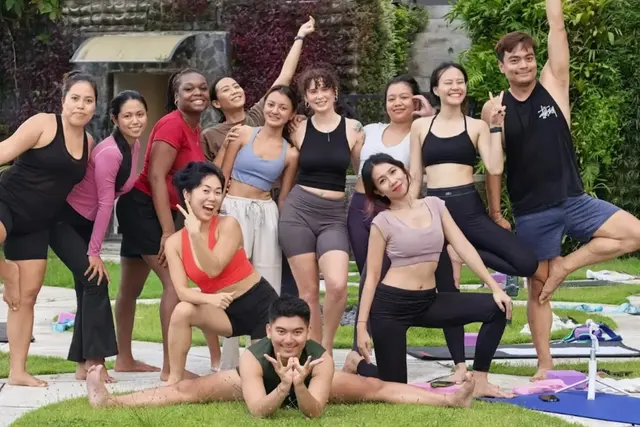
Reviewed by Yogi Ashish Ji (Lead Trainer, Divinepath Bali)
Quick answer: A 200-hour yoga teacher training in Bali costs $1,299 to $4,500 USD in 2026 and runs 20 to 28 days residential. DivinePath runs two Bali campuses: the Ubud campus (Jl. Bisma) at $1,299 USD shared for 20 days, and our 200-hour in Klungkung (east Bali) at $1,450 USD shared for 23 days. Both are all-inclusive — room, three meals a day, materials, and the Yoga Alliance RYT 200 pathway — with batches capped at 10–15 students and intakes on the 1st of every month. Most other established Bali schools charge $3,000–$4,500 for the same certificate, because they run resort venues rather than residential campuses.
A 200-hour YTT is the entry-level qualification recognised by Yoga Alliance, the body most international studios use as a hiring baseline. Complete one at a Registered Yoga School and you can register as an RYT 200 and teach anywhere in the world.
The number is a curriculum standard, not a difficulty rating. Yoga Alliance specifies how many contact hours go into technique, anatomy, philosophy, teaching methodology and practicum — it does not specify that you must arrive able to hold a handstand. That misunderstanding stops more people from booking than any other, and it's wrong. Roughly two-thirds of the students who walk into our Bali shalas have never taught a class in their life, and a good share have never held a headstand either.
What the 200 hours actually change is your relationship to the practice. You stop doing yoga and start seeing it — where a pose comes from, why a sequence is ordered the way it is, what a body is doing when it compensates. Whether you teach afterwards is a separate question, and one worth reading our honest career guide about before you assume the answer.
If you want the transactional detail — live dates, seat counts, deposits, booking — those live on the programme pages: 200-Hour YTT Klungkung and 200-Hour YTT Ubud. This guide is for the decision you make before you open those.
Bali has the widest price spread of any major YTT destination on earth. Here is where the money actually sits, verified in July 2026.
| Campus | Room type | Price (USD) | Duration | Intakes |
|---|---|---|---|---|
| Ubud (Jl. Bisma) | 6-shared female room | $1,299 | 20 days | 1st–20th monthly |
| Ubud | Twin shared | $1,699 | 20 days | 1st–20th monthly |
| Ubud | Private | $2,299 | 20 days | 1st–20th monthly |
| Klungkung (east Bali) | Shared (two single beds) | $1,450 | 23 days | 1st–23rd monthly |
| Klungkung | Private | $1,950 | 23 days | 1st–23rd monthly |
| Klungkung | Early bird, shared | $1,378 | 23 days | Book 6+ months ahead, save 5% |
| Klungkung | Early bird, private | $1,853 | 23 days | Book 6+ months ahead, save 5% |
| Klungkung | Course only (no room or meals) | $1,100 | 23 days | 1st–23rd monthly |
Both campuses include: accommodation for the full course, three vegetarian meals daily, herbal teas and juices, the course manual and props, a complimentary Balinese massage, weekend excursions, and the Yoga Alliance RYT 200 pathway. Klungkung additionally includes one-way pickup from Ngurah Rai (DPS) airport. Neither includes flights, visa, travel insurance, or the Yoga Alliance registration fee you pay after you graduate.
Bali 200-hour market, verified July 2026 — full detail in our best-schools comparison.
| Tier | Typical 2026 price | What you're paying for |
|---|---|---|
| Residential campus | $1,299–$1,600 | Tuition, shared room, meals. DivinePath Ubud and Klungkung sit here. |
| Tuition-only schools | $1,600 advertised → $1,900–$2,950 real | Headline price excludes accommodation. The most common budgeting mistake in Bali. |
| Mid-range all-inclusive | $2,000–$3,200 | Larger cohorts, Ubud or Canggu locations, all-inclusive on discounted tiers. |
| Resort and villa tier | $3,500–$4,500+ | Resort venue, private villas, plunge pools, excursion programmes. |
The certificate at the end is byte-for-byte identical across all four tiers. What changes is where you sleep and how many people are in the room with you.
| Location | Shared price | Duration | Character |
|---|---|---|---|
| Goa (Arambol) | $899 | 20–23 days | Beach residential, lowest price we run |
| Rishikesh (Tapovan) | $950 | 25 days | Classical Himalayan lineage, Ganga-side campus |
| Bali (Ubud) | $1,299 | 20 days | Central, walkable, town-based |
| Bali (Klungkung) | $1,450 | 23 days | Quiet, residential, east Bali |
Bali costs more than India for us for the same reasons it costs more for everyone: property, staffing and food are more expensive on the island, and the visa and flight routes assume a Western budget. If price is your deciding variable, Goa is the honest answer and we'd rather tell you than sell you the wrong month — our three-location comparison lays out the trade-offs.
This is the question we now get most often, and it deserves a straight answer rather than marketing. The syllabus, the batch cap, the certification and the standard of teaching are identical at both campuses. Everything below is about the life around the training, not the training itself. For the full room-tier cost maths and “wrong for” lists, see our Klungkung vs Ubud campus guide.
| Ubud campus | Klungkung campus | |
|---|---|---|
| Address | Jl. Bisma, Ubud, Gianyar | Jalan Pura Dalem, Satra, Klungkung |
| Shared price | $1,299 | $1,450 |
| Private price | $2,299 (twin $1,699) | $1,950 |
| Duration | 20 days (1st–20th) | 23 days (1st–23rd) |
| Time from DPS airport | ~60 min | ~90 min |
| Airport pickup | On request | One-way DPS pickup included |
| Days off look like | Campuhan Ridge walk, Monkey Forest, cafes, galleries, temples — all walkable | Rice fields, Sidemen valley, east-coast beaches, village temple life |
| Shared tier is | A 6-bed female dorm | Two single beds in a shared room |
| Choose it if | You want a town around you, and want to keep exploring after class | You want silence, and want your attention to have nowhere else to go |
The honest cons. Ubud is central, which means traffic noise and scooters exist, and the $1,299 tier is a dorm rather than a twin room — if that matters, the twin is $1,699. Klungkung is quiet, which means there is no cafe strip and you are 45–60 minutes from Ubud; some students find week two long. Neither is better. They select for different temperaments, and the students who are happiest are usually the ones who read that table honestly rather than optimistically.
If you're a beginner and genuinely unsure, we lean toward Klungkung — the extra three days and the absence of a town to escape into tend to help first-timers settle. Our beginner's guide to Bali YTT goes into that in more depth. Campus hubs: Ubud and the main Bali YTT hub.
Ready to compare live dates?
Yoga Alliance sets the categories; each school sets the emphasis. Ours is multi-style — Hatha as the foundation, Ashtanga for structure, Vinyasa for sequencing intelligence, Yin in the evenings when bodies are tired.
| Module | What it covers |
|---|---|
| Asana (technique, training, practice) | Roughly 80–100 postures across Hatha, Ashtanga primary series fundamentals, and Vinyasa. Correct execution, cueing, and sequencing. Morning and evening practice daily. |
| Alignment and adjustment | How to see a body from across a room, what to correct, what to leave alone, and how to touch a student safely — including when not to. |
| Anatomy and physiology | Skeletal and muscular systems as they apply to asana, common yoga injuries, contraindications, and how to adapt a pose to the body in front of you. |
| Pranayama | Nadi Shodhana, Kapalabhati, Bhastrika, Ujjayi and the theory underneath them. Daily practice, not a single workshop. |
| Shatkarma | The six classical cleansing practices, taught with proper supervision. Jala Neti and Kapalabhati feature; the more intensive kriyas are demonstrated and optional. |
| Meditation and mantra | Multiple techniques rather than one house style, plus Sanskrit chanting and its pronunciation. |
| Mudras and bandhas | The energetic locks and seals, and where they genuinely change a practice rather than decorate it. |
| Philosophy | Patanjali's Yoga Sutras, the Eight Limbs, the Bhagavad Gita in outline, and yogic ethics as they apply to running a class. |
| Teaching methodology | Voice, cueing language, class structure, sequencing for levels, demonstration, and the business realities of teaching. |
| Practicum | Progressive teaching practice from early in the course, building to leading a full class, with structured peer and mentor feedback. |
A note on hours: our programme pages currently list these modules without per-module hour counts. If you need the exact Yoga Alliance hour breakdown for a registration or visa application, ask us on WhatsApp and we'll send the syllabus document.
Both campuses run the same rhythm. It is genuinely intensive — this is the part most students underestimate.
| Time | Session |
|---|---|
| 06:30 | Wake, Shatkarma (on scheduled days) |
| 07:00–08:00 | Pranayama and meditation |
| 08:00–09:30 | Morning asana — Hatha or Ashtanga |
| 09:30–10:30 | Breakfast |
| 11:00–12:00 | Anatomy and physiology |
| 12:00–13:00 | Yoga philosophy |
| 13:00–14:00 | Lunch |
| 14:00–15:30 | Rest, self-study, or assignment work |
| 15:30–17:00 | Teaching methodology and practicum |
| 17:30–19:00 | Evening asana — Vinyasa or Yin |
| 19:00 | Dinner |
| 21:30 | Lights out |
Six days a week. Sundays are off — two Sunday excursions are included, plus Saturday-evening kirtan and campfire. For an honest account of what that schedule does to a person across three weeks, including the week-two slump nobody advertises, read our week-by-week Bali account.
Bali's dry season runs roughly April to October — reliable sun, lower humidity, and the busiest booking period. The wet season, November to March, brings afternoon downpours rather than all-day rain, greener rice terraces, thinner crowds, and better availability. We run 200-hour batches on the 1st of every month at both campuses, year round.
Practical timing advice: most months fill 6–8 weeks ahead, and July–September fills earlier. If you want the Klungkung early-bird rate ($1,378 shared), you need to book 6+ months in advance, which in practice means deciding a season ahead. Our best time to visit Bali for yoga guide covers the month-by-month detail.
Most nationalities enter Indonesia on a 30-day Visa on Arrival (about $35 USD), extendable once for a further 30 days (about $45). The Ubud course is 20 days and Klungkung is 23, so a single VoA covers either training with room to arrive early or stay on — but not with room to travel for three weeks first. Apply for the extension before your first 30 days lapse; overstay fines are charged per day. Full detail, including the tourism levy and e-VoA process, is in our Bali visa guide.
Beyond the course fee, budget honestly for:
Our full Bali cost breakdown builds these into a realistic total. Packing checklist: what to pack for Bali YTT.
Four checks, in order of how much they'll actually protect you.
1. Verify the Yoga Alliance registration yourself. Don't accept a badge image — look the school up on the Yoga Alliance directory. DivinePath is RYS 200, School ID 457520.
2. Establish what the headline price excludes. In Bali specifically, "from $1,600" routinely becomes $2,900 once a room and meals are added. Ask directly: does this number include accommodation, and how many meals a day?
3. Ask the batch size, and ask it as a number. "Small groups" means nothing. We cap at 10–15. Resort-scale schools run 25–40, which is a different educational product regardless of the brochure.
4. Read the teacher bios, not the testimonials. Who is actually leading your practicum, what lineage did they train in, and is there a profile page you can read? Ours are Yogi Ashish Ji and Yogi Sunil Ji at Klungkung. Campus hubs: Ubud and the Bali YTT hub.
We published verified competitor prices for exactly this reason — see the best Bali YTT schools comparison, which lists seven schools including us, with the numbers checked against each school's own site.
Not always. If you're unsure whether you want to teach at all, the 100-hour course — 10 days at Klungkung from $950 — is the first half of the 200-hour syllabus. Complete the second block later and you have the full RYT 200. It's a smaller financial and calendar commitment for a decision this large, and we'd rather you took it than talked yourself out of the whole idea. Read is a 100-hour Bali YTT worth it if you're on the fence.
If you already hold an RYT 200 and you're here by mistake, you want the 300-hour pathway instead.
Credible Yoga Alliance programmes run $1,299 to $4,500 USD. DivinePath charges $1,299 shared at Ubud (20 days) and $1,450 shared at Klungkung (23 days), both all-inclusive of room, three meals daily, materials and the RYT 200 pathway. Most established Bali schools sit at $3,000–$4,500 because they run resort venues.
Typically 20–28 days residential. DivinePath Ubud is 20 days (1st–20th monthly); Klungkung is 23 days (1st–23rd monthly). Both fit inside a 30-day Visa on Arrival.
Ubud ($1,299, 20 days) if you want a walkable town — cafes, Campuhan Ridge, temples, the Monkey Forest. Klungkung ($1,450, 23 days) if you want silence, three extra training days, and DPS airport pickup included. Syllabus, batch size and certification are identical.
No. Three to six months of consistent practice is enough. Batches cap at 10–15 so beginners get individual correction. Minimum age 18 (16–17 with guardian consent); no upper limit.
A 30-day Visa on Arrival (~$35 USD) covers either course, extendable once (~$45). See our Bali visa guide before booking flights.
Yes, if the school is a Yoga Alliance RYS. DivinePath is RYS 200, School ID 457520 — graduates of either campus register as RYT 200 and teach internationally. Yoga Alliance charges its own ~$115 first-year registration fee, which no school includes.

One of the Best Yoga Teacher Training Courses & Retreats in India & Indonesia.
 Yoga Alliance RYS 200
School ID 457520
Verify registration →
Yoga Alliance RYS 200
School ID 457520
Verify registration →
Divinepath Yoga School & Retreat © 2026. All Rights Reserved.