



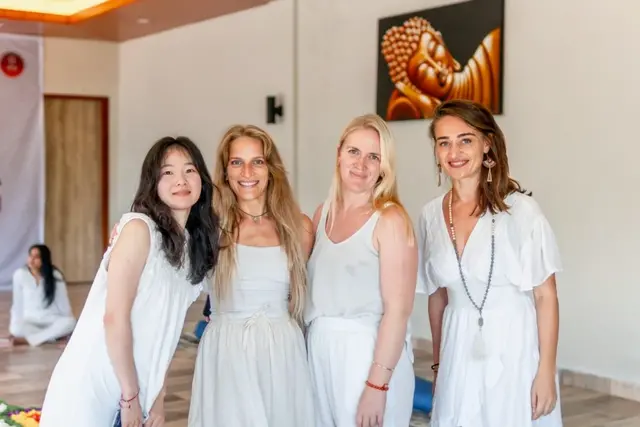
Reviewed by Yogi Ashish Ji, Lead Trainer (Hatha, Shatkarma & Pranayama), Divinepath Bali
Quick answer: At Divinepath, the 100-hour Yoga Teacher Training in Bali is not a separate short course — it is the first 100 hours of the 200-hour programme. It costs $950 USD (shared AC) or $1,199 USD (private AC) for 10 days at the Klungkung campus (1st–10th of every month). It is worth it if you are unsure about committing to the full 200-hour upfront: complete this block first, then book the second 100 hours when you are ready to finish RYT 200. If you already know you want to teach professionally, you can enrol in the full 200-hour directly instead.
This guide covers everything you need to make the decision: the curriculum in detail, what a typical day looks like, what the campus is actually like, who the course is right for, who should skip it, and an honest breakdown of whether ten days at Divinepath Klungkung is worth your time and money. Comparing schools across Bali first? See our verified best yoga teacher training schools in Bali 2026 table.
At many schools worldwide, "100-hour yoga teacher training" can mean anything from a weekend workshop series to a standalone retreat-style programme. At Divinepath Bali, it means something specific: the 100-hour is the first half of the 200-hour course — the opening 100 hours of the same Yoga Alliance-registered syllabus, taught by the same faculty, on the same campus.
In practical terms, you can enrol in the 100-hour block (10 days, 1st–10th each month at Klungkung) if you are not ready to commit to the full 200-hour in one go. When you finish, you receive a certificate for completing that first block. To qualify for RYT 200, you complete the second 100-hour block on a later batch — or book the full 200-hour programme from the start if you already know you want certification.
The same split structure applies at our Ubud campus: first 100 hours (1st–10th), then the second 100 hours to finish the full 200-hour course. The 100-hour is not a different product with a different outcome — it is a lower-commitment entry point into the same 200-hour pathway.
In a residential intensive, each 10-day block packs roughly 10 hours of structured activity per day — asana, philosophy, anatomy, pranayama, meditation, and teaching methodology across long days that begin before sunrise. The intensity is deliberate; immersive formats accelerate learning in ways weekly drop-in classes cannot replicate.
Divinepath's 100-hour curriculum at Klungkung is built around five core subject areas, each running across the 10-day intensive:
Daily asana sessions form the backbone of the schedule — expect three to four hours of asana practice each day across both Hatha and Vinyasa styles. Hatha sessions focus on alignment, breath integration, and holding postures long enough to understand what is happening in the body from the inside. Vinyasa sessions develop your capacity for flowing sequences, smooth transitions, and continuous movement linked directly to breath rhythm.
Across the 10 days you will work systematically through the major standing postures, seated postures, forward folds, backbends, inversions, and restorative shapes that constitute the foundational vocabulary of contemporary yoga. Adjustments and alignment feedback are a consistent part of each session — this is one of the core benefits of training in person rather than from a video library.
If you arrive with a well-established personal practice, you will find the sessions challenging but manageable. If you arrive with minimal prior yoga, the physical intensity can become a barrier to absorbing the other teachings. More on this in the preparation section below.
The philosophical content is introduced through the lens of Patanjali's Yoga Sutras — specifically the eight-limbed path (Ashtanga) — as well as foundational concepts including the three gunas, the overview of Samkhya philosophy that underlies classical yoga, and the ethical foundations of the yamas (restraints) and niyamas (observances). Sessions connect these frameworks directly to what you are experiencing in daily practice rather than treating philosophy as abstract theory.
The 100-hour goes into considerably less philosophical depth than the 200-hour — you receive a genuine introduction rather than a comprehensive study — but enough to give your practice an intellectual and ethical context that changes how you relate to what you are doing on the mat.
The anatomy module covers the foundations that directly apply to yoga practice: skeletal alignment and major joint mechanics, the primary muscle groups engaged in key posture families, contraindications for common postures, basic injury prevention principles, and how to modify postures for different bodies. This is entry-level anatomy — sufficient to understand why a posture is cued a particular way — rather than the comprehensive anatomy study required for RYT 200 certification.
Introductory pranayama forms a consistent thread through the schedule. Foundational techniques include Dirga (three-part breath), Nadi Shodhana (alternate nostril breathing), Kapalabhati (skull-shining breath), and Bhramari (humming bee breath). Sessions address the physiological relationship between breathing pattern and nervous system state. The 200-hour program covers pranayama more extensively, including advanced techniques and the classical energetic framework from which the techniques originate.
The teaching methodology module introduces the fundamental skills of leading a yoga class: cueing language and instruction style, basic sequencing principles, observation and safe assisting techniques, class management, and the structure of a beginner-appropriate session. You will lead short sequences in a peer-teaching context during the first block. The full supervised teaching practicum required for RYT 200 is completed across both blocks — which is why the first block alone does not yet qualify you for registration.
Daily meditation practice is integrated throughout — guided sessions typically open and close each day. Techniques include mindfulness-based concentration practice (dharana), mantra repetition, and yoga nidra (non-sleep deep rest). The meditation sessions serve both as practice in their own right and as an experiential gateway to the philosophical content covered in lectures.
The daily schedule is intensive but structured around natural rhythms — early starts, practice in the cooler morning air, theoretical work in the heat of the day, and a return to practice in the late afternoon. The following reflects the standard residential intensive format; confirm exact timings with the school at pre-arrival.
| Time | Session |
|---|---|
| 05:30 | Wake-up, optional silent walk on campus |
| 06:00 | Morning meditation and pranayama |
| 07:00 | Hatha or Vinyasa asana practice (2 hrs) |
| 09:00 | Breakfast (vegetarian, sattvic) |
| 10:00 | Anatomy lecture or yoga philosophy session |
| 12:30 | Lunch |
| 14:00 | Teaching methodology workshop / peer-teaching practicum |
| 16:00 | Afternoon asana practice or adjustment workshop |
| 18:00 | Evening meditation |
| 19:00 | Dinner |
| 20:00–21:00 | Self-study, journaling, rest |
By days three and four, most students hit a fatigue wall — particularly those who are not used to practicing twice a day in a tropical climate. By the second half of the program, the body adapts and the depth of practice that becomes possible under immersive conditions begins to show up in ways that a weekly class schedule cannot produce.
The evenings are quiet by design. The early morning schedule makes late nights unsustainable, and the campus environment in Klungkung village does not offer nightlife or tourist strip distractions to compete with rest.
Divinepath's campus sits at Jalan Pura Dalem, Satra, Kec. Klungkung, Bali 80761, in eastern Bali's Klungkung regency — a significant distance from the tourist-concentrated areas of Canggu, Seminyak, and even central Ubud. This location is deliberate.
Klungkung is one of Bali's most culturally intact regions — the historical capital of the Klungkung Kingdom, home to the Kertha Gosa royal courts, traditional Balinese weaving villages, and working rice terraces that have not been converted into boutique resort grounds. Training in Klungkung means your ten days are genuinely removed from the tourist corridor.
Facilities include a purpose-built yoga shala with natural ventilation, air-conditioned accommodation rooms in both shared and private configurations, and shared common areas where meals are served. The campus layout keeps all activity — practice, study, meals, rest — within the same space.
Getting there: Ngurah Rai International Airport (DPS) in Denpasar is approximately 1.5–2 hours from the Klungkung campus by car, depending on traffic. Plan for this journey in your arrival and departure logistics.
For students comparing Klungkung with Divinepath's Ubud campus, see Ubud vs Canggu for Yoga Teacher Training for a broader location comparison. For a full cost picture across Bali programmes, read How Much Does Yoga Teacher Training in Bali Really Cost?
The senior faculty at Klungkung teaches across all four program levels — 100-hour, 200-hour, 300-hour, and 500-hour. There is no separate junior staff for the shorter course.
Yogi Ashish Ji — Lead Trainer specializing in Hatha, Shatkarma, and Pranayama. Ashish Ji leads the Hatha sessions, the pranayama and breathwork modules, and the philosophy discussions, with the teaching team supporting asana, alignment, and methodology workshops across the 100-hour curriculum.
This is the same team that teaches the 200-hour and 300-hour programs. The depth of what you receive in the 100-hour is limited by curriculum scope and the time available in 10 days — not by who is standing at the front of the shala.
A clear budget picture matters when planning a trip to Bali for training. See also our Bali YTT cost guide for a fuller breakdown across campuses.
Included in the $950–$1,199 USD course fee:
Not included:
For most international students, the all-in cost of the trip — including flights, the course fee, and a few days before or after in Bali — will sit somewhere between USD 1,500 and USD 2,800 depending on origin city and flight timing.
This is the core decision most people reading this guide are working through. The table below covers all three current Divinepath Bali options. Klungkung 200-hour pricing verified from the live product page (June 2026): $1,450 USD shared / $1,950 USD private.
| Aspect | 100-Hour (Klungkung) | 200-Hour (Klungkung) | 200-Hour (Ubud) |
|---|---|---|---|
| Duration | 10 days | 23 days | 23–26 days |
| Price (shared) | $950 USD | $1,450 USD | From $1,299 USD |
| Price (private) | $1,199 USD | $1,950 USD | From $2,299 USD |
| Yoga Alliance RYT? | After 2nd block only | Yes — RYT 200 | Yes — RYT 200 |
| Qualifies for studio hiring? | Not at most studios | Yes, majority internationally | Yes, majority internationally |
| Philosophy depth | Introductory (8 limbs, gunas) | Comprehensive (Sutras, Samkhya, Vedanta) | Comprehensive |
| Anatomy depth | Introductory (key muscles, joints) | Comprehensive (full systems) | Comprehensive |
| Pranayama | 4–5 foundational techniques | Full classical curriculum | Full classical curriculum |
| Supervised teaching practicum | Short (peer sequences) | Extensive (multiple supervised sessions) | Extensive |
| Certificate | Block 1 cert → RYT 200 after 2nd block | RYT 200 + Divinepath | RYT 200 + Divinepath |
| Campus | Klungkung (east Bali) | Klungkung (east Bali) | Ubud (central Bali) |
| Teaching team | Ashish Ji | Same as 100h | Ubud campus |
| Best for | Testing the 200h path, 10-day window first | Anyone ready for full certification | Anyone ready for full certification |
Confirm live dates and inclusions on the 100-hour, 200-hour Klungkung, and 200-hour Ubud course pages before booking.
Not on its own — but it is part of the RYT 200 pathway.
Completing only the first 100-hour block does not qualify you for Yoga Alliance RYT registration yet. You receive a certificate for completing the first 100-hour block of Divinepath's 200-hour programme — proof you finished the opening half of the syllabus.
When you complete the second 100-hour block at Divinepath (same school, same registered 200-hour curriculum), you finish the full 200-hour course and become eligible to apply for RYT 200 with Yoga Alliance. Alternatively, enrol in the full 200-hour programme in one booking (23 days at Klungkung) if you do not need the split entry route.
What the first block alone will not do:
What it will do: give you a real, structured first half of teacher training — and a clear, low-risk way to decide whether to continue to the second block before committing the full time and budget.
Worth it if you:
Go straight to the full 200-hour if you:
Want a longer on-the-ground picture of the 23-day programme? Read What Does 23 Days of Yoga Teacher Training in Bali Really Feel Like?
Yes — at Divinepath, that is exactly how the split entry route works.
The 100-hour programme is the first block of our 200-hour course. Students who are unsure about enrolling in the full 200-hour upfront can start with the first 10 days, complete the block, and decide later whether to book the second 100-hour block to finish certification. Many students return on the next monthly batch; others take a break and come back when dates suit.
This is different from combining two unrelated 100-hour courses from different schools — that does not create RYT 200 eligibility. At Divinepath, both blocks are part of the same registered 200-hour curriculum with the same teaching team, so completing block one and block two equals completing the full 200-hour programme.
If you already know you want RYT 200 and can take 23 consecutive days, booking the full 200-hour at Klungkung (or the Ubud 200-hour) in one enrolment is usually simpler. Contact the school to confirm current terms for continuing from block one to block two, including batch dates and any re-enrollment policies.
Yes — a regular practice is strongly recommended.
The 100-hour course is not beginner-friendly in the way that a drop-in class or a gentle wellness retreat is. The schedule runs at intensive pace from day one. A practical baseline: at least 6–12 months of consistent yoga practice, ideally three to five times per week. You do not need to be advanced — you need embodied familiarity with foundational postures and a basic sun salutation sequence.
If you are a newer practitioner who is deeply motivated, speak to the school before booking. Every cohort includes students at different experience levels, but your experience will be more limited without an established practice behind you.
Physical preparation. Establish or strengthen a daily home practice in the weeks leading up — ideally 45–60 minutes per day. Focus on sun salutations, standing postures, seated postures, and basic hip openers. Introduce morning practice before 7am to adapt to the campus schedule.
Dietary preparation. Divinepath serves sattvic vegetarian food throughout — no meat, no eggs, typically no caffeine. Transitioning toward simpler plant-based eating in the two to three weeks before arrival reduces the physical disruption of a sudden dietary shift.
Pre-reading. Accessible introductory texts include The Yoga Sutras of Patanjali (translated by Sri Swami Satchidananda) and The Heart of Yoga by T.K.V. Desikachar.
Sleep schedule. Early mornings (5:30–6:00am) are fixed. Shifting your sleep pattern one to two weeks before arrival reduces the physiological adjustment of the first intense days.
What to pack. Comfortable, breathable practice clothes (five to seven changes), a personal yoga mat if you have one, a notebook for lecture sessions, personal medications, sunscreen, and keep luggage light. For the full 10-day checklist — rainy season, temple dress, and campus notes — see our Bali YTT packing guide.
Most international visitors enter Bali on Indonesia's Visa on Arrival (VoA), available at Ngurah Rai International Airport (DPS) to passport holders from most countries. Cost is approximately USD 35, valid for 30 days with one 30-day extension available. Since the 100-hour course is 10 days, a standard VoA is sufficient for the course period plus travel days before and after.
Always verify current Indonesian visa requirements for your specific nationality before booking flights. For a fuller breakdown, see our Bali Visa for Yoga Teacher Training guide.
Ngurah Rai International Airport (DPS) in Denpasar is the standard entry point. From the airport, the Klungkung campus is approximately 1.5 to 2 hours by car, depending on traffic — longer during July–August peak season and during religious ceremonies when local roads close.
Arrange your airport transfer in advance. Arrive the day before the course begins where possible — arriving the same morning as the first session adds unnecessary stress.
Divinepath runs the 100-hour every month, 1st through 10th, so timing is flexible.
On successful completion of the first block, you receive a Divinepath certificate confirming you completed the first 100 hours of the 200-hour programme. This documents real progress through the registered syllabus — not a generic retreat attendance note.
How to use it: list it on your CV or teacher bio as documented study; show Divinepath you have completed block one when booking the second 100-hour block.
What it will not do on its own: qualify you for Yoga Alliance RYT registration or satisfy a completed "RYT 200 required" employment clause — you need the second block or a full 200-hour enrolment for that.
If the first block confirms you want to continue, book the second 100-hour block to complete the full 200-hour course and apply for RYT 200. Alternatively, if you are ready before returning, enrol directly in the full 200-hour at Klungkung or Ubud 200-hour in one stay. Contact the school about batch continuity and re-enrollment terms.
From RYT 200, the continuing education path includes Divinepath's 300-hour programme (RYT 500 pathway) and 500-hour programme. See Is a 300-Hour Yoga Teacher Training Worth It? for the advanced decision framework.
"Worth it" is a function of what you are actually trying to achieve.
If your goal is to test whether the 200-hour is right for you: yes — that is the main reason the split entry route exists. $950 USD for the first block gives you a real 10-day immersion in the same programme you would complete for RYT 200, without committing to 23 days upfront.
If your goal is RYT 200 and you already know you are ready: skip the split route and book the full 200-hour directly — faster and one enrolment instead of two.
For a full Bali cost picture across all programme lengths, see How Much Does Yoga Teacher Training in Bali Really Cost?
See current start dates, room options, and inclusions for the 10-day 100-hour intensive or the full 23-day RYT 200 program at Klungkung.
Not after the first block alone. RYT 200 requires completing the full 200-hour course — either both 100-hour blocks at Divinepath or the full 200-hour in one enrolment. The first block is step one of that pathway, not a standalone teaching credential.
At Divinepath, the 100-hour is the first 100 hours of the 200-hour course (10 days at Klungkung, 1st–10th monthly). The full 200-hour covers both blocks — 23 days at Klungkung in one booking, or two 10-day blocks. Completing both blocks qualifies you for RYT 200.
$950 USD (shared AC) or $1,199 USD (private AC), including accommodation and three daily meals, for the 10-day course at Klungkung. Course runs the 1st through 10th of every month.
Students unsure about the full 200-hour commitment, travellers who can take 10 days now and return for block two later, or anyone who wants to experience the first half of the registered syllabus before booking the full programme. If you already know you want RYT 200, book the full 200-hour directly.
Yes — at Divinepath, that is the split entry route. The 100-hour is block one of the 200-hour course. Complete the second 100-hour block to finish RYT 200 eligibility. Two unrelated 100-hour courses from different schools do not combine.
Foundational Hatha and Vinyasa asana, yoga philosophy introduction (eight limbs, yamas/niyamas), basic anatomy, four to five pranayama techniques (Dirga, Nadi Shodhana, Kapalabhati, Bhramari), entry-level teaching methodology, and daily meditation practice.
Yes — at least 6–12 months of consistent practice is strongly recommended. The schedule is intensive from day one and assumes some embodied familiarity with foundational postures.
10 nights accommodation (shared or private AC), three vegetarian meals daily, all instruction and materials, and a Divinepath completion certificate. Not included: flights, travel insurance, visa fees, airport transfer, or personal spending.
Most nationalities can use Indonesia's Visa on Arrival (approximately USD 35, valid 30 days). See our Bali visa guide for current requirements.
Bali's dry season (May–September) offers the most comfortable practice conditions. Shoulder months May, June, and September offer near-ideal weather with lower flight costs than the July–August peak.

One of the Best Yoga Teacher Training Courses & Retreats in India & Indonesia.
 Yoga Alliance RYS 200
School ID 457520
Verify registration →
Yoga Alliance RYS 200
School ID 457520
Verify registration →
Divinepath Yoga School & Retreat © 2026. All Rights Reserved.