




Reviewed by Yogi Saransh Ji, Goa Lead Facilitator
A 300-hour yoga teacher training is worth it if you already hold a 200-hour certificate, have taught a little, and want to teach advanced classes, specialise, or reach the RYT 500 level — and it is not worth it if you are still new and need more foundation first. At DivinePath we run 300-hour courses in Goa, Bali, and Rishikesh (Goa from $980), and we turn students away from the advanced course every month because the timing is wrong for them. This guide gives you the same honest filter we use, so you can decide before you spend.
We run schools in all three of our locations, so we are not trying to push you into one course — we would rather you do the right one at the right time.
A 300-hour yoga teacher training is the advanced, second stage of the Yoga Alliance pathway. You take it after a 200-hour course, and together they add up to 500 hours — the senior teaching credential, RYT 500. It is not a beginner course and it is not a repeat of your 200-hour. It assumes you already know the basics and pushes you into deeper practice, real anatomy, hands-on adjustment, and serious teaching practice.
If you have not done a 200-hour yet, this is not your next step — start with a 200-hour YTT and come back to this question in a year. If you are simply weighing the levels against each other, our 200 vs 300 vs 500-hour guide compares them side by side.
At DivinePath we say a 300-hour course is worth it if most of these are true for you:
It is probably not worth it yet if:
We tell prospective students this plainly. An advanced course is wasted on someone who needs more foundation, not more theory.
Most graduates do not ask us "should I do the 300-hour?" They ask "when?" Our honest answer: teach for six to twelve months first. Once you stand in front of real students — people with stiff hamstrings, old injuries, and questions your manual never covered — you quickly find out what you don't know yet. Come to the 300-hour with that list, and everything you learn will stick, because you are fixing problems you have actually faced.
There are exceptions. If you already know teaching is your career, doing the 200 and 300 back to back can work — some of our students stay in Goa and finish both in two months. The one thing we warn against is booking the 300-hour just because you don't know what else to do next. You get the most out of this course when you arrive with your own questions, not when you hope the course will give you some.
One more reason not to rush — explained in the RYT 500 section below: the classes you teach between the two courses count toward your RYT 500, so that time is never wasted.
The value of a 300-hour is depth, not repetition. At DivinePath the advanced syllabus concentrates on the things that make you a better, safer, more employable teacher:
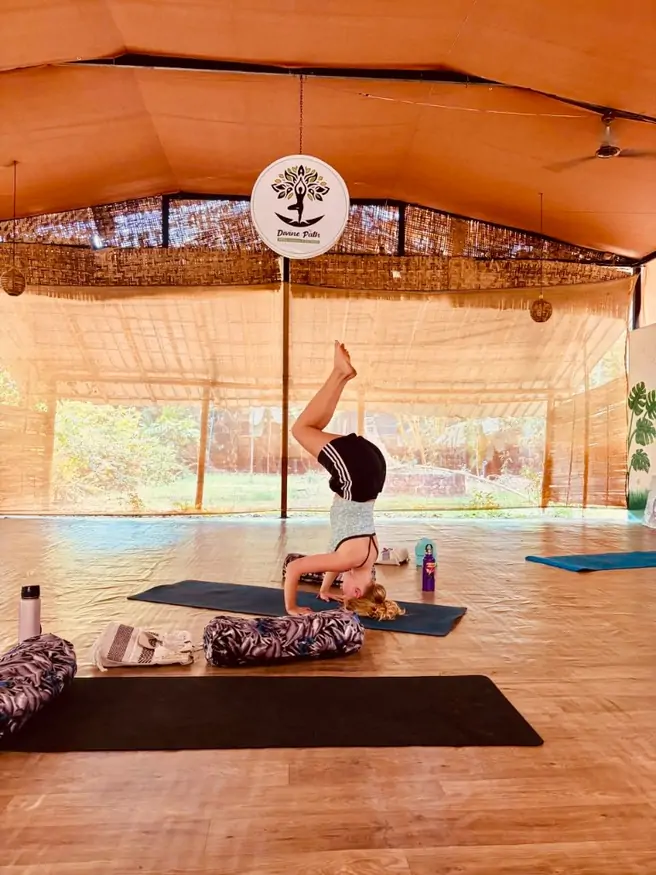
That practicum time — teaching, being watched, being corrected — is where most of the real value sits. It is the difference between holding a certificate and being able to run a room with confidence.
Completing a 300-hour on top of your 200-hour qualifies you to register with Yoga Alliance as an RYT 500 — there is no separate 500-hour exam; the two courses stack, and they may even be taken at different schools as long as each holds an active RYS designation. RYT 500 lets you teach advanced classes, lead workshops with authority, and is often required to teach on teacher trainings yourself, which is among the best-paid work in the field.
One detail many schools skip: Yoga Alliance's Standards for RYT Credentials also require at least 100 hours of teaching experience after your training before the RYT 500 is granted. So the months you spend teaching between your 200 and 300 are not just good practice — they count directly toward the credential.
If your goal is a long-term teaching career, the 300-hour is usually a sound investment — it widens what you are allowed and trusted to teach. After you graduate you upgrade your registration directly with Yoga Alliance (see the official RYT requirements). Our guides on registering with Yoga Alliance and building a teaching career explain where the credential leads.
If the filter above says yes for you, the course page has current start dates, room availability, and application steps for DivinePath Goa.
A 300-hour is a real investment, so judge the return (skills, credibility, what you are allowed to teach) against the total cost, not the headline fee alone. Because DivinePath runs its own campuses, our advanced pricing is transparent and on the affordable side.
| Your situation | Is the 300-hour worth it? | Better step |
|---|---|---|
| RYT 200, teaching, want to go advanced | Yes — strong return | Book the 300-hour |
| RYT 200 but never taught | Wait | Teach first, then return |
| No 200-hour yet | No | Start with the 200-hour |
| Just want travel / rest | No | A short retreat |
| Want to lead trainings one day | Yes — needed for RYT 500 | 300-hour → RYT 500 |
DivinePath's 300-hour is from $980 in Goa, around $1,200 in Rishikesh, and from $2,099 in Bali — meals and accommodation included on residential tiers. For the full money breakdown, see our Goa YTT cost guide. Confirm live prices and dates on the course page before booking.
Time is part of the cost too, so plan around the format: the Goa edition runs 27 days residential at our Arambol campus with batches starting every month, and groups are capped at 10–15 students so the practicum feedback stays personal. The Bali (Ubud) edition runs 26 days. Factor in flights, your Indian or Indonesian visa, and a buffer day either side of the course.
All three give the same RYS 300 credential; the difference is setting and price. Goa balances affordability with beach decompression, Rishikesh offers the most classical setting at a similarly low cost, and Bali is the premium island option. If location is your deciding factor, our pillar Rishikesh vs Goa vs Bali lays them out honestly. Your Goa advanced practicum is led by Yogi Saransh Ji.
A 300-hour yoga teacher training is worth it when you already have your 200-hour, some teaching under your belt, and a real reason to go advanced — to teach harder classes, specialise, or reach RYT 500. It is not worth it as a second beginner course or another holiday. If that filter says "yes" for you, see current dates on the 300-hour course page and talk to our admissions team — and if it says "wait," we will tell you that too.
See current start dates, room options, inclusions, and availability for our 27-day advanced training in Goa — or ask us honestly whether you should wait.
Yes — if you already hold a 200-hour certificate, have taught a little, and want to teach advanced classes or reach RYT 500. It is not worth it if you are new and need more foundation, or only want another travel experience.
No. The 300-hour is an advanced course that assumes you already completed a 200-hour (RYT 200). Beginners should start with the 200-hour first.
Your 200-hour and 300-hour stack to 500 hours, which qualifies you to register with Yoga Alliance as an RYT 500. There is no separate 500-hour exam.
From $980 in Goa, about $1,200 in Rishikesh, and from $2,099 in Bali, with meals and accommodation included on residential tiers. Confirm live prices on the course page.
Not automatically — but it lets you teach advanced classes, lead workshops, and train teachers, which are higher-value work. The return depends on how you use the credential.
We recommend teaching for six to twelve months first, so you arrive with real questions from real students. Yoga Alliance also requires 100 hours of teaching experience after your training before granting the RYT 500, so those months count toward the credential. Committed career-changers sometimes take the two courses back to back instead.
At DivinePath the residential 300-hour runs 27 days in Goa (batches start every month, groups of 10–15) and 26 days in Bali (Ubud). Add a buffer day on either side for travel.

Yoga Alliance Registered Yoga School — RYS 200, 300 & 500 · School ID 457520
 Yoga Alliance RYS 200, 300 & 500
School ID 457520
Verify registration →
Yoga Alliance RYS 200, 300 & 500
School ID 457520
Verify registration →
Divinepath Yoga School & Retreat © 2026. All Rights Reserved.