



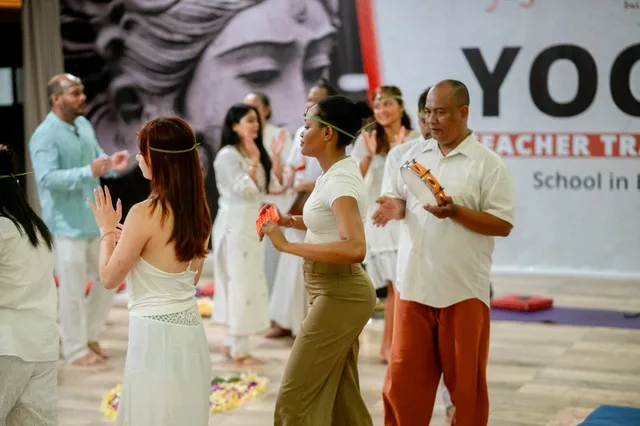
We run two yoga teacher training campuses in Bali, about 40 minutes apart. One is in a residential village in Klungkung, in the east. The other is on Jl. Bisma, five minutes’ walk from Monkey Forest Road in central Ubud.
Same school. Same syllabus. Same 10–15 student cap. Same certificate.
Almost everything else is different, and most people picking between them are guessing, because nobody publishes this comparison — including, until now, us. Every Bali teacher training guide we have ever read is an Ubud guide. We understand why. But it means that if you’re choosing where in Bali to spend a month of your life, the internet is only telling you about half of it.
Here is the honest version, including the parts where each campus is the wrong answer.
| Compare | Klungkung | Ubud |
|---|---|---|
| Where | Jalan Pura Dalem, Satra — residential village, east Bali | Jl. Bisma, central Ubud |
| What’s outside the gate | Rice fields, warungs, village life, temple processions | Cafés, galleries, yoga studios, traffic, the Monkey Forest |
| From Denpasar (DPS) | About 90 minutes, traffic depending | About 60–90 minutes, traffic depending |
| 200-hour length | 23 days (1st–23rd) | 20 days (1st–20th) |
| 200-hour, course only | $950 | Not published — residential packages only |
| 200-hour, shared | $1,450 (shared cottage) | $1,299 (6-share female) · $1,699 (twin) |
| 200-hour, private | $1,950 | $2,299 |
| Best for | Depth, focus, lower like-for-like cost, second courses | First time in Bali, solo travellers, life outside class |
| Wrong for | Anyone who needs a town around them | Anyone easily pulled off a schedule |
Look at our own price tables and Ubud appears cheaper: the 200-hour is $1,299 in Ubud and $1,450 in Klungkung. That comparison is wrong, and we’d rather explain it than let you find out at check-in.
The two headline prices are different rooms. Ubud’s $1,299 is a six-bed shared female room. Klungkung’s $1,450 is a shared cottage room. Compare the same thing and the picture flips:
| Room type | Klungkung | Ubud | Difference |
|---|---|---|---|
| Course only (no room/meals) | $950 | Not offered on the published price list | — |
| Shared cottage / twin shared | $1,450 | $1,699 | Klungkung $249 cheaper |
| Private room | $1,950 | $2,299 | Klungkung $349 cheaper |
| 6-share female dorm | Not offered | $1,299 | Ubud’s entry bunk option |
Klungkung is the cheaper campus at every comparable residential tier it publishes. Ubud simply publishes a lower entry price because it offers a bunk option Klungkung doesn’t.
Why the gap? Ubud land and food cost more, and the Jl. Bisma campus is a five-minute walk from one of the most visited streets in Indonesia. You are partly paying for the postcode. That is a legitimate thing to pay for. It is not a better course.
Do this maths on any school you’re considering, not just us. “From $499” almost always means course-only. Ask for the all-in figure for the room you’d actually take.
The Klungkung 200-hour runs 1st–23rd. The Ubud 200-hour runs 1st–20th. Same 200-hour syllabus and the same RYT-200 pathway.
That calendar difference is real: Klungkung gives you three more days in the container. Whether daily contact blocks are identical on every date is something you should confirm on the published timetable for the campus you book — add the morning, theory, teaching lab, and evening blocks yourself, the same way we’d tell you to audit any school. If a page’s day count and daily hours don’t reconcile on their face, ask what fills the gap before you pay.
What we can say either way: a 200-hour teacher training is a full-time job. Roughly dawn to evening, six days a week, with one day off. If you are picturing yoga in the morning and beaches in the afternoon, that is a retreat, not a training.
Satra is a village. It is not a resort area, a digital-nomad area, or a tourist area. There is a temple, there are warungs, there are rice fields, and there are people going about a life that has nothing to do with you. The campus is residential — rooms, shala, dining, and kitchen on one property at Jalan Pura Dalem — so most of the day happens inside the gate.
What that gives you. Very little to do except the course. Students who choose Klungkung tend to be the ones who came to actually learn, and it shows by week two — the group settles faster, and the evening practice is better attended because there is nowhere else to be. Balinese village life happens around you rather than being performed for you: ceremonies, offerings, a gamelan practising two streets over. It is quieter, it is cheaper on like-for-like rooms, and it sits closer to east Bali’s quieter coastline and Mount Agung than central Ubud does.
What that costs you. Honestly:
Lead teaching on this campus is headed by Yogi Ashish Ji (Hatha, Vinyasa, pranayama, Shatkarma).
Jl. Bisma runs off the top of Monkey Forest Road. You are ten to fifteen minutes’ walk from Ubud Palace, and inside a town that has been organised around visiting yoga students for thirty years. The campus itself stays structured for training; the town does not.
What that gives you. Everything, immediately. Somewhere to eat every dietary requirement ever invented. Other yoga students who are not in your cohort. Massage, laundry, a pharmacy, a bank, a bus to anywhere. If you are travelling alone and this is your first time in Asia, Ubud is a soft landing in a way a village is not — and that matters more than people admit.
What that costs you. Also honestly:
Compare published fees and dates for both Divinepath Bali campuses, then ask for the timetable of the batch you’d actually join.
Choose Klungkung if:
Choose Ubud if:
Choose neither if you want the beach-and-surf version of Bali. That’s Canggu or Uluwatu, and we don’t run there.
And choose India instead if cost is the deciding factor. Our Goa 200-hour starts at $500 course-only and $699 for a dorm, against $950 course-only and $1,450 shared cottage in Klungkung. Bali is roughly twice the price of Goa for the same certificate pathway. If the qualification is what you’re buying and the location is incidental, train in Goa or Rishikesh and spend the difference on your first year of teaching. We would rather say that than take the booking.
Bali’s wet season runs roughly November to March. Unlike Goa’s monsoon shutdown, Bali rain usually arrives in short, heavy bursts — often afternoon — and training continues under a roof. Dry season (roughly April–October) is clearer and easier for rest-day scooters and excursions.
Klungkung: the village setting means fewer covered cafés to duck into between sessions. The residential campus keeps you on property for most of the day, which is an advantage when roads are wet and you don’t want to negotiate scooter traffic. Ask us about the current shala setup for your month if heavy rain worries you — open-air halls with roofs stay usable in most storms, but wind-driven rain can interrupt outdoor spaces.
Ubud: town infrastructure helps on wet days (covered walkways, more indoor food options), but Monkey Forest Road traffic gets uglier in the rain and Grab times stretch. If you chose Ubud for evenings out, wet season makes those evenings shorter and stickier.
Personal preference from how we brief students: peak comfort months at both campuses are usually May–September. If you can only travel December–February, either campus still runs — just pack a light rain jacket and expect muddy lanes in the village and crowded covered cafés in town.
For the 500-hour pathway (200 + 300), yes — students sometimes complete the blocks in one continuous Bali stay in Klungkung, or split between both campuses. Confirm availability for your months when you enquire; seats are capped separately at each campus.
No. Same registration, same syllabus pathway, same RYT eligibility. The certificate does not name which Bali campus you attended.
Both host solo travellers every month, and the honest answer is that they suit different temperaments rather than different risk levels. Ubud has more people around and more to do alone in the evenings. Klungkung is quieter and the group becomes your social world for the month, which some people find safer-feeling and others find claustrophobic.
Ubud, slightly — not because the teaching differs, but because a first-time visitor to Asia has fewer things to adjust to at once. If you already travel comfortably, this shouldn’t decide it.
Yes. A month-long training will not fit a short visa-on-arrival without an extension or the correct longer stay. Indonesian rules change — confirm before you fly.
If you’re already in Bali, message us. Campus visits can often be arranged when staff and batch schedules allow — it isn’t a drop-in tourist attraction, so we need a little notice. WhatsApp is fastest.

Yoga Alliance Registered Yoga School — RYS 200, 300 & 500 · School ID 457520
 Yoga Alliance RYS 200, 300 & 500
School ID 457520
Verify registration →
Yoga Alliance RYS 200, 300 & 500
School ID 457520
Verify registration →
Divinepath Yoga School & Retreat © 2026. All Rights Reserved.

Student & Visitor Comments
Be the first to leave a comment.
Leave a comment