



300-Hour Yoga Teacher Training in Bali: Who Is It For and What Does It Cost? (2026)
Editorial note: Prices, visa rules, and statutory fees can change. This guide was last reviewed on Apr 21, 2026. Always confirm current details on the official programme page, our Yoga Alliance public profile, and official Indonesian immigration sources before booking or travel.
Looking for a clear 300-hour yoga teacher training Bali cost answer? Divinepath’s 28-day advanced programme in Klungkung is $2,300 shared, $2,400 sea view, or $2,500 sea view with balcony, and is built for teachers who already hold a 200-hour certificate. This guide covers eligibility, syllabus depth, real all-in budget, visa planning, and whether Bali or India offers better value for your RYT 500 path.
Key takeaways
- Entry requirement: A completed 200-hour YTT certificate (any Yoga Alliance RYS school).
- Price: From $2,300 shared room / $2,400 sea view / $2,500 sea view with balcony at Klungkung (28 days).
- Decision lens: Bali offers comfort and environment; India (Goa/Rishikesh) offers lower cost for equivalent certification.
- Related: Bali visa guide · Bali 200h cost guide
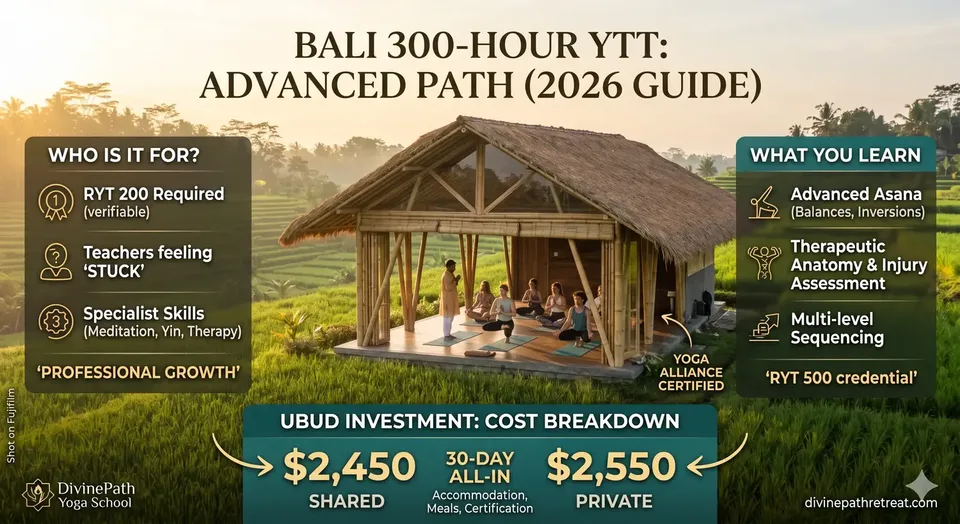
Divinepath’s advanced training on the Ubud campus starts from $2,099 shared / $2,699 private (26 days, meals and accommodation included). Klungkung pricing is on our 300-hour in Bali. The course is for teachers who have already completed a 200-hour YTT. It covers advanced asana, therapeutic anatomy, multi-level sequencing, extended teaching practice, and deeper philosophy toward the RYT 500 pathway.
This post answers three questions we get every week: who actually qualifies for the 300-hour course, what you learn that you didn’t cover in 200 hours, and whether the investment is worth it. No marketing language. Just the facts from a school that runs advanced training in Bali, Goa, and Rishikesh.
What's in This Guide
- Who Qualifies for the 300-Hour YTT?
- Who Should NOT Do the 300-Hour Course Yet?
- What Do You Learn in 300 Hours?
- How Does the Course Work at Divinepath?
- What Does a Typical Day Look Like?
- What Do Graduates Do After Certification?
- How Much Does the Course Cost?
- Bali vs Goa vs Rishikesh for 300-Hour
- Realistic All-In Budget for Bali
- What Visa Do You Need?
- Is the Course Worth the Investment?
- What Is the Accommodation Like?
- Most Popular Training Paths
- How Do You Book?
- Frequently Asked Questions
Who Qualifies for the 300-Hour Yoga Teacher Training?
You need a completed 200-hour YTT from any Yoga Alliance Registered School. That’s the only hard requirement. It doesn’t have to be from Divinepath. It doesn’t have to be from India or Bali. Any RYS 200 certification worldwide qualifies you for our 300-hour programme. You can verify Divinepath’s school listing on the Yoga Alliance public profile.
Beyond the certification, though, the question is whether you’re ready. Here’s who the 300-hour course is genuinely designed for:
- Teachers who have been teaching for 6–12+ months. This is our strongest recommendation. The advanced material makes sense only when you’ve experienced real classrooms, real students, and real challenges. If you completed your 200 hours last month and haven’t taught a single class, the 300-hour curriculum will feel abstract. You’ll learn techniques for managing mixed-level rooms before you’ve ever taught a beginner class. That’s backwards.
- Teachers who feel stuck in their sequencing. You’ve been teaching the same 5–8 class templates for months. Your students are progressing but your classes aren’t. You want to build creative, intelligent sequences that peak at challenging poses without injuring anyone. The 300-hour addresses this directly.
- Teachers who want to specialise. The 300-hour curriculum includes modules on therapeutic yoga, Yin yoga, advanced meditation, and Yoga Nidra. These are add-on skills that let you offer classes most 200-hour graduates cannot. Meditation and Yin classes are the fastest-growing segments in Western yoga markets.
- Teachers aiming for RYT 500. Completing both 200 and 300 hours makes you eligible for the Yoga Alliance RYT 500 credential. This is the highest standard teaching certification. Many premium studios, retreat centres, and yoga festivals require RYT 500 for lead teacher positions and workshop facilitation.
Who Should NOT Do the 300-Hour Course Yet?
- If you finished 200 hours less than 3 months ago: wait. Go home. Start teaching. Discover what you don’t know. Come back in 6–12 months with real questions that the advanced material can answer. The 300-hour is not a continuation of 200-hour training — it’s a refinement of teaching skills you’ve already started using.
- If you’re doing this because you think more hours means better credentials: pause. RYT 200 is enough to teach in most studios worldwide. The 300-hour adds depth, not basic qualification. If you’re collecting certifications without teaching between them, you’re spending money on credentials you’re not using.
- If your budget is tight: consider Rishikesh or Goa first. Divinepath’s 300-hour costs from $2,300 in Bali, $1,299 in Goa, and $1,250 in Rishikesh. The certification and curriculum depth are equivalent. The price difference is accommodation and location cost. If $2,300 stretches your finances, Rishikesh at $1,250 saves you $1,100 for the same Yoga Alliance RYT 300.
What Do You Learn in 300 Hours That You Didn’t Cover in 200?
This is the question that matters most. Here’s the side-by-side comparison:
| Already Covered in 200h | New in 300h | Why It Matters |
|---|---|---|
| Basic Hatha + Vinyasa asana | Arm balances, inversions, advanced backbends | You can demo and teach the poses students ask about most |
| Intro anatomy (bones, muscles) | Therapeutic anatomy, injury assessment, contraindications | You can safely modify for students with injuries |
| Basic sequencing | Multi-level sequencing, peak pose builds, workshop design | You can design classes for mixed-level rooms |
| Intro philosophy (Yoga Sutras overview) | Deep study: Bhagavad Gita, Tantra philosophy, chakras | You can answer student questions beyond the basics |
| 15-min practice teaches | Full 60–90 min class teaches with feedback cycles | You graduate ready to lead a real studio class immediately |
| Basic adjustments | Hands-on assists, partner work, prop-based modifications | You can safely adjust students in any pose |
| Intro meditation | Extended meditation practice, teaching meditation, Yoga Nidra | You can lead meditation classes (increasingly in demand) |
Planning 300-hour training in Bali?
View advanced YTT dates, prerequisites, and full cost breakdown for Ubud.
The shift from 200 to 300 is the shift from “I can teach a basic class” to “I can handle any room, any student, any situation.” The 200-hour gives you tools. The 300-hour teaches you when and how to use them intelligently.
How Does the 300-Hour Course Work at Divinepath Bali?
- Duration: 28 days. The course runs from the 1st to the 28th of every month, with checkout on the 29th. That’s 5 days longer than our 200-hour programme (23 days), which gives you more time for advanced material, extended teaching practice, and deeper integration.
- The mentorship model. At Divinepath, the 300-hour course runs concurrently with a 200-hour batch. As a 300-hour student, you share some morning sessions (Hatha flow, kirtan, philosophy review) with the 200-hour group. But your schedule extends further with exclusive advanced workshops from 12:00–4:00 PM that 200-hour students don’t attend. This concurrent structure is deliberate. Revisiting foundational material alongside newer students deepens your understanding — you see concepts from a teacher’s perspective, not a student’s. Several 300-hour graduates have told us this “revision through teaching eyes” was the most valuable part of the course.
- Group size: 5–10 students. Our advanced batches are smaller than the 200-hour groups (which cap at 15). This means more personal attention from Ashish Ji and the senior teaching team. In a group of 7, you get detailed feedback on every practice teach. In a group of 20 (common at other Bali schools), you might teach twice and get a paragraph of notes.
- Lead instructor: Ashish Ji. He specialises in Anatomy and Vinyasa Yoga. His advanced anatomy workshops are where the 300-hour curriculum separates itself from the 200-hour. He teaches therapeutic application — how to assess a student’s movement patterns, identify limitations, and modify intelligently. This is the knowledge that turns a good teacher into a trusted one.
What Does a Typical Day Look Like in the 300-Hour Course?
The daily schedule is more intense than the 200-hour because you have exclusive afternoon workshops that 200-hour students do not attend.
- 6:00 AM — Wake up. Ubud mornings are cool and quiet. By now you know the routine — this is your second course, and the early start feels natural.
- 6:30–8:00 AM — Pranayama and advanced meditation. Longer meditation sits than the 200-hour course. You are learning to teach meditation, not just practise it. Ashish Ji introduces Yoga Nidra techniques during some of these sessions.
- 8:00–9:30 AM — Morning asana (shared with 200h batch). You revisit Hatha and Ashtanga fundamentals alongside the 200-hour students. This revision is intentional — you see foundational material through a teacher’s eyes now, noticing cueing choices and sequencing decisions you missed the first time.
- 9:30–10:30 AM — Breakfast. Smoothie bowls, tropical fruits, Indonesian dishes. Same quality Sattvic meals as the 200-hour programme.
- 10:30 AM–12:00 PM — Shared philosophy or anatomy session. Philosophy goes deeper in the 300-hour — Bhagavad Gita, Tantra, chakra systems. Anatomy covers therapeutic application and injury assessment.
- 12:00–4:00 PM — EXCLUSIVE 300-hour workshops. This is the core differentiator. While 200-hour students break for lunch and afternoon Vinyasa, you attend advanced clinics: arm balance progressions, inversion safety, multi-level sequencing workshops, extended teaching practice with detailed feedback, and hands-on adjustment intensives. These four hours are where the 300-hour investment pays off.
- 4:00–5:00 PM — Kirtan or self-study.
- 5:00–6:00 PM — Dinner. Lights out by 9:30 PM. The schedule is demanding — roughly 10–12 hours of structured learning per day, six days a week.
One rest day per week with an optional cultural excursion. The rest days matter more in the 300-hour than the 200-hour because the daily load is heavier. Use them for genuine rest, not study catch-up.
What Do 300-Hour Graduates Do After Certification?
The RYT 300 opens doors that the RYT 200 does not. Here is what we see Divinepath graduates doing within 6–12 months of completing the advanced training:
- Teaching at premium studios. Many studios have a two-tier pay structure: RYT 200 teachers get the base rate, RYT 500 (which requires completing both 200h and 300h) teachers get a premium. In London, New York, and Sydney, the gap can be ten to twenty dollars per class. Over 10–15 classes per week, that adds up fast.
- Leading workshops and immersions. Most studios only allow RYT 500 teachers to run paid workshops, weekend immersions, and specialised series (like a 6-week arm balance progression). These are higher-margin offerings than regular group classes and build your reputation as a specialist.
- Working at yoga retreats. Retreat centres in Bali, Thailand, Portugal, and Costa Rica prefer or require RYT 500 for lead teacher positions. Some Divinepath graduates have returned to teach at our own retreats after completing the 300-hour.
- Teaching meditation and Yoga Nidra. The 300-hour curriculum includes meditation teaching methodology and Yoga Nidra, which most 200-hour courses skip or cover superficially. Meditation and Yoga Nidra classes are growing in demand globally, and there are fewer qualified teachers than for asana classes. This is a genuine competitive advantage.
- Applying for teacher training faculty positions. If you want to teach other teachers (assist or lead a YTT programme), Yoga Alliance requires the lead trainer to hold RYT 500. Completing the 300-hour is the first step toward becoming a teacher trainer yourself.
How Much Does the 300-Hour Course Cost at Divinepath Bali?
- Shared room: $2,300 USD (28 days). Twin-share room with ensuite bathroom, AC, and campus access.
- Sea view room: $2,400 USD (28 days). Private room with sea/river views, ensuite, and AC.
- Sea view room with balcony: $2,500 USD (28 days). Premium private room with balcony overlooking the pool, river, and ocean.
Both options include: 28 days of accommodation (checkout on the 29th), three Sattvic vegetarian/vegan meals daily, all classes and workshops, course materials, Yoga Alliance RYT 300 certification, free airport pickup from Ngurah Rai (DPS), weekly cultural excursion, pool access, and one complimentary Balinese massage.
Not included: flights, visa and extension fees (~$70 total), travel insurance, personal expenses, and Yoga Alliance membership fee.
How Does Bali Compare to Goa and Rishikesh for the 300-Hour?
We run the 300-hour course at all three locations. Here’s the straight comparison:
| Rishikesh | Goa | Bali | Duration | |
|---|---|---|---|---|
| 300h Shared | $1,250 | $1,299 | $2,300 | 27–28 days |
| 300h Private | $1,250 (all-inc) | $1,800 | $2,400–$2,500 | 27–28 days |
| Certification | YA RYT 300 | YA RYT 300 | YA RYT 300 | Identical |
| Cost per day | ~$43/day | ~$48/day | ~$84/day |
Rishikesh is cheapest at $1,250 for 28 days. That’s $43 per day including private room, meals, and certification. If budget is your primary driver and you want maximum value per dollar, Rishikesh is the clear winner for the 300-hour course.
Goa is mid-range at $1,299 for 27 days. Beach setting, Arambol community, multiple room options. A good balance of cost and lifestyle.
Bali is premium from $2,300 for 28 days. Sea-view campus accommodation with pool in Klungkung. The most comfortable living environment. The extra cost is accommodation and Bali’s higher cost of living. See our full comparison of all three locations here.
The certification is identical at all three locations. Your RYT 300 from Divinepath Bali is the same credential as RYT 300 from Divinepath Rishikesh. The choice is lifestyle, not quality.
What’s the Realistic All-In Budget for 300-Hour in Bali?
| Expense | Estimated Cost | Notes |
|---|---|---|
| Course fee (shared cottage) | $2,300 | 28 days, all-inclusive |
| Return flights (Europe/US/Australia) | $500–$900 | Book 2–3 months ahead |
| e-VOA + extension | $70 ($35 + ~$35) | 29-day stay fits the 30-day VoA with one day of buffer. Extend if staying longer. |
| Tourism Levy | $10 | Mandatory for all tourists |
| Travel insurance (1 month) | $30–$80 | World Nomads / Safety Wing |
| Personal expenses (month) | $100–$250 | Ubud cafes, laundry, rest-day activities |
| Yoga Alliance registration | $50 + $65/year | Optional. Paid to YA after graduation. |
| REALISTIC TOTAL | $3,110–$3,660 | All-in including flights and extras |
Compare that to the 300-hour in Rishikesh (total: ~$1,700–$2,000) or Goa (~$1,800–$2,300). Bali costs roughly $1,000–$1,500 more all-in. The question is whether Ubud’s villa accommodation, cafe scene, and island lifestyle are worth that premium to you. (See our Bali Cost Guide for more details).
What Visa Do You Need for the 28-Day Course?
The e-VOA ($35) gives you 30 days. Your course runs from the 1st to the 28th with checkout on the 29th, leaving just one day of buffer. If you plan any time in Bali after the course, start the visa extension process around Day 15–20. The extension costs approximately $35 at a Bali immigration office and gives you an additional 30 days. Divinepath provides guidance on the extension process.
Alternatively, apply for a B211 visa before traveling. This gives you 60 days from the start — no extension needed. Costs $100–$150 through an Indonesian embassy. Divinepath issues an enrollment letter to support your application. If you plan to travel Bali after graduation, the B211 is the safer choice. Full visa details for all course lengths are in our dedicated Bali visa guide.
Compliance note: This section is educational and does not constitute legal or immigration advice. Verify visa category, stay duration, and extension policy with official Indonesian authorities before departure.
Is the 300-Hour Course in Bali Worth the Investment?
For a campus-neutral decision guide covering Goa, Rishikesh, and Bali, start with our Is a 300-Hour YTT Worth It? article — then use this page for Bali-specific costs.
If you’re teaching regularly and feel limited by your 200-hour training: yes. The 300-hour fills the gaps that show up after real teaching experience. How to handle a student with a knee injury. How to sequence a 75-minute class that builds to a challenging peak pose without rushing. How to teach meditation to a room of people who can’t sit still for 30 seconds. These are the skills that earn you repeat students and premium class rates.
If you want to teach at premium studios, retreats, or festivals: yes. Many of these venues require or prefer RYT 500 (which needs both 200h + 300h). Without the 300-hour, you’re limited to entry-level teaching positions. With it, you qualify for lead teacher roles, workshop facilitation, and teacher training faculty positions.
The return on investment in numbers: An RYT 500 teacher in the US, UK, or Australia can charge $80–$150 per private session and $30–$60 per group class. If the 300-hour credential helps you charge $10 more per class or land one additional private client per week, the $2,300+ investment pays for itself within 6–12 months of regular teaching.
If you’re not actively teaching and don’t plan to start soon: probably not worth it yet. The 300-hour is a professional development investment. If you’re not using your 200-hour certification, adding 300 hours on top doesn’t change the underlying equation. Teach first. Come back when the advanced material has a purpose.
What Is the Accommodation Like for 300-Hour Students?
- Shared room ($2,300): Twin-share room with ensuite bathroom, AC, and campus access. Same-gender pairing with another 300-hour student.
- Sea view room ($2,400): Private room with sea/river views, ensuite, and AC.
- Sea view room with balcony ($2,500): Premium private room with balcony overlooking the pool, river, and ocean.
Both options include the Balinese massage and free airport pickup. The campus has a student lounge with Wi-Fi, filtered water stations throughout, and a communal area where 300-hour students often study together in the evenings. The pool is shared with 200-hour students, but the vibe is quiet — most people are in bed by 9:30 PM. (Read more in our guide to yoga in Bali).
For a month-long course, accommodation quality genuinely affects your experience. Thirty days in an uncomfortable room drains energy you need for training. Thirty days in a clean, air-conditioned cottage with a pool to jump into after Ashtanga practice — that restores you. This is part of why students choose Bali for the advanced course even when India is cheaper.
What Are the Most Popular Training Paths at Divinepath?
- Path 1 (Budget-first): 200h in Goa ($899) → teach for 6–12 months → 300h in Rishikesh ($1,250). Total: $2,149 for your full RYT 500 journey. The cheapest path in the Divinepath network.
- Path 2 (Best of both worlds): 200h in Goa ($899) → teach for 6–12 months → 300h in Bali (from $2,300). Total: from $3,199. Affordable foundation in India, premium advanced experience in Bali. Our most popular split.
- Path 3 (All-Bali): 200h in Bali ($1,450) → teach → return for 300h in Bali (from $2,300). Total: from $3,750. Consistent location and teaching team. Good if you love Ubud and want continuity.
- Path 4 (Combined 500h): 500h in Bali ($3,950, 56 days). Combines 200h + 300h in one continuous programme with a 3–5 day integration break, and you only fly to Bali once. Best for students who are certain about their commitment.
How Do You Book the 300-Hour in Bali?
25% deposit secures your seat: ~$588 for shared cottage. Remaining $1,762 due on or before arrival day. Credit/debit cards (USD) and bank transfer accepted.
Batches start on the 1st of every month, year-round. Group size is 5–10 students. Advanced batches fill slower than 200-hour batches, so booking 3–4 weeks ahead is usually sufficient. Dry season (April–October) is most popular.
When you book, send us your 200-hour certificate so we can verify your eligibility. We accept certificates from any Yoga Alliance Registered School worldwide. Contact: +91-8868043473 (WhatsApp) or through our website.
At Divinepath, we have trained hundreds of graduates from multiple countries across Rishikesh, Goa, and Bali. Our 300-hour curriculum is refined through ongoing student feedback and faculty review from each intake.
Frequently Asked Questions: 300-Hour YTT in Bali
How much does the 300-hour yoga teacher training cost in Bali?
At Divinepath in Klungkung, the 300-hour YTT costs $2,300 for a shared room, $2,400 for a sea view room, or $2,500 for a sea view room with balcony (28 days, all-inclusive). This includes accommodation, three meals daily, all classes, course materials, Yoga Alliance RYT 300 certification, free airport pickup, and a Balinese massage. The same course costs $1,299 in Goa and $1,250 in Rishikesh.
Do I need a 200-hour certification to join the 300-hour course?
Yes. A completed 200-hour YTT from any Yoga Alliance Registered School is required. It does not need to be from Divinepath. Send us your certificate when you book so we can verify eligibility. We recommend having at least 6 months of teaching experience before starting the 300-hour, though this is a recommendation, not a requirement.
What visa do I need for the 28-day 300-hour course in Bali?
Get the e-VOA ($35 online) and plan to extend it around Day 20 at a Bali immigration office (additional ~$35). The 29-day stay uses almost the entire VoA window, so the extension provides essential buffer. Alternatively, apply for a B211 visa ($100 to $150) before traveling for 60 days from the start. Divinepath provides an enrollment letter for B211 applications.
Is the 300-hour cheaper in India than Bali?
Yes, significantly. Divinepath's 300-hour costs $1,250 in Rishikesh and $1,299 in Goa versus from $2,300 in Bali. The certification is identical. The price difference is accommodation quality and cost of living. If budget is your main concern, Rishikesh saves you $1,100 for the same Yoga Alliance RYT 300.
What is the difference between 200-hour and 300-hour yoga training?
The 200-hour teaches you to lead a basic yoga class safely. The 300-hour teaches advanced asana (arm balances, inversions), therapeutic anatomy, multi-level sequencing, extended teaching practice (60 to 90 minute classes), deeper philosophy, and meditation teaching skills. Completing both qualifies you for the RYT 500 credential, which many premium studios and retreat centres require.
Can I do 200 hours in Goa and 300 hours in Bali?
Yes. This is Divinepath's most popular cross-location path. Complete 200 hours in Goa ($899), teach for 6 to 12 months, then return for 300 hours in Bali (from $2,300). Total for your RYT 500 journey: from $3,199. Your training records transfer seamlessly between Divinepath campuses under our shared Yoga Alliance registration.
Ready to Advance Your Teaching?
Join our 300-hour teaching team in Ubud. Pick your month, choose your room type, and secure your spot with a 25% deposit.
Explore Ubud 300h Dates WhatsApp Us
Written By
Yogi Naveen Ji
Ashtanga & Alignment Instructor, Divinepath Yoga School & Retreat
Reviewed by Ashish Ji (Anatomy & Vinyasa, Bali)
View Profile