



Reviewed by Yogi Naveen Ji, Pranayama & Meditation Teacher, DivinePath Rishikesh
Quick Answer: Yes — a beginner can absolutely complete a 200-hour yoga teacher training in Rishikesh. At DivinePath's Ganga-side campus near Lakshman Jhula, roughly a third of every batch arrives with under a year of practice. Our 25-day, Yoga Alliance–certified 200-hour YTT costs $950 USD (shared room) or $1,300 USD (private room), all-inclusive: tuition, accommodation, and three vegetarian meals daily, in batches capped at 15 students. What beginners actually need isn't advanced asana — it's 3–6 months of consistent practice, realistic expectations about ashram-style routine, and preparation for a more traditional, disciplined experience than Goa or Bali.
That's the short version. The honest, longer version — including what beginners find hardest about Rishikesh specifically — is below.
No, and it helps to understand why this myth is so persistent.
Rishikesh has a reputation as the birthplace of yoga — the town where the Beatles studied, where sadhus meditate by the Ganga River, and where more than a hundred yoga schools operate within a few kilometres of Lakshman Jhula. That reputation makes beginners assume the training here must be for "serious" practitioners only.
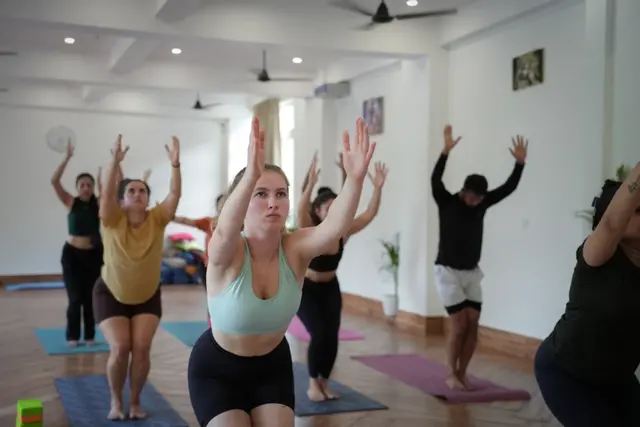
The reality inside the shala is different. A 200-hour YTT is a foundation course. It is designed by Yoga Alliance as an entry-level qualification — the RYT 200 is the first rung of the teaching ladder, not the last. The curriculum assumes you are learning postures properly for the first time. When I teach alignment in week one, I teach it from zero, because even students with five years of self-taught vinyasa usually have habits that need rebuilding.
What we actually ask of applicants at DivinePath:
If you can honestly tick those four boxes, you are a viable candidate. If you have practiced for less than 3 months, we'll usually suggest waiting one or two months and following a simple preparation routine — not because you'd fail, but because you'd enjoy the course far more with a small base.
This is the question that matters most, because the beginner experience in Rishikesh is meaningfully different from our Goa and Bali campuses. Some beginners thrive on the difference; others should honestly pick a beach campus instead.
The certification is identical — Yoga Alliance RYT 200, valid worldwide. Batch sizes are capped at 15 at all DivinePath campuses. The core 200-hour curriculum (asana, anatomy, philosophy, teaching methodology, practicum) is the same syllabus. And the teacher attention a beginner gets in a 15-person batch is the same in Rishikesh as in Goa or Bali.
If you're weighing locations seriously, our Rishikesh vs Goa vs Bali comparison goes deeper. You can also read our companion guides for beginner YTT in Goa and beginner YTT in Bali.
Here is the real daily schedule from our 200-hour course, with notes on how beginners typically experience it:
| Time | Activity | Beginner notes |
|---|---|---|
| 05:30 | Wake up, herbal tea | The hardest adjustment of week one. By week two, natural. |
| 06:00–07:30 | Shatkarma (cleansing) + pranayama | Taught from zero. Jala neti feels strange twice, then normal. |
| 07:30–09:00 | Hatha yoga (alignment-focused) | This is where beginners build their foundation. Modifications always offered. |
| 09:00–10:00 | Breakfast | — |
| 10:30–11:30 | Yoga philosophy | Yoga Sutras, taught conversationally, no prior reading required. |
| 12:00–13:00 | Anatomy & physiology | The most "study-like" hour. Beginners often do best here — no habits to unlearn. |
| 13:00–16:00 | Lunch + rest / self-study | Protect the rest. Your body is adapting. |
| 16:00–17:30 | Ashtanga/Vinyasa practice | The most physical session. Weeks 1–2 are humbling for everyone, not just beginners. |
| 18:00–19:00 | Meditation / mantra / Ganga aarti (some evenings) | Many students' favourite hour of the day. |
| 19:00–20:00 | Dinner | — |
| 21:30 | Lights out | You will not resist this by day four. |
The pattern our teachers see every batch: days 3–6 are the physical low point for beginners (sore, tired, questioning), days 10–14 bring the first "I can actually do this" moment, and by the teaching practicum in week four, the beginners are often more careful, clearer instructors than the experienced students — because they remember what not-knowing feels like.
Six practical preparation steps, in priority order:
Beginners sometimes assume they should "start small" with a 100-hour course. Our honest advice: if your goal is to teach, or even to maybe teach, choose the 200-hour.
The reasons are structural, not sales talk. At DivinePath, the 100-hour course is Part 1 of the full 200-hour programme — a 12-day foundation, not a stand-alone teaching qualification. Only the RYT 200 registers with Yoga Alliance as a teaching credential. And the transformation beginners describe — the one that happens somewhere between week two and the practicum — needs the full arc of the 25 days to unfold. The 200-hour course page has current dates and the full syllabus.
If a month away is genuinely impossible, the 100-hour is a legitimate first step — you can return anytime to complete Part 2 and earn your full RYT 200. Treat it as depth and a pathway, not a shortcut around certification.
A beginner's experience is shaped by teachers more than by any other factor, so meet ours:
Yogi Rajesh Ji (that's me) — Lead Hatha & Alignment. My job is your foundation: I teach postures assuming you're learning them properly for the first time.
Yogi Naveen Ji — who reviewed this guide — leads pranayama and meditation, and is usually the teacher beginners bond with first.
Yogi Jaggi Ji — philosophy and mantra, the voice of the traditional Rishikesh lineage in our faculty.
All classes are in English. With a maximum of 15 students, every beginner is known by name by day two — this is the single biggest difference between a small school and the 40-student factory batches common in Rishikesh. Our best Rishikesh schools comparison shows honestly how school sizes and prices vary across town, from $549 to $2,750.
The complete picture for DivinePath's 200-hour YTT in Rishikesh (verified on the course page, July 2026):
| Item | Shared room | Private room |
|---|---|---|
| Course fee (all-inclusive) | $950 USD | $1,300 USD |
| Deposit to book | $238 | $325 |
| Duration | 25 days (1st–25th monthly) | 25 days |
| Included | Tuition, accommodation, 3 vegetarian meals daily, course materials, RYT 200 certification | Same |
| Not included | Flights, India e-visa (~$25–$80 by nationality), travel insurance, personal spending (~$50–$150/month is realistic in Rishikesh) | Same |
There are no hidden extras — no "certification fees" or "materials fees" added later, a practice some schools in town use to advertise low headline prices. Budget guidance in more detail: Rishikesh YTT cost breakdown.
Check current batch dates and book with a 25% deposit on the 200-hour course page. Questions first? A real teacher answers, usually within a day.
Technically yes — no school checks a practice logbook — but we honestly recommend 3–6 months of consistent practice first. Total beginners can complete the course, but they spend energy on basic conditioning that students with a small base spend on learning to teach. If you have zero experience and a fixed travel date, tell us at booking and we'll send a simple 8-week preparation routine.
Rishikesh is one of India's safer towns for solo women — it's a holy, alcohol-free town with a huge international student population. Standard precautions apply (modest dress, avoid isolated riverbanks after dark, use known taxi drivers). Most of our students are solo female travellers, and the residential campus means you're never navigating alone at night.
December–January mornings can be 5–8°C before sunrise; days warm to 18–22°C. The shala is sheltered but not heated during morning practice. One fleece, warm socks, and a shawl solve it. October, November, and February are milder. If cold mornings are a dealbreaker, choose March–May or September — or our Goa campus, which is warm year-round.
You'll be qualified (RYT 200) and you'll have taught real classes in the supervised practicum. Most graduates start with community classes, studio cover slots, or online sessions, then grow. What the certificate really gives you is a foundation and permission to start — see our realistic career guide for what the first year of teaching actually looks like.
No, but you'll eat vegetarian for 25 days — the whole town does; Rishikesh is legally vegetarian and alcohol-free. Students routinely report it as easier than expected and often keep elements of it afterwards. If you have dietary restrictions (vegan, gluten-free, allergies), tell us at booking; the kitchen handles all of these monthly.
Our typical batch spans 22–60+, with the median around 30–35. We regularly certify students in their 50s and 60s. Age matters far less than consistency of practice and willingness to modify postures — and Hatha-based training with alignment focus is the most age-adaptable format there is.

One of the Best Yoga Teacher Training Courses & Retreats in India & Indonesia.
 Yoga Alliance RYS 200
School ID 457520
Verify registration →
Yoga Alliance RYS 200
School ID 457520
Verify registration →
Divinepath Yoga School & Retreat © 2026. All Rights Reserved.