



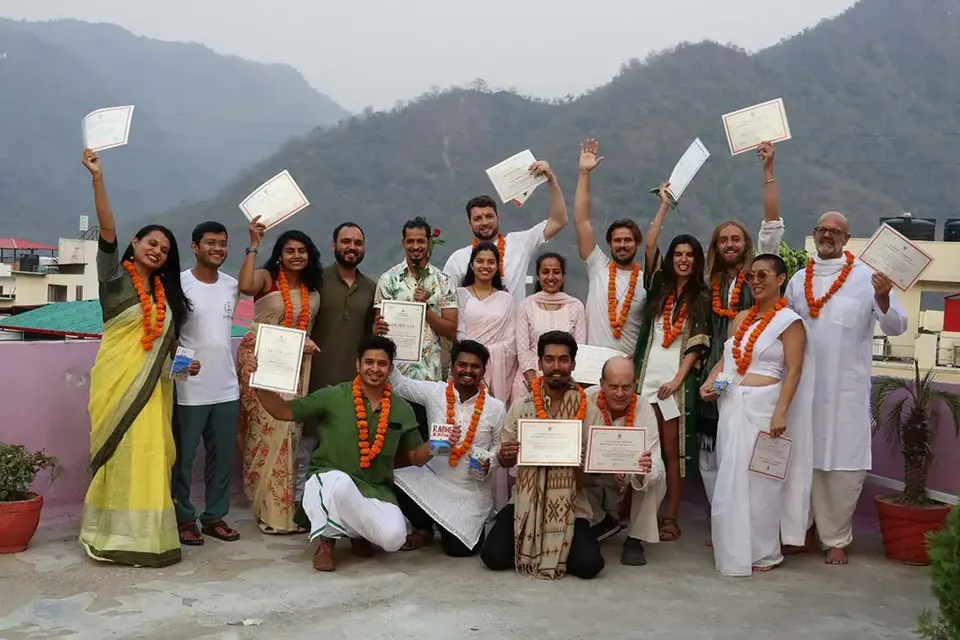
Reviewed by Naveen Ji (Ashtanga & Alignment Instructor, Divinepath Rishikesh)
Quick answer: We compared six Yoga Alliance-registered 200-hour YTT schools in Rishikesh on real, verified 2026 pricing. Prices range from $549 USD (Arogya Yoga School) to $2,750 USD (Rishikesh Yogpeeth, private room). Divinepath's own 25-day program sits at $950 USD shared / $1,300 private — positioned as full-curriculum, small-batch value between the budget ashram schools and the premium retreat-style academies. Below is the line-by-line comparison, with honest pros and cons for each.
Pricing verification note: All competitor prices below were checked directly against each school's own program page on or around June 2026 by the Divinepath content team. Prices are in USD and subject to change without notice — readers should confirm current pricing on the school's own site before booking.
If you've already decided on the curriculum depth you want and just need the planning details, see our 200-Hour YTT Rishikesh 2026 Planning Guide.
Rishikesh has more 200-hour YTT schools than any single city in India — estimates put the number near 100, most clustered around Lakshman Jhula and Tapovan on the banks of the Ganga River. Search results and review sites blur them together. This guide picks six schools with genuinely verifiable, current pricing — including our own — and compares them honestly, including where Divinepath is not the cheapest option.
Rishikesh sits at the base of the Himalayas on the banks of the Ganga River, near Lakshman Jhula — a setting that shapes which schools exist there and how they compete. Unlike Goa or Bali, where YTT schools often compete partly on beach proximity or lifestyle amenities, Rishikesh schools mostly compete on lineage, tradition, and curriculum depth, because the spiritual reputation of the town itself is the draw. This is also why Rishikesh has more schools per square kilometre than almost anywhere else in the YTT world — estimates put the number of registered schools near 100 in the Tapovan and Lakshman Jhula areas alone. That density is exactly why an honest, verified comparison matters more here than almost anywhere else: the sheer number of options makes it easy to get lost in marketing copy instead of real pricing and real curriculum differences. For a three-location overview, see our Rishikesh vs Goa vs Bali for Yoga Teacher Training guide and Bali vs Rishikesh YTT comparison.
Every price in this comparison was checked directly against the school's own official program page in June 2026, not against third-party listing sites or aggregators, which are frequently outdated. Where a school's own site contained an internal inconsistency (for example, Rishikesh Yogpeeth's FAQ section states one figure while its pricing table states another), we used the pricing table figure as authoritative and noted the inconsistency so readers can verify it themselves before paying a deposit. For two schools — House of Om and Arogya Yoga School — full page content exceeded what could be captured in detail, so the figures below come from the schools' own meta descriptions and pricing sections rather than a full line-by-line breakdown; we recommend confirming exact inclusions directly with those two schools before booking.
We did not include two of the schools originally considered for this list — Omkarananda Ashram and Parmarth Niketan — because neither returned clear, current, school-specific pricing during this research pass. Rather than publish a guess, we substituted two schools with verifiable, current pricing.
| School | Sharedtwin room | Privatesingle room | Duration | Style | YogaAlliance | Best for |
|---|---|---|---|---|---|---|
| Divinepath Rishikesh | $950 | $1,300 | 25 days | Hatha, Ashtanga & Alignment | RYT 200 | Small batches, full curriculum, best value mid-tier |
| Rishikesh Yogpeeth (Abhayaranya Yoga Ashram) | $2,100 (twin) | $2,750 | 21 days | Hatha, traditional ashram | RYT 200 | Established brand, 16+ years, structured ashram routine |
| Sattva Yoga Academy | $2,100 (standard) | ~$2,550 (single, +$450 surcharge) | 23 days | Himalayan Yogic Tradition (Hatha + Kundalini/Tantric) | RYT 200 | Luxury retreat amenities, spiritually immersive, less budget-conscious students |
| Himalayan Yoga Ashram | From ~$595 | — | 24 days | Vinyasa Flow | RYT 200 | Budget-conscious students wanting Vinyasa focus |
| House of Om | From ~$1,700 (early bird) to ~$2,150 | — | ~20 days | Multi-style | RYT 200 | Students who may want to also experience the school's Bali or Thailand locations |
| Arogya Yoga School | $549 | — | 200/300/500-hour options | Hatha, Sound Healing, Yoga Therapy | RYT 200 | Tightest budget, therapeutic/sound-healing interest |
Prices verified directly from each school's official program page, June 2026. USD, subject to change — confirm current pricing before booking.
The honest pitch: Divinepath is not the cheapest school in Rishikesh, and it is nowhere near the most expensive. At $950 for a 25-day, fully-inclusive program with small batch sizes and a teaching team (Yogi Rajesh Ji, Yogi Naveen Ji, Yogi Jaggi Ji) that includes a former engineer-turned-Ashtanga-instructor and a philosophy-focused teacher, the program is built for students who want real teaching competence, not just a certificate.
Pros: Monthly batches (1st-25th) mean you rarely wait long to start. Small group sizes. Curriculum balances Hatha, Ashtanga, alignment, and philosophy rather than specializing narrowly. $950 all-inclusive pricing (accommodation, meals, materials, certification) removes guesswork.
Cons: Less brand recognition internationally than Rishikesh Yogpeeth or Sattva. No luxury amenities — Divinepath is not trying to be a retreat resort.
Full curriculum and live batch dates: 200-Hour YTT Rishikesh.
See live batch dates, room options from $950 USD shared, and what is included on the official course page.
One of the most established names in Rishikesh, operating for over 16 years with a claimed 10,000+ student alumni base. The 21-day program follows a traditional Hatha curriculum with a detailed daily schedule including Shatkarma (cleansing practices) on a weekly rotation.
Pros: Long track record, structured and traditional, optional add-on certification through HNBGU (a government-affiliated university) for students who want an additional credential beyond Yoga Alliance.
Cons: More than double Divinepath's price for a shorter course (21 days vs. 25). The school's own FAQ section cites a $2,000 figure in one place and $2,100 in its pricing table elsewhere — a minor inconsistency worth confirming directly with them before booking.
Run under Anand Mehrotra's Sattva lineage, this is the most premium option compared here — a 23-day program at a purpose-built retreat centre with AC rooms, a pool, steam room, and river/mountain views. The curriculum leans more into the Himalayan Yogic Tradition: Hatha as a base, with Kundalini, Tantric, and mantra elements layered in — a meaningfully different style than the straight asana-and-anatomy approach of most other schools on this list.
Pros: The most resort-like physical environment of any school here. Deeply spiritual/lifestyle-oriented curriculum for students specifically seeking that.
Cons: Highest price point. Far fewer batches per year than the other five schools — in 2026, batches run only in September, November, and into 2027, so booking flexibility is the lowest on this list. Not the right fit for students who want a primarily physical/anatomical asana-and-alignment-focused training.
A Vinyasa Flow-focused 24-day program and the most budget-friendly mid-tier option on this list, with meals included in the quoted price.
Pros: Strong value for a Vinyasa-focused curriculum. Yoga Alliance RYT 200 certified.
Cons: Less publicly available detail on batch sizes and accommodation standard than the larger, more established schools — worth requesting specifics directly before booking. Narrower stylistic focus (Vinyasa) than schools offering a broader Hatha/Ashtanga/philosophy mix.
House of Om is a multi-location yoga brand operating in Rishikesh, Bali, and Thailand, which is itself a relevant data point for students who might want to do a follow-up training somewhere else in the same network later. Pricing on their own site references an early-bird rate as low as $1,700 and a standard rate up to roughly $2,150, with course length described around 20 days for some of their program formats — worth confirming directly which exact program length and inclusions apply to the 200-hour certification track specifically.
Pros: Brand recognition across three countries; possible continuity for students who want to train at multiple House of Om locations.
Cons: Pricing and program-length details are less consistently presented than the single-location schools on this list — confirm specifics directly before booking. Mid-to-premium price point without the single-location specialization of dedicated Rishikesh-only ashrams.
The most budget-accessible verified option in this comparison, offering 200, 300, and even 500-hour programs, with an unusual additional focus on Sound Healing and Yoga Therapy alongside the standard curriculum.
Pros: Lowest verified price on this list, by a wide margin. Sound Healing/Yoga Therapy specialization is a genuine differentiator for students with therapeutic or wellness-coaching career interests.
Cons: At this price point, expect simpler accommodation and likely larger batch sizes than the mid-tier and premium schools — worth confirming specifics directly. Less internationally documented track record than Rishikesh Yogpeeth or Sattva.
Tuition price comparisons can be misleading if they don't account for what's actually included. Across these six schools, the headline price almost always includes accommodation and meals for the duration of the course, plus the Yoga Alliance certification fee. What it typically does not include, at any of the six schools: flights to Delhi or Dehradun (the nearest airports, both requiring a further ground transfer to Rishikesh), the Indian e-Visa (roughly $25-$80 USD depending on duration and nationality), personal expenses, optional excursions beyond what's built into the schedule, and laundry at some of the more basic ashram-style schools. Budget an additional $150-$300 USD beyond tuition for most international students once flights are excluded, slightly more if you're flying from outside Asia. For a full fee breakdown by school tier, see our Yoga Teacher Training Rishikesh Cost guide.
This matters most at the budget end of the table: Arogya Yoga School's $549 and Himalayan Yoga Ashram's ~$595 prices look dramatically cheaper than Divinepath's $950, but the gap narrows somewhat once you account for the fact that all six schools carry roughly the same visa and travel costs on top. The real question isn't "which is cheapest" in isolation — it's "which gives the best curriculum and experience for the total amount you're willing to spend."
One of the genuinely hardest things to verify from outside any of these schools is real batch size — the number of students actually training alongside you in a given month, as opposed to the venue's total capacity across multiple simultaneous programs. Schools have an incentive to describe themselves as "intimate" regardless of actual numbers, and batch size isn't something that shows up reliably in marketing copy or even most third-party reviews. Divinepath's batches are capped by physical classroom space at the Rishikesh campus, which keeps the group small by structural necessity rather than just by claim. For the other five schools, we'd recommend asking directly — by email, before booking — what the actual headcount was for the most recent completed batch, not just the advertised maximum.
If budget is the binding constraint, Arogya Yoga School ($549) or Himalayan Yoga Ashram (~$595) are the verified low end. If you want the most resort-like physical environment and don't mind paying for it, Sattva Yoga Academy is the clear premium pick — but check their limited 2026 batch calendar first. If you want an established, traditional ashram brand with name recognition, Rishikesh Yogpeeth is the safe, well-documented choice at $2,100+. If you want a full, balanced curriculum (Hatha, Ashtanga, alignment, philosophy), small batches, monthly start dates, and a price that sits clearly between the budget and premium tiers without retreat-centre markup, that is Divinepath's specific positioning at $950.
Price gets the most attention in comparisons like this, but the single biggest factor in whether you'll be happy with your choice is stylistic fit, not cost. Rishikesh Yogpeeth and Divinepath both teach a traditional Hatha foundation with structured daily Shatkarma practice — a good fit if you want a classical, lineage-rooted experience without heavy spiritual specialization. Sattva Yoga Academy's Himalayan Yogic Tradition layers Kundalini, Tantric, and mantra elements onto a Hatha base, producing a noticeably more devotional, ashram-immersive atmosphere — right for students specifically seeking that, and possibly overwhelming for students who just want clean asana and anatomy training. Himalayan Yoga Ashram's Vinyasa Flow focus suits students who already have a Vinyasa background and want to deepen it rather than start from a Hatha foundation. House of Om's multi-style, multi-location approach suits students who value flexibility and brand continuity across countries over deep specialization in one tradition. Arogya Yoga School's added Sound Healing and Yoga Therapy components suit students with a specific therapeutic or wellness-coaching career direction in mind.
If you're not sure which style fits you, the simplest test is this: look at what kind of class you already enjoy most in your home studio, and pick the school whose stated style most closely matches it. A 200-hour training amplifies whatever foundation you bring into it; it rarely converts a Vinyasa-loving student into someone who suddenly prefers a slow, ritual-heavy Hatha-Tantric environment, or vice versa. If you're still weighing Rishikesh against training abroad, our 200-hour yoga teacher training: Bali vs Rishikesh guide covers location and style differences side by side.
Every school in this comparison is Yoga Alliance registered and issues an RYT 200 credential — meaning certification status itself should not be your deciding factor. What actually varies between these schools is accommodation standard, batch size, curriculum emphasis (Hatha vs. Vinyasa vs. Tantric/Kundalini-influenced), and how many batches run per year. Read the "best for" column in the table above first, then narrow by price.
It's worth directly addressing two assumptions that show up constantly in YTT forums and Facebook groups. First: "cheaper always means lower quality teaching." This isn't reliably true. Batch size, accommodation standard, and amenities drive most of the price difference between these six schools — not necessarily the competence of the lead teachers, several of whom across the budget-to-mid-tier range have decades of personal practice and teaching experience. Second: "the most expensive school guarantees the best outcome." Sattva Yoga Academy's premium pricing buys a genuinely different physical environment and a more spiritually immersive curriculum, but it doesn't inherently produce a better-prepared teacher than a $950-$2,100 program with a strong anatomy and teaching-methodology component. The honest takeaway: match the school to what you specifically want out of the 200 hours, then use price as a tiebreaker between schools that already fit your stylistic and practical needs — not as the primary filter.
Ask for the actual batch size you'll be training in, not just the venue's total capacity. Ask whether the quoted price includes all meals or only some. Ask how many teachers will be present for your specific batch — a school can have a large total teaching staff but assign only one or two teachers per batch. And ask directly whether the price you were quoted is current; several of the schools above have minor inconsistencies between their own FAQ pages and pricing tables, so a direct email confirmation before paying a deposit is worth the extra day.
It would be easier, from a pure marketing standpoint, to write a page that only talks about Divinepath. We chose not to, for a simple reason: students researching Rishikesh YTT schools already know there are dozens of options, and a page that pretends otherwise loses trust immediately. The honest version — where we point out that we are not the cheapest, that Sattva Yoga Academy genuinely offers a more luxurious physical environment, and that Rishikesh Yogpeeth has a longer track record than we do — is the version that's actually useful to someone making a real decision. Our case for Divinepath isn't "we're better than everyone at everything." It's narrower and more specific: a full Hatha-Ashtanga-alignment-philosophy curriculum, small monthly batches, and a price that sits deliberately between the budget ashram tier and the premium retreat tier, without retreat-centre markup. If that's what you're looking for, we think the case is strong. If you're looking for something else — luxury amenities, a narrower Vinyasa specialization, the lowest possible price — one of the other five schools above may genuinely be the better fit, and we'd rather you know that before you book than after.
Arogya Yoga School at $549 USD, followed by Himalayan Yoga Ashram from around $595. Lower prices typically mean simpler accommodation and larger batches than mid-tier schools.
Not necessarily. Price differences mostly reflect accommodation standard and batch size, not teaching quality. Divinepath's $950 is a deliberate mid-point: full curriculum and small batches without retreat-centre pricing.
Ashram-style schools (Rishikesh Yogpeeth, Himalayan Yoga Ashram, Arogya) are simpler and lower-cost. Retreat-style schools (Sattva Yoga Academy) offer hotel-grade amenities at a premium. Divinepath and House of Om sit in between.
Yes, all six are Yoga Alliance registered and issue RYT 200 on completion. Certification status is not the differentiator — curriculum, batch size, accommodation, and teaching style are.
For Divinepath's monthly batches, 2-3 months ahead secures your preferred month. Sattva Yoga Academy runs far fewer batches per year, so book 6+ months ahead for that school specifically.
Yes — it includes 25 nights of accommodation, three meals a day, materials, and RYT 200 certification. It does not include flights, visa costs, or personal expenses.

One of the Best Yoga Teacher Training Courses & Retreats in India & Indonesia.
 Yoga Alliance RYS 200
School ID 457520
Verify registration →
Yoga Alliance RYS 200
School ID 457520
Verify registration →
Divinepath Yoga School & Retreat © 2026. All Rights Reserved.