



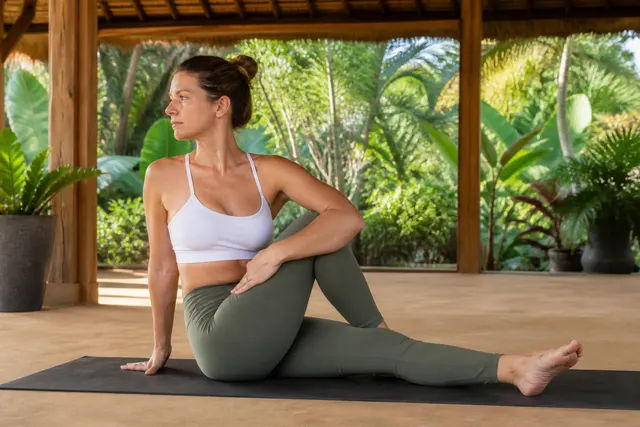
Quick Answer: Ardha Matsyendrasana (Half Lord of the Fishes Pose) is a seated spinal twist that improves digestion, relieves lower back stiffness, increases spinal mobility, and strengthens the core. It is one of the twelve basic Hatha yoga poses and appears in the Ashtanga primary series. Hold for 30–60 seconds per side, always practise both sides equally, and avoid if you have a herniated disc, recent abdominal surgery, or are in your second or third trimester of pregnancy.
At DivinePath Yoga School & Retreat, we teach Ardha Matsyendrasana as part of our 200-hour yoga teacher training in Goa, Bali, and Rishikesh. This guide covers how to do it safely, what it does for your body, who should avoid it, common mistakes, and how the half version differs from the full Matsyendrasana — written by teachers who practise and teach this pose daily.
| Pose Detail | Information |
|---|---|
| Sanskrit Name | Ardha Matsyendrasana |
| English Name | Half Lord of the Fishes Pose / Seated Spinal Twist |
| Pronunciation | ARE-dah MAT-see-en-DRAH-sah-nah |
| Level | Beginner to Intermediate |
| Type | Seated twist, stretching, strengthening |
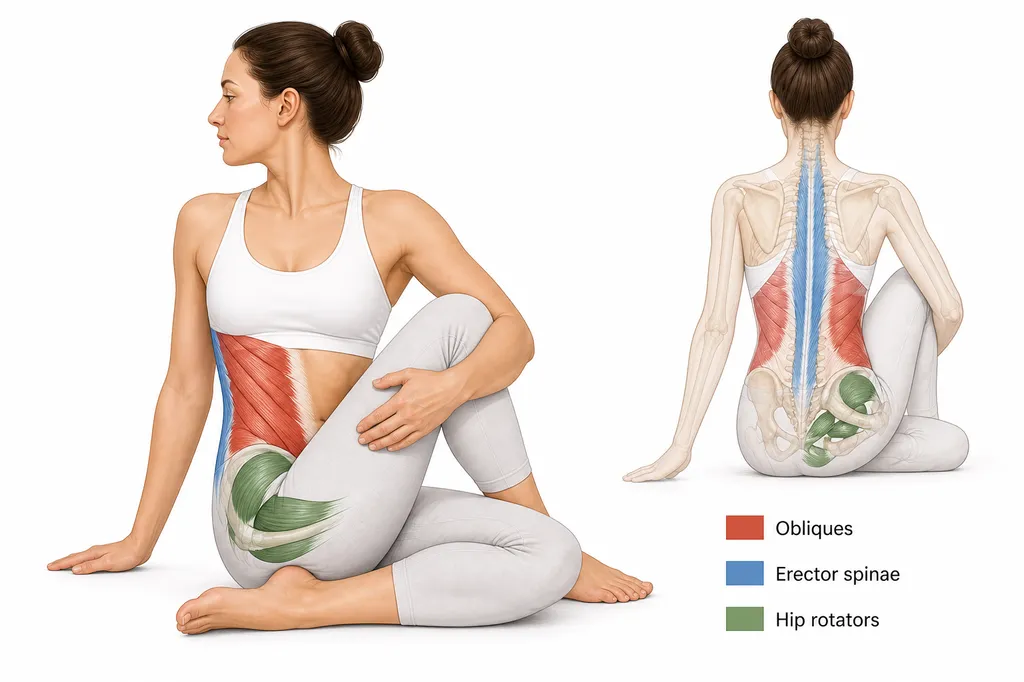
| Primary Muscles | Obliques, erector spinae, multifidus, quadratus lumborum, gluteus medius |
| Secondary Muscles | Piriformis, hip rotators, intercostals, rhomboids, deltoids |
| Hold Time | 30–60 seconds per side (5–8 breaths) |
| Appears In | Hatha Yoga (basic 12), Ashtanga Primary Series, Vinyasa, Iyengar |
| Chakra | Manipura (Solar Plexus) and Svadhisthana (Sacral) |
| Contraindications | Herniated disc, recent abdominal surgery, pregnancy (2nd/3rd trimester), severe sciatica, acute back injury |
Ardha Matsyendrasana is a seated twisting posture. You sit on the floor, cross one leg over the other, and rotate your upper body toward the raised knee. It looks simple. It is not. Done correctly, this twist engages your entire spine from the base to the neck, stretches muscles along your back and sides, compresses and releases your abdominal organs, and opens your shoulders and chest.
The pose is named after Matsyendranath, one of the founders of Hatha Yoga. According to yogic tradition, Matsyendranath received the knowledge of yoga while hidden inside the belly of a fish, listening to Lord Shiva teach his wife Parvati. The word “Ardha” means half — this is the accessible version of the full Matsyendrasana twist.
The name breaks down as follows: Ardha = half, Matsya = fish, Indra = ruler or lord, Asana = pose. In English, it is called Half Lord of the Fishes Pose. Some teachers also call it the seated spinal twist, though technically that is a broader category.
In the Ashtanga yoga system, Ardha Matsyendrasana appears in the primary series (the first of six sequential series). It is the ninth of the twelve basic poses in classical Hatha yoga as described in the Hatha Yoga Pradipika. This means it has been practised for centuries — not a modern invention designed for Instagram flexibility reels. See our full Ashtanga yoga asanas names list for where it sits in the sequence.
At DivinePath Yoga School & Retreat, we teach this pose during the seated sequence in Hatha and Ashtanga classes. Students in our Yoga Alliance-registered teacher training learn not just how to do it, but how to teach it safely — including how to adjust the pose for different body types, how to spot when someone is forcing the twist, and when to tell a student to stop.
Follow these instructions carefully. Rushing into a spinal twist without proper setup is how back injuries happen. If you are new to seated twists, start with Surya Namaskar to build a warm-up habit first.
Sit on the floor with both legs extended straight in front of you (Dandasana or Staff Pose). Sit up tall. If your lower back rounds when you sit with straight legs, place a folded blanket under your hips. This lifts your pelvis and takes pressure off your lumbar spine. At DivinePath, we always offer this prop to beginners — most people need it and there is zero shame in using it.
Take two or three calm breaths here. Ground your sitting bones into the floor. Lengthen your spine upward from the base. Feel the crown of your head reaching toward the ceiling. This is your neutral starting point.
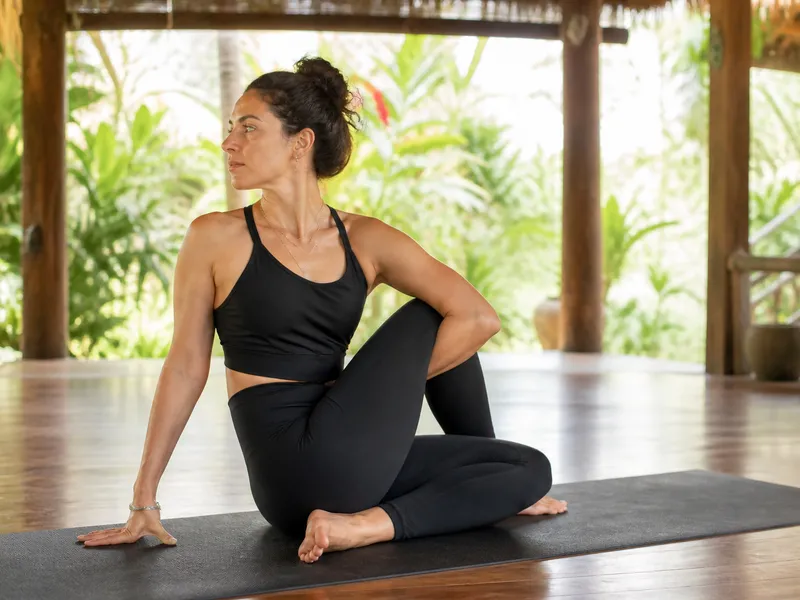
Bend your right knee and place your right foot flat on the floor outside your left thigh. Your right knee should point straight up toward the ceiling. Keep your right foot firmly planted — the entire sole touches the ground.
Now bend your left leg and slide your left foot toward your right hip. Your left heel should rest near (or touching) your right buttock. If this is uncomfortable on your left knee, keep your left leg straight on the floor instead. Forcing a knee into a position it does not want to be in is how you damage the meniscus. Listen to your body.
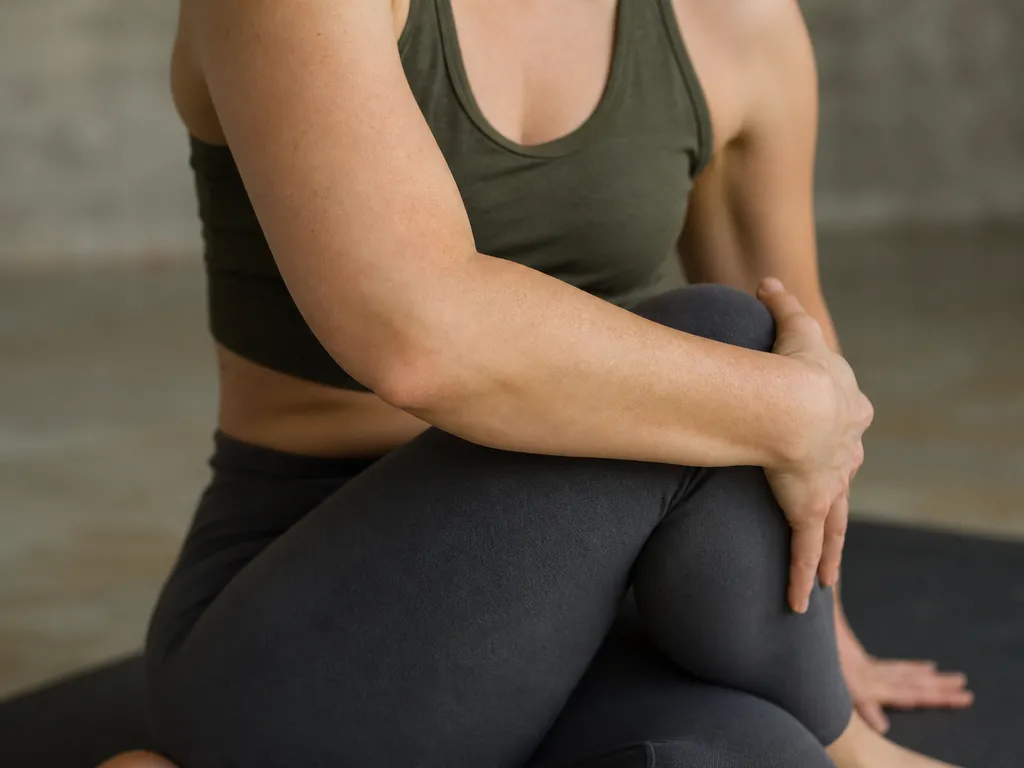
Inhale and lift both arms overhead to lengthen your spine one more time. On your exhale, begin to rotate your torso to the right. Place your left elbow on the outside of your right knee. Your right hand goes behind you on the floor, fingertips pointing away from your back.
The twist happens from the base of your spine upward. Do not start by cranking your neck to the right. Start by rotating your lower belly, then your ribcage, then your chest, then your shoulders, and finally turn your head to look over your right shoulder. This bottom-up sequence protects your lumbar vertebrae and distributes the rotation evenly across your entire spine.
Important: the elbow on the knee is a leverage point, not a crank. You are using your elbow to maintain the twist, not to force a deeper rotation. If you are shoving your elbow hard into your knee to twist further, you have gone too far. Back off slightly until the twist feels firm but not forced.
Breathing is the most underrated part of this pose. Once you are in the twist, inhale to lengthen your spine taller (imagine growing half an inch). Exhale to deepen the twist slightly — not by forcing, but by releasing tension that was holding your torso back. Each inhale creates space. Each exhale uses that space to rotate a little more.
Do not hold your breath. This is the single most common mistake. When the twist feels intense, your instinct is to clench your jaw and stop breathing. Fight that instinct. Steady, audible breathing is what makes the twist therapeutic. Without breath, it is just compression.
Breathe through your nose. Keep the breath smooth and controlled — no gasping, no sighing. If you are training in Ashtanga at DivinePath, your teacher may guide you toward Ujjayi breathing during this pose, but only once your basic breath is stable.
Hold Ardha Matsyendrasana for 30 to 60 seconds (approximately 5 to 8 slow breaths) on each side. In a classroom setting, most teachers hold it for about 45 seconds per side. In your personal practice, you can hold longer if the pose feels good and your breath remains steady.
While holding, check three things every few breaths: (1) Is your spine still tall, or have you collapsed forward? Re-lengthen on your next inhale. (2) Are both sitting bones still on the floor, or has one lifted? Ground down evenly. (3) Is your jaw clenched? Soften your face.
On an inhale, slowly unwind the twist. Bring your torso back to centre. Release your arms. Straighten both legs back into Dandasana. Sit quietly for two or three breaths.
Then repeat the entire sequence on the other side: left foot crosses over right thigh, right foot slides toward left hip, twist to the left. Always practise both sides equally. Twisting only to one side creates muscular imbalance over time.
This pose delivers a wide range of benefits because it simultaneously stretches, compresses, and strengthens different parts of your body. Here is what the research and our teaching experience support:
The twisting action compresses your abdominal organs on one side and stretches them on the other. This creates a squeeze-and-release effect on your stomach, intestines, liver, and kidneys. When you release the twist, fresh blood floods into these organs. This mechanical stimulation helps move food through your digestive tract and can relieve bloating and constipation. Many students at DivinePath Yoga School & Retreat report improved digestion within the first week of daily twisting practice.
The squeeze-and-release mechanism also applies to your liver, spleen, and kidneys. Compressing these organs pushes out stagnant blood and lymph fluid. Releasing the twist allows fresh, oxygenated blood to flow in. This is not a magical “detox” — your liver and kidneys handle detoxification on their own. But improving blood flow to these organs supports their natural function. Think of it as helping the cleaning crew rather than doing the cleaning yourself.
Sitting at a desk for 8 hours locks your lumbar spine into flexion (a rounded position). Ardha Matsyendrasana counteracts this by rotating the spine through its full range of lateral motion. The muscles along your spine (erector spinae, multifidus, quadratus lumborum) get stretched and mobilised. Regular practice can reduce chronic lower back stiffness and the dull ache that comes from prolonged sitting. Our anatomy teachers at DivinePath often recommend this pose specifically for students who work desk jobs.
Your spine is designed to flex, extend, laterally bend, and rotate. Most people only move through the first two (bending forward and backward). Ardha Matsyendrasana trains the rotation component. Over weeks and months of practice, you will notice increased ease when looking over your shoulder while driving, turning to reach something behind you, or performing any movement that requires torso rotation. This is functional flexibility — useful in daily life, not just on the yoga mat.
The twisting compresses blood vessels on one side of your body and opens them on the other. When you release, blood rushes into the previously compressed areas. This creates a flushing effect throughout your torso. Your abdominal organs, spinal muscles, and even your intercostal muscles (between the ribs) benefit from this increased circulation. Students who practise twists regularly often report feeling more energised after practice, which makes physiological sense — better circulation means more oxygen reaching your tissues.
Maintaining the twist requires sustained activation of your obliques (side abdominal muscles), transverse abdominis (deep core), and the small stabiliser muscles along your spine. This is not the crunching, six-pack kind of core work. It is deep, rotational core strength that stabilises your spine during everyday movements. For yoga teachers, understanding this is important — you can honestly tell your students that this pose strengthens their core without promising a flat stomach.
If you have never done this pose, here is what to expect and how to make it accessible:
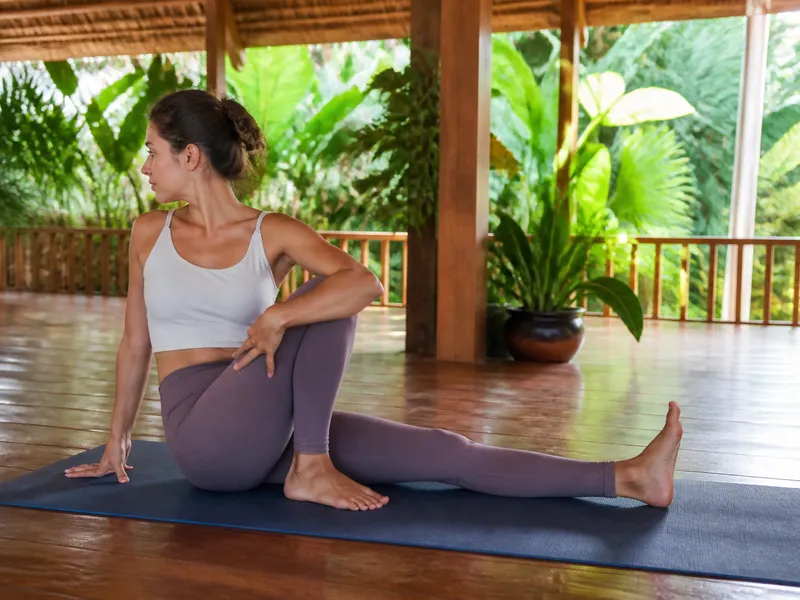
The goal is not to twist as far as possible. The goal is to twist as well as possible. A small, well-aligned twist with steady breathing is more beneficial than a deep, forced twist where you are holding your breath and your sitting bone has lifted off the floor. Tell your ego to sit down. It can twist when the body is ready.
Do not practise this pose if you have any of the following conditions without consulting a medical professional first:
If you are a yoga teacher, memorise these contraindications. In every class you teach, at least one person will have a condition on this list. Knowing when to modify and when to say “skip this pose” is what separates a safe teacher from a reckless one. At DivinePath, we dedicate significant training time to contraindication awareness for exactly this reason.
Students often ask what the difference is between the half and full versions. Here is the comparison:
| Feature | Ardha Matsyendrasana (Half) | Purna Matsyendrasana (Full) |
|---|---|---|
| Difficulty | Beginner to intermediate | Advanced |
| Spinal rotation | Moderate twist (~45–60 degrees) | Deep twist (~80–90 degrees) |
| Bottom leg | Folded under, heel near opposite hip | In full lotus (padmasana) position |
| Hip flexibility needed | Moderate | Very high (requires lotus) |
| Safe for beginners? | Yes, with modifications | No — risk of knee/hip injury |
| Taught in 200h YTT? | Yes — core pose in most curricula | Rarely — usually 300h or advanced only |
| Where in Ashtanga series? | Primary series (seated sequence) | Not in standard Ashtanga series |
The practical takeaway: Ardha Matsyendrasana is the version you will use in 99% of your teaching and personal practice. The full Matsyendrasana (Purna Matsyendrasana) requires lotus-level hip flexibility and extreme spinal rotation that takes years to develop safely. Most yoga classes worldwide teach the half version exclusively. At DivinePath, we teach Ardha Matsyendrasana in the 200-hour curriculum and only introduce the full version in advanced 300-hour training for students whose hips are ready.
You can learn this pose from a YouTube video. Plenty of people do. But here is what a video cannot give you:
Our 200-hour yoga teacher training covers this pose (and dozens of others) across Hatha, Ashtanga, and Vinyasa modules. Courses run in Goa (from $699 dorm or $500 course-only), Rishikesh (from $950 shared), and Bali Klungkung (from $1,450 shared). Read our Ashtanga vs Hatha comparison or the Goa beginners week-by-week guide to see how twists fit into a full training month.
Never jump straight into a deep spinal twist with a cold body. These preparatory poses warm up your spine, hips, and core:
In a typical class at DivinePath, Ardha Matsyendrasana comes toward the end of the seated sequence — after the spine has been warmed through forward folds, hip openers, and gentle twists. We never place it in the first 15 minutes of practice.
After twisting, your spine needs a neutral reset:
DivinePath's 200-hour YTT covers Ardha Matsyendrasana and dozens of other poses across Hatha and Ashtanga modules — hands-on alignment, contraindications, and teaching practice included.
Ardha Matsyendrasana is a seated spinal twist also known as Half Lord of the Fishes Pose. It involves sitting with one leg crossed over the other and rotating the torso toward the raised knee. It is one of the twelve basic Hatha yoga poses and appears in the Ashtanga primary series. The pose improves spinal mobility, aids digestion, relieves lower back stiffness, and strengthens the core. At DivinePath Yoga School & Retreat, it is a core part of our teacher training curriculum.
The main benefits include improved digestion through abdominal compression and release, relief from lower back stiffness, increased spinal flexibility and rotational range of motion, better blood circulation to internal organs, and core strengthening (obliques and deep stabilisers). It also opens the chest and shoulders, which counteracts the effects of prolonged sitting.
Yes. Ardha Matsyendrasana is safe for daily practice as long as you have no contraindications (disc issues, recent surgery, pregnancy). At DivinePath, students practise this pose 4 to 5 days per week during teacher training as part of the Hatha and Ashtanga sequences. Always practise both sides equally and never force the twist beyond comfortable depth.
Hold for 30 to 60 seconds per side, which is approximately 5 to 8 slow breaths. In a classroom setting, 45 seconds per side is standard. In personal practice, you can hold longer if the breath remains steady and the spine stays tall. Do not hold the pose if you are in pain or unable to breathe normally.
Yes, for chronic lower back stiffness caused by prolonged sitting or muscular tension. The spinal rotation stretches the erector spinae, quadratus lumborum, and multifidus muscles. However, it is NOT recommended for acute back injuries, herniated discs, or severe sciatica without medical clearance. If your back pain is sharp, sudden, or radiates down your leg, see a doctor before doing any spinal twists.
One of the Best Yoga Teacher Training Courses & Retreats in India & Indonesia.
 Yoga Alliance RYS 200
School ID 457520
Verify registration →
Yoga Alliance RYS 200
School ID 457520
Verify registration →
Divinepath Yoga School & Retreat © 2026. All Rights Reserved.