



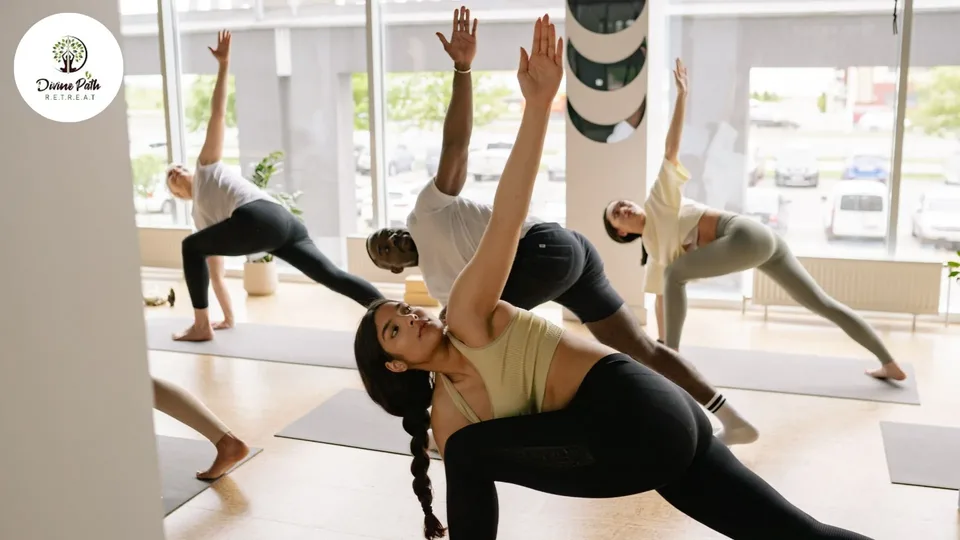
Quick answer: The Ashtanga Yoga asanas are practiced in a fixed order: opening sun salutations, standing postures, seated Primary Series poses, backbends, finishing postures, and savasana. Beginners usually start with Surya Namaskara A/B, Trikonasana, Paschimottanasana, and Marichyasana A before moving into deeper Primary Series work.
Ashtanga Yoga is often described as a flow of breath, ideas, and physical movement—a journey that leads from the body to the soul. The structured sequence of postures known as the Ashtanga Yoga Asanas Names refines both physical and mental states, becoming a powerful tool for transformation.
At Divinepath Yoga School & Retreat, these sacred asanas are taught with precision, especially in our 200-hour Yoga Teacher Training in Rishikesh, enabling students to embody the spiritual and physical strength Ashtanga offers. Understanding these postures is a vital step for those aiming to deepen their practice or become certified yoga teachers.
More than a mere list, these asanas represent a journey of spiritual evolution. Developed by K. Pattabhi Jois, Ashtanga Vinyasa Yoga Teacher Training features six progressive series linked by breath (vinyasa) and gaze (drishti). The Primary Series—Yoga Chikitsa—focuses on detoxification, strength, and discipline.
Learning these names fosters independence, flow, and meditative practice. At Divinepath Yoga School & Retreat, students also learn pose alignment, benefits, modifications, and pronunciation—essential skills for teacher training graduates.
Curious about how much this journey might cost? Explore our yoga teacher training cost guide and compare 200-hour, 300-hour, and 500-hour YTT options before choosing a course.
The complete system entails over 70 postures spread across six series. The Primary Series alone contains about 41 postures, including opening and finishing sequences that help develop strength, flexibility, and focus.
Beginners typically start with Surya Namaskara A & B and foundational standing postures like Trikonasana. Seated poses such as Paschimottanasana A are also included, helping new practitioners build the necessary strength, flexibility, and awareness for deeper practices.
The Primary Series, known as Yoga Chikitsa, includes key postures such as Janu Sirsasana A–C, Marichyasana A–D, Bhujapidasana, Supta Kurmasana, and Setu Bandhasana. These poses are designed to detoxify the body and align the musculoskeletal system.
Yes, the Ashtanga Yoga Asanas follow a strict sequence: Opening Poses, Standing Sequence, Primary Series (Seated Poses), Backbends, and the Finishing Sequence. Each posture is crafted to prepare the body and mind for the next stage of the series.
Not exactly. While both styles coordinate movement with breath, Ashtanga Vinyasa Yoga follows a set series of poses. In contrast, Vinyasa Yoga offers more flexibility in sequencing, allowing instructors to modify the flow based on the class. Ashtanga is more traditional and disciplined.
Deepen asana knowledge on a retreat or 200-hour YTT in North Goa.