




Goa
Book a dry-season batch
November, February and March are the sweet spot — before peak pricing, after the rains.
Goa 200-hour →
We run courses at four campuses in two countries, every month of the year. That means we have no reason to steer you toward a particular month — if Goa is wrong for you in July, Rishikesh or Bali probably is not, and we would rather you came to the right one than the nearest one.
So this is the month-by-month version, with real numbers: what the weather actually does, when the crowds arrive, and the two months when one of our campuses costs more and offers fewer rooms. For how a training day feels once you arrive, see what a YTT day looks like. For every fee tier, see what yoga teacher training costs.
| Campus | Best months | Workable | Hardest |
|---|---|---|---|
| Goa (Arambol) | November · February · March | October, April, December, January | June – September (monsoon) |
| Rishikesh (Tapovan) | October · November · March | February, April, September | May – June (heat), July – August (rain) |
| Bali (Klungkung & Ubud) | May – September | April, October | December – February (wettest) |
If you can travel any month: come to Goa in November or February, Rishikesh in October or November, Bali in June through August.
If your dates are fixed, skip to If your dates are fixed — there is a campus that works in every month of the year, which is the advantage of running four of them.
Goa has the most extreme year of the three. It is also the only campus where the month changes what you pay. Climate figures below are from Climates to Travel; rainfall is the monthly average.
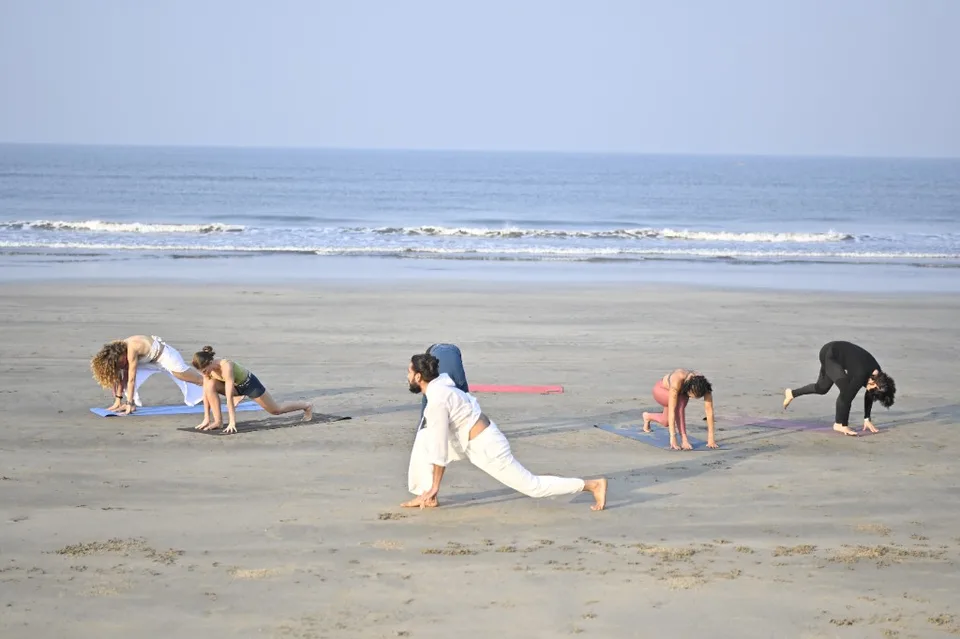
The monsoon runs from late May to early or mid October. Temperatures barely fall — it is the rain, not the heat, that defines it. We still teach through those months. North Goa’s beach infrastructure largely does not.
| Month | Low – High | Rain | What it is like |
|---|---|---|---|
| Nov | 22 – 33°C | very low | The best month. Dry, everything open, post-monsoon green still there |
| Dec | 21 – 32°C | 0 mm | Excellent weather, peak crowds, peak prices |
| Jan | 20 – 32°C | 0 mm | Excellent weather, peak crowds, peak prices |
| Feb | 21 – 32°C | 0 mm | The other best month. Dry, warm, thinner crowds than December |
| Mar | 23 – 32°C | low | Very good. Warming through the month |
| Apr | 26 – 33°C | low | Hot and humid. Practice is harder |
| May | 26 – 33°C | rising | Hot, then the monsoon arrives late in the month |
| Jun | 25 – 30°C | 870 mm | Peak monsoon. Heavy daily rain, rough sea |
| Jul | 24 – 29°C | 995 mm | The wettest month of the Goan year. Nearly a metre of rain |
| Aug | 24 – 29°C | 515 mm | Still very wet, easing |
| Sep | 24 – 30°C | 250 mm | Clearing. The second half is much better than the first |
| Oct | 24 – 32°C | low | Reopening unevenly. Late October is close to full season |
This is the part that catches people out, and it applies to no other campus we run. Full fee tables live on the YTT cost guide and each course page.
December and January are peak season in Goa. Three things change:
| Tier | Rest of the year | December & January |
|---|---|---|
| 100-hour, shared cottage | $649 | $849 |
| 100-hour, private cottage | $749 | $999 |
| 200-hour, dorm | $699 | $799 |
| 200-hour, shared room | $850 | Not offered |
| 200-hour, private room | $999 | Not offered |
| 200-hour, shared cottage | $1,050 | $1,200 |
| 200-hour, private cottage | $1,250 | $1,800 |
In December and January the 200-hour still runs course-only, dorm, and cottages — but the mid room tiers are not offered. If you want a standard private room (not a cottage) in Goa, those two months are the wrong window.
The start dates move too. Most months begin on the 1st. The January 200-hour runs the 5th to the 26th, and the January 100-hour runs the 10th to the 21st. Check the date before you book a flight on the Goa 200-hour or 100-hour booking table.
Why: accommodation in North Goa costs us more across New Year, when the whole north coast is full. The course is identical — same teachers, same hours, same certificate. Rishikesh, Klungkung and Ubud hold one price all year.
What to do about it: if your dates are flexible, come in February, March or November instead. Same course, often $150–$550 less depending on the room, and more room types available. More on the season in our yoga in Goa guide.
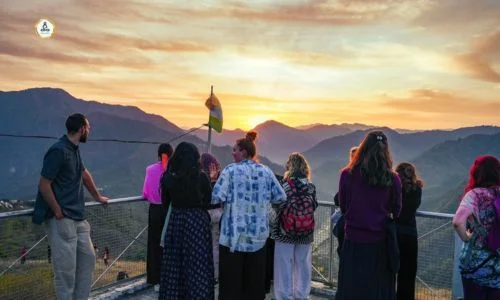
A completely different calendar, because Rishikesh sits in the Himalayan foothills rather than on a beach. Climate figures from Weather Atlas.
Bring more warm clothing than the numbers suggest for December through February. Buildings here are not heated and stone floors hold the cold. A 19°C afternoon and a 6°C dawn are the same day.
| Month | Low – High | Rain | What it is like |
|---|---|---|---|
| Jan | 6 – 19°C | low | Cold mornings. A 6am practice in an unheated hall is a real commitment |
| Feb | rising | low | Warming, good, still cool at dawn |
| Mar | mild | low | Very good. Warm days, cool nights |
| Apr | warm | low | Good, warming fast. Char Dham season begins |
| May | 24 – 36°C | 42 mm | Hot. Afternoons are for lying down |
| Jun | 24 – 36°C | rising | Hot, then the rain arrives |
| Jul | 24 – 32°C | 444 mm | Wettest month. Landslides can close mountain roads |
| Aug | 24 – 32°C | 399 mm | Still very wet |
| Sep | easing | easing | Clearing. Good by late September |
| Oct | 17 – 30°C | 54 mm | Excellent. Warm days, cool nights, the river running clear |
| Nov | 10 – 25°C | 10 mm | The driest month of the year. Cold mornings, beautiful days |
| Dec | 7 – 21°C | 30 mm | Cold early. Quiet, cheap, clear |

Rishikesh is the gateway to the four Himalayan shrines, and the pilgrimage season runs from roughly late April or early May until October or November. The town becomes a transit hub — traffic, full hotels, queues. It does not affect your classes. It very much affects your walk to them.
During the month of Shravan, usually falling in July or August, millions of pilgrims walk to Haridwar and Rishikesh to collect Ganga water. Roads are closed or rerouted and travel in and out becomes difficult for a stretch of weeks. It is extraordinary to witness and a genuinely difficult time to arrive without knowing about it.
Both shift each year with the Hindu calendar, so check the current year’s Char Dham opening (tied to Akshaya Tritiya) and the Shravan window for Kanwar Yatra before booking anything in those windows. More context in our yoga in Rishikesh guide.
The most stable climate of the three. Temperature barely moves all year — between about 23.5°C and 31.7°C every single month. What changes is the rain. Climate figures from Climates to Travel.
Wet season does not mean washed out. It usually means heavy afternoon downpours rather than all-day rain, and the mornings — when you practise — are often clear. It does mean humidity, mud on village roads, and a shala that gets loud under heavy rain.

| Period | Rain | What it is like |
|---|---|---|
| Apr – Oct | under 100 mm/month | Dry season. The best stretch, and the most popular |
| Nov | rising | Wet season starting |
| Dec | 290 mm | Wet |
| Jan | 350 mm | Wettest month of the year |
| Feb | 280 mm | Wet |
| Mar | easing | Wet season ending |
Klungkung and Ubud differ slightly. Both sit inland in the south, which averages around 1,700mm a year. Ubud is a town with pavements and covered walkways, so an afternoon downpour is mostly a timing problem. Klungkung is a village campus — wet-season scooter trips and muddy lanes matter more if you are moving around between sessions. Morning practice usually still happens; heavy rain is louder on a shala roof than it is a cancellation. If monsoon timing is your main worry, ask admissions what the current campus feels like in your month.
We run every month at every campus. That is not the same as recommending every month.
The advantage of running four campuses is that there is a good answer in every month. Side-by-side location context: Rishikesh vs Goa vs Bali.
| If you can only travel in… | Go to |
|---|---|
| January | Bali (warm, though wettest) or Goa (excellent weather — budget for peak pricing and dorm/cottage tiers) |
| February | Goa — one of its two best months |
| March | Goa or Rishikesh — both very good |
| April | Rishikesh or Bali — dry season starting in Bali |
| May | Bali — dry season |
| June | Bali — dry season, and the one clearly right answer this month |
| July | Bali |
| August | Bali |
| September | Bali, or Rishikesh late in the month |
| October | Rishikesh — its best month |
| November | Goa or Rishikesh — the best month of the year at both |
| December | Goa (peak pricing) or Rishikesh (cold mornings, quiet, one price all year) |
No. All four campuses run every month. Most intakes start on the 1st. The January Goa intakes are the exception — the 200-hour starts on the 5th and the 100-hour on the 10th.
No. Same syllabus, same hours, same teachers, same certificate. What changes is what you do on your day off.
Only in Goa, and only in the sense that December and January cost more. The other ten months are one price, and Rishikesh, Klungkung and Ubud are one price all year. See the seasonal table on the cost guide.
Bali — it sits between roughly 24°C and 31°C every month of the year. Goa is warm too. Rishikesh is not.
Batches cap at about 10–15 students. December, January and the October–November Rishikesh window fill first.
November, February and March are the sweet spot — before peak pricing, after the rains.
Goa 200-hour →
Warm days, cool nights, clear river — the month most people wish they had booked.
Rishikesh 200-hour →
The clearest answer if your dates fall in the Indian monsoon.
Bali 200-hour →Written by Amit Rana, founder, Divinepath Yoga School & Retreat. Prices and dates checked 16 September 2026. Climate data: Climates to Travel and Weather Atlas. Course pages carry the authoritative offers — this page illustrates seasonal timing only.

One of the Best Yoga Teacher Training Courses & Retreats in India & Indonesia.
 Yoga Alliance RYS 200
School ID 457520
Verify registration →
Yoga Alliance RYS 200
School ID 457520
Verify registration →
Divinepath Yoga School & Retreat © 2026. All Rights Reserved.