200 Hour Yoga Teacher Training Rishikesh Cost
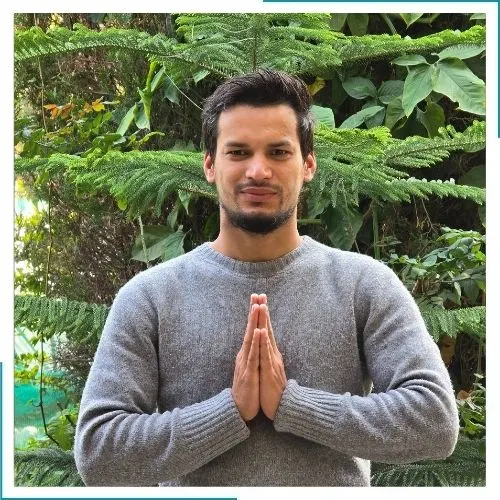
 Yogi Naveen Ji
Quick answer: 200 hour yoga teacher training Rishikesh cost ranges from $599 to $2,750. Most shared-room packages sit between $900 and $1,500 with meals. DivinePath: $950 shared / $1,300 private for 25 days, three meals, and Dehradun airport pickup. Yoga Alliance registration is extra — $115 the first year.
The 200 hour yoga teacher training Rishikesh cost sits between $599 and $2,750 right now. I'm Yogi Naveen Ji — I teach Ashtanga and alignment at DivinePath Yoga School & Retreat here in Rishikesh, and I've watched students pay everywhere in that range. Some got exactly what they paid for. Others didn't.
That spread exists because schools bundle different things into the fee. A $950 package with meals, accommodation, and airport pickup isn't the same product as a $649 listing where you're paying for your room and dinner separately. But you can't tell that from the headline price on a website.
I'll break down what these fees actually include at different price points, show you our own pricing with nothing hidden, and give you a way to calculate your real total cost — flights, visa, spending money, all of it — before you send anyone a deposit.
How Much Does a 200-Hour Yoga Teacher Training in Rishikesh Cost?
I checked published pricing for seven schools in Rishikesh in October 2026. Most shared-room packages land between $900 and $1,500. Private rooms add $200–$700 on top of that.
The table below shows what each school publishes. I've used the most commonly advertised shared-room price — some schools list multiple sharing options (triple, twin, dorm), so I picked the one they feature most prominently.
| School | Shared Room | Private Room | Duration | Meals Included? |
|---|---|---|---|---|
| DivinePath Yoga School | $950 | $1,300 | 25 days | Yes — 3 per day |
| Ekam Yogashala | $999 (3-share) | $1,449 | 23–24 days | Yes — 3 per day |
| Samadhi Yoga Ashram | $990 (6-share) | $1,690 | 25 days | Not confirmed on site |
| Vinyasa Yoga Academy | $1,390 | $1,690 | 25 days | Not confirmed on site |
| Rishikul Yogshala | ~$1,200 | ~$1,350 | ~23 days | Yes — 3 per day |
| Rishikesh Yogpeeth | ~$2,100 | ~$2,750 | 21 days | Yes |
| Sattva Yoga Academy | ~$2,100 | ~$2,550 | 23 days | Yes |
"Not confirmed on site" means the school's page didn't state clearly whether meals were part of the fee. It doesn't mean they're excluded — it means I couldn't verify it from what was published. Confirm with the school directly.
You'll also see prices as low as $549–$649 from a few schools. Those usually apply to a dorm bed in a 4–6 person room, or they're an early-bird promotional rate. The price on the website and the price you actually pay aren't always the same, so get the final number in writing before transferring money.
What's Included in 200 Hour Yoga Teacher Training Rishikesh Fees?
I had a student last year who booked a $649 programme at another school, then messaged me two weeks later asking if she could switch. Meals weren't included. She was spending $12–15 a day eating out, and by day ten she'd already spent more than the $300 difference between that school and ours. That's why this section matters more than the price table above.
What $900–$1,500 Programmes Typically Cover
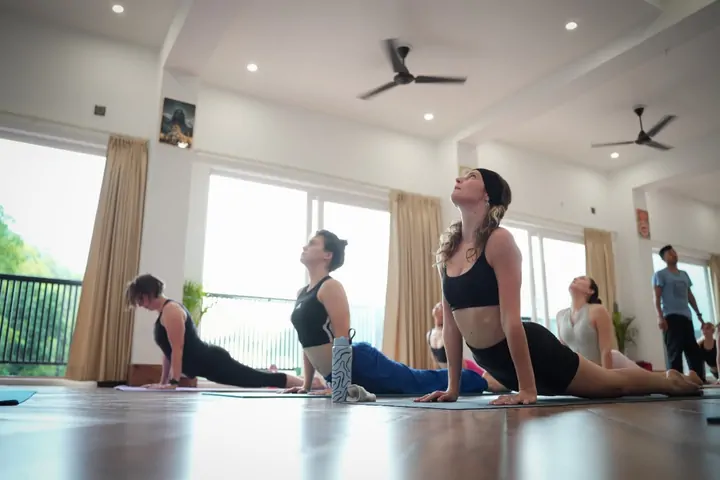
In this price range — where most Rishikesh 200-hour courses sit — the fee usually covers tuition (all 200 contact hours), a shared or private room for the course duration (21–28 nights depending on the school), and three vegetarian meals a day. You'll also get a course manual or textbook and a completion certificate from the school.
One thing students often miss: the certificate from your school and Yoga Alliance registration are two separate things. Your school gives you a certificate for completing the 200 hours. If you want to list yourself as RYT 200 on Yoga Alliance's directory, you apply and pay Yoga Alliance directly — $115 for the first year. The school certificate is included in your course fee. The Yoga Alliance registration isn't.
Extras That Vary Between Schools
Airport pickup is the big one. Getting from Dehradun Airport to Rishikesh costs $10–15 by taxi, and a few schools charge $25–40 for an arranged pickup. We include it free. Other schools don't mention it until you ask.
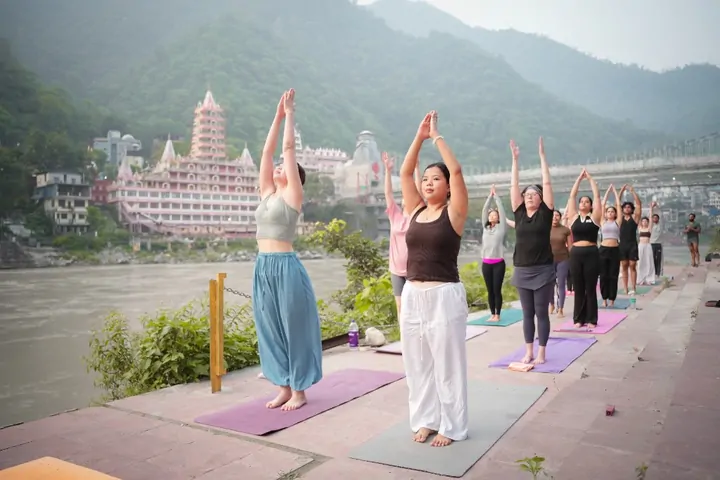
Weekend excursions are similar — some schools take students to waterfalls, temples, or Ganga Aarti as part of the programme. Others charge separately or don't organise them at all. Yoga props (mats, blocks, straps) are provided during class at almost every school, but only a few let you keep the mat. A couple of schools include a shatkarma cleansing kit with a neti pot and rubber cord. Nice touch, but it shouldn't drive your decision.
What's Almost Never Included
Regardless of what you pay for the course, these costs are on you: international flights to Delhi or Dehradun, your Indian visa, travel insurance, laundry, and personal spending. I'll get into the actual numbers for each of these further down.
What Our 200-Hour Programme Costs
Our 200-hour YTT in Rishikesh runs 25 days, starting the 1st of every month. I'll lay this out completely so you know exactly what you're paying and what you're not.
| Room Type | Fee (USD) | Deposit (25%) |
|---|---|---|
| Shared cottage | $950 | $238 |
| Private cottage | $1,300 | $325 |
Indian residents pay ₹40,000 (shared) or ₹50,000 (private). If you're not sure which currency applies, ask our admissions team — it depends on your passport and payment method.
Book six months or more in advance and you get 5% off. That brings the shared room to about $903 and private to $1,235. We limit early-bird seats per batch, so it's first-come.
Both packages include the full programme in Ashtanga and Vinyasa, daily pranayama and meditation, mantra chanting, shatkarma practices, your room with attached bathroom, three sattvic vegetarian meals daily (no onion, no garlic), course materials, a weekend excursion, free airport pickup from Dehradun, and your RYS 200 certificate.
We cap batches at 15 students. In quieter months we've run with 8 or 9, which is a different experience entirely — I can spend real time watching each student teach, correcting their cues, fixing their sequencing. That doesn't happen in a room of 30.
You don't pay for: flights, visa, insurance, laundry, personal spending. Our cancellation policy gives you a full refund if you cancel more than 30 days before your start date. Inside 30 days, the deposit stays with us. You can change your date once, free, up to 7 days before the course begins.
How Your Room Choice Changes the Price
Room type is the single biggest variable in your course fee. At most schools, upgrading from shared to private adds $200–$700 to the total.
I'll be honest: if you're on a budget, take the shared room. You'll spend maybe 7 hours a day in that room — sleeping and some evening reading. The rest of your time is in class, at meals, or on the campus. A few students tell me they chose private because they're introverts who need space to recharge, and I understand that. But the shared cottage has given most of our students a built-in training partner for the month. That's worth something too.
What's worth checking before you book your room:
Hot water matters in winter. Rishikesh gets cold from December to February, and not every budget school has electric geysers. Some rely on solar heating, which runs out by evening. Ask.
"Attached bathroom" means different things to different schools. Some advertise a private room where the bathroom is technically shared with the room next door. Ask whether the bathroom door is inside your room.
On-campus vs. off-campus rooms: some schools house students in partner guesthouses across the road or down the street. That works fine in October. During monsoon or summer heat, a daily walk to class gets old fast.
Check-in and check-out timing also catches people off guard. At our school, check-in is 10 AM on day 1 and checkout is noon on day 25. If you're arriving the night before, you'll need to arrange one night at a local guesthouse ($8–20) unless your school explicitly includes the pre-course night.
What You'll Spend Beyond the Course Fee
Your tuition covers 25 days of training, food, and a bed. Getting to Rishikesh and living like a human while you're here — that's on your wallet. I'll walk through each cost using real numbers.
Flights
Rishikesh doesn't have a commercial airport. You'll fly into either Dehradun Jolly Grant (DED) — 35 km away — or Delhi (DEL) — about 250 km.
From Europe, round-trip tickets to Delhi usually run $400–$900. From the US, $700–$1,300. Southeast Asia and Australia, $200–$600. If you fly into Delhi, a domestic flight to Dehradun adds $50–$100 one way, or you can take a bus or train for $5–25. Booking 2–3 months ahead and flying in shoulder season (February–March or September–October) usually saves you $100–$200 on the airfare.
Visa
The Indian e-Tourist Visa costs about $25 for 30 days (single entry) or $40 for a one-year multiple entry. You apply online at indianvisaonline.gov.in and it takes 3–5 business days. A 30-day visa covers a 25-day course, but I'd recommend some buffer — flight delays happen, and overstaying an Indian visa creates real problems.
Travel Insurance
I'd get it. Basic medical and trip-cancellation coverage runs $40–$100 for a month. World Nomads and SafetyWing are the ones I see our students using most. Make sure whatever you buy specifically covers India and includes medical evacuation — the nearest large hospital is in Dehradun, and if something serious happens, you want to know you can get there without a $3,000 ambulance bill.
Getting From Delhi to Rishikesh
If you land in Delhi, you have four options. A government or private bus from ISBT costs $5–10 and takes 6–7 hours. A train to Haridwar ($5–15 depending on class) takes about 5 hours, then a 30-minute taxi ($5) finishes the trip. A private car from Delhi airport runs $80–$120 and takes 5–7 hours depending on traffic. Or you book a connecting domestic flight to Dehradun ($50–$100), then a 45-minute taxi ($10–15).
Most of our European students take the bus or train. Most Americans and Australians either fly to Dehradun or hire a private car. There's no right answer — it depends on how much you value sleep over savings.
Personal Spending
Rishikesh is cheap. Chai is 10–20 rupees ($0.12–$0.25). A meal at a local restaurant is $2–4. Most students spend $100–$250 over the full 25 days on things like a SIM card ($5–10), laundry ($15–20 for the month), weekend activities like rafting ($5–15), and whatever shopping catches their eye in Laxman Jhula.
Yoga Alliance Registration
Optional. After your 200-hour course, you can register as RYT 200 through Yoga Alliance's website. First-year cost: $50 application fee + $65 annual membership = $115. You don't need this to teach. But some studios and hiring managers ask for it, so it depends on your career plans.
Putting It All Together: What You'll Actually Pay
I've seen enough booking enquiries to know what a typical total looks like. Two scenarios:
| Expense | Budget (Europe) | Comfortable (US) |
|---|---|---|
| Course fee (shared room) | $950 | $950 |
| Upgrade to private room | — | + $350 |
| Flights (round-trip to Delhi) | $500 | $900 |
| Delhi to Rishikesh | $10 (bus) | $90 (taxi) |
| Visa | $25 | $25 |
| Travel insurance | $50 | $80 |
| Personal spending (25 days) | $120 | $200 |
| Yoga Alliance (optional) | $115 | $115 |
| TOTAL (without YA) | ~$1,655 | ~$2,595 |
| TOTAL (with YA) | ~$1,770 | ~$2,710 |
The budget column is a real student: flew Wizz Air to Delhi, took the overnight bus, shared room, spent modestly, skipped Yoga Alliance. The comfortable column is also a real student: flew from New York, took a private car, wanted a private room, ate out on rest days. Your number will fall somewhere in between depending on where you're flying from and how you like to travel.
If you're already in India or flying from Southeast Asia, that flight cost drops to $200 or less, and your total could land under $1,400.
How to Compare 200-Hour YTT Fees Without Getting Misled
I've talked to students who picked a school purely because it was $150 cheaper than ours. Some were happy. A few weren't — because that $150 difference disappeared once they paid for meals, bought their own materials, and covered a taxi from the airport.
If you're comparing two or three schools, run through these questions before deciding:
How many days does the course actually run? A $1,200 fee for 21 days works out to $57 per day. Our $950 fee for 25 days is $38 per day. Per-day cost tells you more than the headline number.
Are meals included on rest days and weekends? This one catches people. Some schools serve three meals daily during the week but nothing on Sundays.
What's the maximum batch size? A $1,500 course with 30 students is a lecture. A $950 course with 12 students is mentorship. Ask for the number, in writing.
How much practice teaching is built in? Yoga Alliance requires it, but "some" could mean 10 hours or 25 hours. If you want to teach after the course, this matters more than almost anything else on the syllabus.
Get the deposit terms, refund policy, and balance-due date in writing before you transfer money. A school that can't send you a one-page fee breakdown probably can't send you a refund either.
And ask directly: are there any additional charges for the certificate, exams, course materials, excursions, or airport transfer? I've heard of schools adding ₹2,000–5,000 in fees that weren't on their website.
Is a $2,500 Programme Actually Better Than a $950 One?
Not necessarily. I'm biased — we charge $950 — but I've also seen what the $2,500 schools offer, and in many cases the difference isn't in the teaching. It's in the room.
A $2,500 programme often gets you a private AC room, a campus that looks like a boutique hotel, maybe a pool, better-quality meals with more variety, and sometimes a guest teacher flown in for a weekend workshop. Those are genuine comforts. They make the experience more pleasant. They don't make you a better yoga teacher.
On the other end, a $600 programme might cut corners you'll notice: basic dormitory bunks, fewer meals, larger class sizes, less experienced instructors covering the same material with less depth. The curriculum on paper might look identical to a $1,500 school's because they all have to match the Yoga Alliance hour breakdown — but there's a real difference between "30 hours of anatomy" taught by a physiotherapist and "30 hours of anatomy" taught by a yoga teacher reading slides.
My honest advice: prioritise the teaching over the campus. Ask who the lead teacher is, how long they've been teaching, what their lineage is, how many practice-teaching sessions you'll lead, and how feedback is given. Those answers tell you more than the brochure photos. Reviews from recent graduates help too, but be specific — ask them about the teaching quality, not the food.
Pricing Red Flags I've Seen in Rishikesh
A few patterns that should slow you down:
Full packages under $500. At that price, something's either subsidised, cut, or the real cost shows up later in hidden charges. It might be a perfectly good programme. But get a complete written breakdown before you pay.
"50% OFF — Limited Time!" that's been running for three years. If the discounted price never changes, it's the real price. The original number is marketing. Don't let fake urgency rush you.
No pricing on the website at all. You have to email or WhatsApp for a quote. Transparent schools publish their fees. When pricing is hidden, it sometimes means the number changes depending on who's asking.
Schools that demand 100% payment six months in advance with no refund policy. A 20–30% deposit is standard. Full payment with no cancellation terms puts all the risk on you.
And watch for very large batch sizes — 30+ students in a 200-hour course. At that number, individual corrections and practice-teaching feedback become thin. If the school won't tell you their batch cap in writing, that's its own answer.
Frequently Asked Questions About 200-Hour TTC Fees in Rishikesh
What is the average cost of a 200-hour yoga teacher training course in Rishikesh?
I checked seven schools in October 2026. Shared-room packages ranged from $599 to $2,750. Most fall between $900 and $1,500 with accommodation and meals included. The spread comes down to room type, campus quality, batch size, and what's bundled in. There's no single "average" because a $990 dorm bed and a $2,100 private suite aren't the same product.
What are the 200 hour yoga teacher training Rishikesh fees at DivinePath?
$950 for a shared cottage, $1,300 for a private cottage. That covers 25 days of training, three meals daily, your room, course materials, a weekend outing, Dehradun airport pickup, and your RYS 200 certificate. Indian residents: ₹40,000 shared or ₹50,000 private. Book six months ahead for 5% off.
Does the fee include accommodation and meals?
At most schools charging $900+, yes — accommodation and three vegetarian meals daily are included. Below $700, it gets inconsistent. Some include a dorm bed but not meals. Others include meals but put you in a partner guesthouse off-campus. Always ask specifically what the published price covers.
Is the private room upgrade worth the extra cost?
Depends on you. The price difference is typically $200–$700. At our school it's $350. Most of your day is spent in class, at meals, or on campus — you'll be in the room for sleeping and a couple of hours of reading. If you need quiet time alone to recharge, a private room helps. If you're fine sharing space with a training partner, the shared room saves money you could spend on flights or extending your trip.
Are there certification or registration fees on top of the course fee?
The school's own certificate is included in your course fee. Yoga Alliance registration — which lets you list as RYT 200 on their directory — is separate. You pay them directly: $50 application + $65 annual membership = $115 first year. It's optional. You can teach without it.
What hidden costs should I watch for?
Airport pickup charges ($15–$40), separate fees for course materials or the certificate, exam fees, meals not included on rest days, and off-campus accommodation that requires daily transport. Ask the school for a complete fee breakdown before booking. If they can't provide one, that tells you something.
When is the cheapest time to do a 200-hour YTT in Rishikesh?
Monsoon months (July–August) and peak summer (May–June) are quieter, and some schools discount rates to fill seats. Flights to India are cheaper in shoulder season (February–March, September–October). Combining a quieter month with an early-bird booking can save you $100–$200 on the total.
For a broader look at pricing across all course durations — 100h, 200h, 300h, and 500h — see our guide on yoga teacher training in Rishikesh costs.