



Struggling with yoga poses? You're not alone. This guide covers the 5 most common mistakes beginners make—from holding your breath to locking your joints—and offers simple, actionable fixes to make your practice safer and more enjoyable.
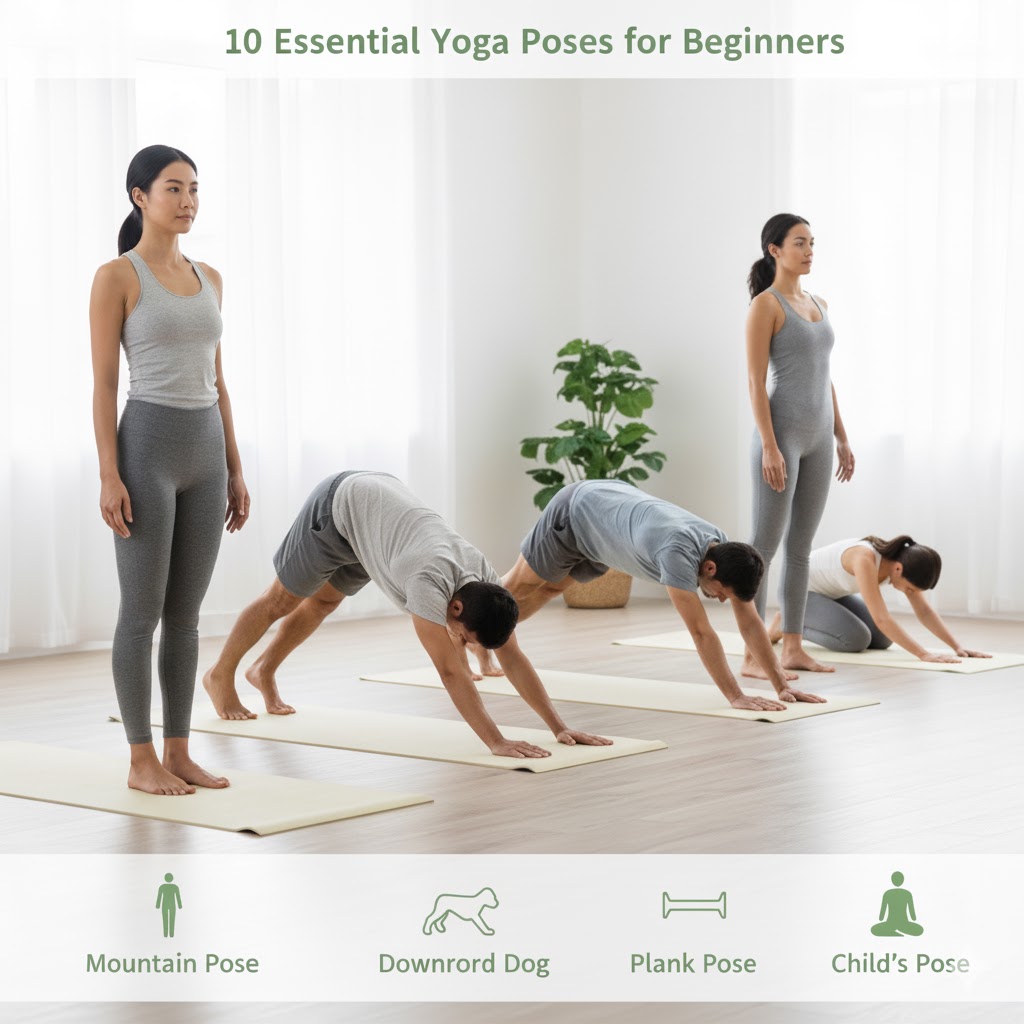
So, congratulations, in case you are new to the field of yoga. That’s the hardest part. You were likely already introduced to our Top 10 Basic Yoga Poses Every Beginner Should Learn guide, and as you are getting used to your steps (figuratively) in the Downward-Facing Dog and Warrior II.
However, the point is that it happens that those poses are not always amazing but can be awkward, right?
We are all of us there—including your super-bendy instructors. It is absolutely natural to do something wrong in yoga, particularly when you are a beginner. It's how we learn and grow! For comprehensive guidance on your journey, check out our Ultimate Yoga in Goa Guide.
Today we will discuss the most frequent yoga errors all the beginners commit and, more crucially, provide you with easy and friendly remedies. Consider it a cheat sheet that you have been taught to use to make your practice safer, more effective, and far more enjoyable. We shall make those little slip-ups giant breakthroughs!
We will adopt a basic problem-solution framework. In the case of each yoga beginner mistake, we will examine what it entails, the reason why it occurs, and how we can simply rectify it.
What It Is: This is the first mistake in yoga among beginners. Either you hold your breath, or breathe too fast, or your breathing does not keep up with the movement (e.g., when you are moving into a deep position, hold the breath).
Why It Happens: When we are experiencing an intense concentration on our body and the form of the position, we forget the breathing aspect of it! When things become a struggle, we are prone to fall back to our fight-or-flight breathing styles: shallow and rapid.
The breath is the yoga. Begin by making your breaths deep and smooth (Ujjayi Breath is good with this!). The golden rule is inhale to lengthen or prepare, and exhale to deepen, twist, or fold.
The Fix: Get it into your mind that you will experience the breath before you experience the stretch. Should you notice that you are holding your breath, stop the pose, re-establish your breath, and then resume the position again. It is to keep in mind that once you cannot breathe easily, you have gone too far!
What It Is: This is one of the primary yoga pose errors and corrections. It is bending your knees or arms forward until they straighten back, which is usually done in standing poses (such as Triangle) or arm supports (such as Plank).
Why It Happens: This commonly occurs to naturally very flexible individuals (hypermobile) or those who consider straight to be locked. Joint locking places the ligaments and cartilage in a state of strain, instead of leaving the muscles to work.
Always maintain a micro-bend on knees and elbows.
The Knee Rehab: Once on your feet, press them downward and use your thigh muscles (quads). This will also raise your kneecaps and relieve the joint, a safe, supported straight leg with the knee.
Fixing Elbows: In Plank or Downward Dog, bend the creases of your elbows slightly, facing each other the same way. This contracts the arm muscles and helps to avoid locking of the elbows backwards.
What It Feels Like: Experiencing sharp pain or heavy pressure in your wrists when you are in Downward-Facing Dog, Plank, or Tabletop.
The Cause: We press the greatest part of our weight on the heel of the hand, which is the weakest part of the wrist.
It's time to "Grip the Mat"!
The Solution: Keep your fingers apart. Dig deeply with your knuckles (the L shape), particularly under your index finger and thumb. Suppose that you had a palm a little domed, like a suction cup. This move moves the load off the joint in the wrist to the muscles in the forearm, therefore securing the safety of your wrists, and poses are more powerful.
What It Means: The attempt to get what can be considered the ideal image of a pose (such as reaching your toes on a forward fold) without necessarily bending or bending your back.
Why It Works: Newcomer frenzy! We observe a picture or a teacher, and we believe that we should look like him or her. This results in typical errors that yoga novices make in focusing more on depth than alignment.
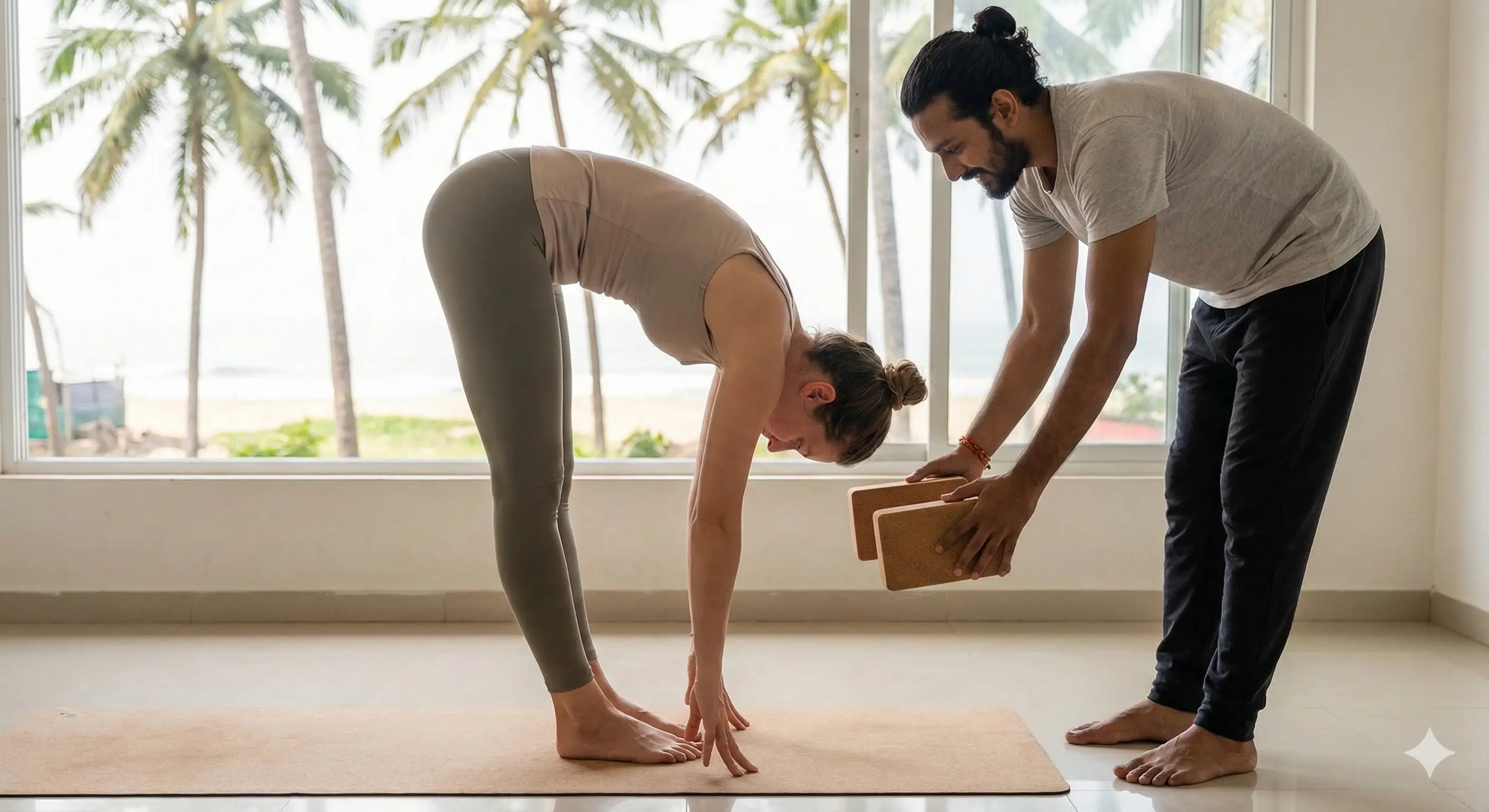
The presence of props is not an indicator of weakness; they are used to have a greater and safer alignment! This is necessary so that yoga beginners do not make errors.
The Solution to the Forward Folds: When your hamstring is tight, you always have to bend your knees and/or place your hands on blocks. This maintains the length of your spine and prevents injury to your lower back.
The Fix to Seated Poses: When you are tight in the hips in the cross-legged seat or as a seated pose, sit on a folded blanket or block. This lifts the hips higher than the knees, and this tilts the pelvis forward so that your back gets an opportunity to be straight and comfortable.
What It Is: Leaving the studio the moment the physical practice is over and getting up.
Why It Happens: It is common to have people believe that Savasana (Corpse Pose) is simply lying there, and their thoughts already drift to the next item on their to-do list.
The most significant pose is, arguably, savasana! This is the place your nervous system consolidates everything that you have just done. It is like baking a cake and removing it out of the oven before it is cooked—you lose the best!
The Remedy: Set aside five minutes. Get used to blankets or eye pillows. Consider Savasana an opportunity to do nothing and be in profound stillness. Thou hast thy reward, not thy duty!
These are some of the questions we are constantly asked! Let us debunk some of the common fears of errors in doing yoga.
Absolutely not! Consider warming up poses (such as Sun Salutations or easy stretching) a kind of safety net for your body. They provide blood circulation and give your muscles a slight warning that they are going to get going and reduce the chances of being injured drastically. Never skip it.
This is incredibly common!
The Solution: Bend your legs in any forward fold. In the case of a seated forward fold, a rolled-up blanket is to be placed beneath your knees. It is to produce a long, happy spine, remember, not to touch your toes.
No! Balance varies on a daily basis depending on stress and sleep and even the food you ate.
The Fix: Supporting in a walking balance position (as a tree or eagle) is done with the aid of the wall, chair, or rear of a block. Please do not look at anyone—have one, undispersed object of vision (a drishti) on the floor or wall.
Grab a strap! Wrap a yoga strap (or a scarf or a belt) over the balls of your feet. Hold the strap in your hands. This is like a continuation of your arms; thus, you concentrate on lengthening your spine without exerting any effort in accessing your toes.
Understanding your body is key. Discomfort (a deep stretch or muscle working hard) is generally okay—that's where growth happens. Sharp, shooting, tingling, or pinching pain is NOT okay. That is your body saying "Stop!" Listen to it immediately to avoid injury.
It is best to practice on a relatively empty stomach. A heavy meal can make you feel nauseous during inversions or twists. If you are hungry, try a light snack like a banana or a few nuts about 45-60 minutes before class.
Congratulations! You are not a yoga beginner anymore. With these pitfalls in mind, you are becoming a yogi who is educated and aware. The minor changes that we have touched upon today will really make the difference in your sensations on the mat.
Provided you are willing to go even further, to hone your alignment and to really learn how to teach these little fixes to others, you may be ready to go to the next level.
Deepen Your Knowledge
Ready to master alignment and perhaps guide others? Our Teacher Training in Goa focuses heavily on correct form and safety.
Good-bye on the mat, and good-bye practicing!