



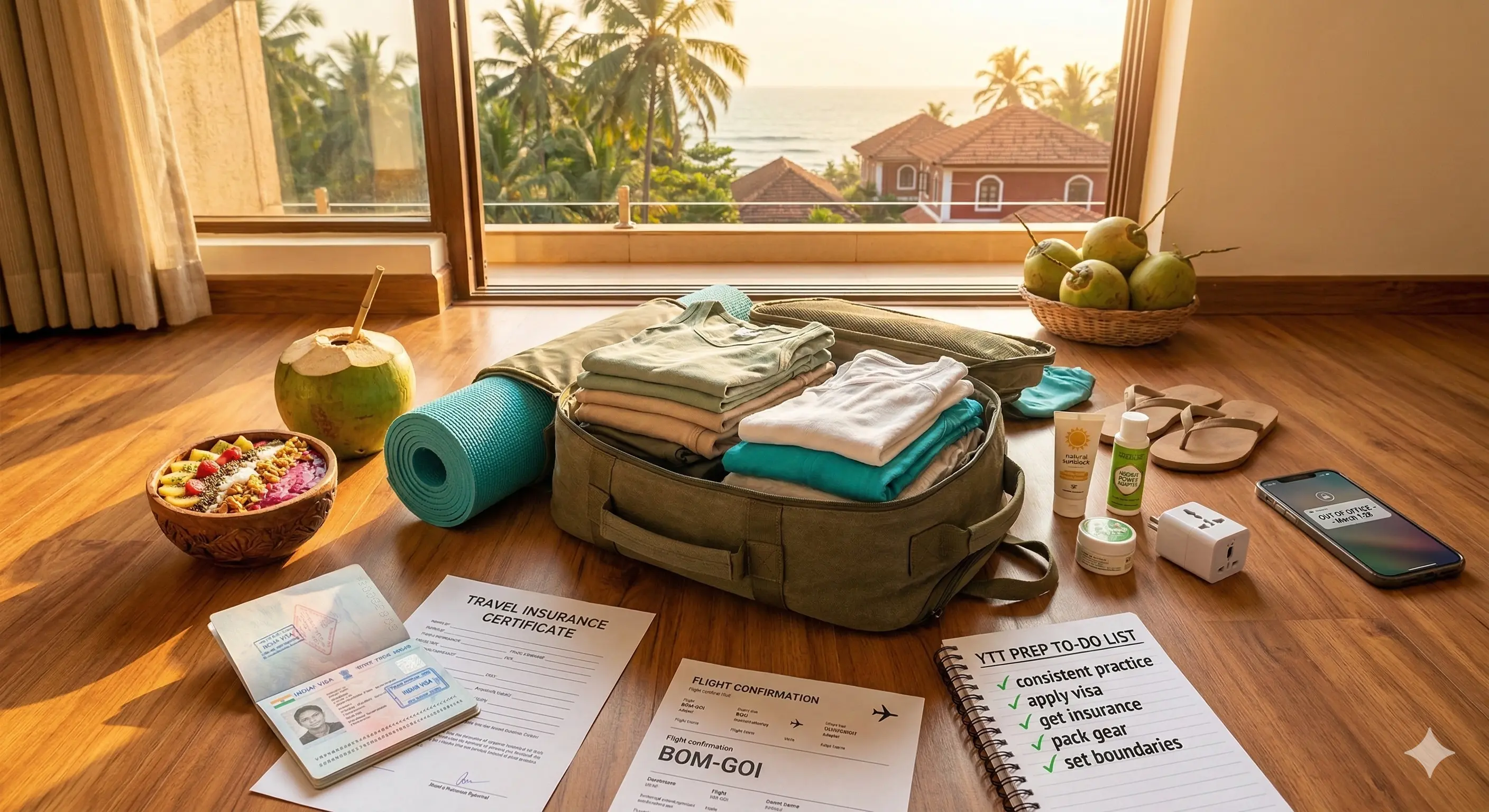
A 200-hour yoga teacher training in Rishikesh costs between $599 and $2,900 USD in 2026, depending on the school, room type, and batch size. Most mid-range schools (including DivinePath at $999 shared / $1,250 private) include accommodation, three meals, and your Yoga Alliance certification in the price. Budget schools start at $599 but typically run larger batches of 25-30 students. Premium ashram-based schools charge $1,700-$2,900 for a more secluded experience. This guide compares real prices from 7 schools so you can decide what makes sense for your budget.
We run a yoga school in Rishikesh. We also run schools in Goa and Bali. So when we write about what yoga teacher training costs, we are not guessing from the outside — we are telling you what we charge, what our competitors charge, and what the real differences are behind those numbers.
This is the article we wish existed when we first started DivinePath. Back then, every school website said "affordable" and "all-inclusive" but nobody put actual prices next to each other. Nobody explained why one school charges $599 and the one next door charges $2,900 for what looks like the same 200-hour certificate.
So here it is. Real numbers. Real schools. No vague language.
The 200-hour yoga teacher training is the most popular course in Rishikesh and the starting point for most people. It runs for 21-25 days depending on the school, and graduates you as an RYT 200 (Registered Yoga Teacher) with Yoga Alliance.
Here is the honest price range based on what schools are currently charging in 2026:
Notice how wide that range is. The cheapest 200-hour course is nearly five times less expensive than the most expensive one. Same city. Same certification. Same Yoga Alliance logo on the certificate. So what accounts for the difference? We will break that down below.
We researched the current 2026 pricing of seven established schools in Rishikesh. These are all Yoga Alliance registered schools offering 200-hour courses. We checked their websites directly in March 2026.
| School | Shared / Twin | Private Room | Duration | Batch Size | Meals Included |
|---|---|---|---|---|---|
| Arogya Yoga School | $599 (triple) / $899 (double) | $1,050 | 25 days | 20-30 | Yes (3/day) |
| AYM Yoga School | $749 (dorm) / $849 (twin) | $1,099 | 24 days | 20-25 | Yes (3/day) |
| Himalayan Yoga Ashram | ~$899 | ~$1,100 | 25 days | 25-30 | Yes (3/day) |
| DivinePath Yoga School | $999 | $1,250 | 25 days | Max 15 | Yes (3/day + excursions) |
| Vinyasa Yogashala | ~$1,000 | ~$1,300 | 25 days | 14-15 | Yes (3/day) |
| House of Om | $1,700 (early bird) | $2,000+ | 20 days | 16-20 | Yes (3/day) |
| Rishikesh Yogpeeth | $2,150 | $2,900 | 21 days | 15-20 | Yes (3/day) |
Prices checked in March 2026. Prices may vary by season or early-bird offers. We encourage you to verify directly on each school's website.
A few things stand out from this table. First, the batch size is often the biggest hidden variable. A school charging $599 with 30 students per batch is collecting roughly $18,000 per batch. A school charging $999 with 15 students is collecting about $15,000 per batch — but giving each student twice as much personal attention. At DivinePath, we chose to cap at 15 specifically because our teachers told us they cannot give meaningful individual corrections to more than 15 people in a morning asana class.
Second, duration matters. A 20-day course and a 25-day course might both say "200 hours," but the extra 5 days means less cramming and more time for practice teaching, excursions, and self-study. If you divide the total fee by the number of days, you get the actual daily cost — which is often more revealing than the headline price.
Every school in Rishikesh claims to be "all-inclusive." But that word means different things to different schools. Here is what is typically included, and what is not.
What SHOULD be included (and is, at DivinePath):
What is NOT included (at any school, usually):
Things to watch for in "budget" schools:
We always recommend asking any school: "Is there ANY additional charge beyond the listed price?" before you book. At DivinePath, the answer is no. The price on our website is the price you pay. The only extra costs are your flights, visa, and personal spending.
The 200-hour gets the most attention, but Rishikesh schools offer the full range. Here is what each course costs at DivinePath, and roughly where the market sits:
| Course | DivinePath (Shared) | DivinePath (Private) | Duration | Market Range | Who It Is For |
|---|---|---|---|---|---|
| 100-Hour YTT | $750 | $950 | 12 days | $500-$1,200 | Beginners, short-term travelers. Part 1 of 200h. |
| 200-Hour YTT | $999 | $1,250 | 25 days | $599-$2,900 | Anyone wanting RYT 200 certification to teach worldwide. |
| 300-Hour YTT | $1,200 | $1,300 | 28 days | $1,000-$3,000 | 200h-certified teachers wanting RYT 500 (combined). |
| 500-Hour YTT | $2,150 | $2,550 | 53 days (8 weeks) | $1,800-$5,000 | Zero-to-master: 200h (Month 1) + 300h (Month 2) = RYT 500. |
The 100-hour course is worth mentioning because it is often overlooked. If you only have two weeks and want to experience a real yoga training (not just a retreat), this is a solid option at DivinePath. It costs $750 for 12 days and serves as Part 1 of our full 200-hour programme. You can come back anytime to finish the second 100 hours and get your RYT 200.
The 500-hour course is structured as two consecutive months: Month 1 is the full 200-hour foundation, Month 2 is the 300-hour advanced training. You do not need any prior experience. At $2,150 for 53 days, it works out to about $40 per day — which is remarkable when you consider that covers your room, three meals, and 8-10 hours of daily instruction.
This is the question everyone asks but few people answer honestly. So here it is, from someone who runs a school and knows what things actually cost.
1. Batch size is the biggest factor. A school charging $599 per student but filling 30 seats per batch earns $18,000 per batch. A school charging $999 with 15 students earns $15,000. The cheaper school actually makes more revenue, but your experience as a student is very different. In a batch of 30, you might get corrected once during a morning asana class. In a batch of 15, the teacher walks by you multiple times and catches mistakes in your alignment before they become habits.
2. Location and property costs. A school operating from a rented building in the Tapovan market area pays much less than one with a dedicated riverside campus or a mountain ashram with private land. Rishikesh Yogpeeth, for instance, runs from Abhayaranya Ashram in the mountains — beautiful, but everything (groceries, water, building materials) has to be carried up by manual labour. That shows up in their pricing.
3. Teacher qualifications and ratios. Some budget schools rotate junior teachers through different batches. Premium schools employ full-time E-RYT 500 faculty who teach the same students throughout the course. At DivinePath, our Rishikesh team includes Yogi Rajesh Ji (E-RYT 500, advanced asana and alignment), Jagjeet Singh Ji (E-RYT 500, philosophy and meditation), and Yogi Naveen Ji (Master's in Yoga Science, anatomy and biomechanics). These are the same teachers in every batch, not rotating substitutes.
4. Accommodation quality. A $599 school typically offers dormitory beds or basic triple-sharing rooms with shared bathrooms. A $999-1,200 school offers proper twin or private rooms with attached bathrooms, hot water, and Wi-Fi. A $2,000+ school may offer air conditioning, daily housekeeping, and resort-style amenities.
5. What "extra" is included. Excursions (Ganga Aarti, temple visits, trekking) cost the school money to organise. Course materials, yoga mats, and manuals cost money. Some schools absorb these costs into the price; others charge separately or simply do not offer them.
After running schools in three countries, we have heard every story. Here are the real costs people forget to budget for:
Flights: This is your biggest variable. From Europe, expect $400-$700 return to Delhi. From the US, $700-$1,100. From Australia, $500-$900. From Southeast Asia, $200-$400. Book 2-3 months ahead for the best prices. Fly into Delhi (DEL) and take a domestic flight or train to Dehradun (DED), or fly directly into Dehradun if your airline offers it.
Indian e-visa: $25 for most nationalities. Apply online at indianvisaonline.gov.in at least 4 days before travel. It takes 24-72 hours to process.
Airport transfer: Dehradun to Rishikesh is about 45 minutes by car. A prepaid taxi costs INR 1,200-1,500 (roughly $15-18). If you fly into Delhi, the train to Haridwar (5-6 hours) followed by a short taxi to Rishikesh is the cheapest option at about $10-15 total. We help all enrolled students arrange their transfer — just share your flight details and we coordinate it.
Personal spending in Rishikesh: Rishikesh is genuinely cheap. A fresh juice is INR 80-120 ($1-1.50). A full meal at a local restaurant is INR 150-300 ($2-4). An Ayurvedic massage is INR 500-800 ($6-10). Laundry is INR 100-200 per load. Most students spend $100-200 total in personal expenses over 25 days.
Travel insurance: Not mandatory, but strongly recommended. World Nomads or SafetyWing offer plans for $40-80 per month that cover medical emergencies, trip cancellation, and lost luggage. This is one cost we always tell students not to skip.
The cost nobody thinks about: time off work. A 200-hour course is 25 days. With travel, that is roughly 4 weeks. For many people, this is the biggest "cost" of the training — not the fee itself but the income they are not earning during that month. The 100-hour course (12 days) exists precisely for people who want a serious training but cannot take a full month off.
We are in a unique position to answer this because DivinePath operates in all three locations. Here is an honest comparison:
| Factor | Rishikesh | Goa | Bali |
|---|---|---|---|
| DivinePath 200h Price | $999 shared / $1,250 private | $1,099 shared / $1,350 private | $1,599 shared / $2,150 private |
| Market Average (200h) | $600-$1,500 | $800-$1,600 | $1,000-$2,500 |
| Cheapest Available | ~$599 | ~$600 | ~$1,000 |
| Local Cost of Living | Very low ($5-10/day personal) | Low-moderate ($8-15/day) | Moderate ($10-20/day) |
| Setting | Mountains, Ganges river, temples | Beaches, palm trees, coastal | Rice paddies, jungles, Hindu temples |
| Weather (Peak Season) | Oct-Mar (cool, clear) | Oct-Mar (warm, dry) | Apr-Oct (dry season) |
| Visa Cost | $25 (India e-visa) | $25 (India e-visa) | $35 (Bali visa on arrival) |
| Best For | Deepest tradition, most affordable | Beach + yoga, relaxed vibe | Comfort, nature, food scene |
If price is your primary concern, Rishikesh wins. It is the cheapest place in the world to get a legitimate, Yoga Alliance-certified teaching qualification. But price should not be the only factor. Some students prefer the beach energy of Goa. Others want the lush jungle setting of Bali.
No. And this is where we will be blunt.
A 200-hour yoga teacher training is not like buying a t-shirt where the cheapest option is fine because you just want the product. You are investing 25 days of your life and trusting strangers to teach you how to safely put other people's bodies into physical positions. The quality of that teaching matters — not just for your certificate, but for the safety of every future student you will teach.
That said, the most expensive school is not automatically the best either. Some premium schools charge $2,500+ partly because they are in beautiful, remote locations with high operating costs. Beautiful views are nice, but they do not make you a better teacher.
Here is what we think actually matters more than price:
At DivinePath, our 200-hour course sits at $999 because we believe that is the right balance: small enough batches (15 students) for personal attention, experienced full-time teachers with real qualifications, proper accommodation with attached bathrooms and hot water, and all excursions and materials included. Could we charge $599 and fill 30 seats? Yes. But we would not be proud of the graduates we produce.
Let us put real numbers together for a typical 200-hour student coming to DivinePath from different parts of the world:
| Expense | From Europe | From USA | From Australia | From SE Asia |
|---|---|---|---|---|
| Course fee (shared room) | $999 | $999 | $999 | $999 |
| Return flights | $400-$700 | $700-$1,100 | $500-$900 | $200-$400 |
| Indian e-visa | $25 | $25 | $25 | $25 |
| Airport transfer | $15-$25 | $15-$25 | $15-$25 | $15-$25 |
| Personal spending (25 days) | $100-$200 | $100-$200 | $100-$200 | $100-$200 |
| Travel insurance | $40-$80 | $40-$80 | $40-$80 | $40-$80 |
| TOTAL ESTIMATE | $1,580-$2,030 | $1,880-$2,430 | $1,680-$2,230 | $1,380-$1,730 |
For context: a 200-hour yoga teacher training in the US or Europe typically costs $3,000-$5,000 for tuition alone, without accommodation or meals. Rishikesh gives you the same internationally recognised certification plus room and board for roughly half the price of a Western tuition-only course.
Between $599 and $2,900 USD depending on the school. Budget schools with larger batches (25-30 students) charge $599-$849. Mid-range schools like DivinePath charge $999 shared / $1,250 private with a cap of 15 students. Premium mountain ashrams charge $1,700-$2,900. All prices typically include tuition, accommodation, and three meals daily.
At DivinePath: full tuition, accommodation (private or shared cottage), three sattvic vegetarian meals per day, all course materials, weekend excursions (Ganga Aarti, Kunjapuri trek, waterfall hikes), yoga mat and props, Wi-Fi, hot water, and your Yoga Alliance certificate. Not included: flights, Indian e-visa ($25), airport transfer ($15-25), and personal spending.
Four factors: batch size (25-30 students vs 10-15), accommodation (dorm beds vs private cottages), teacher credentials (rotating junior teachers vs full-time E-RYT 500 faculty), and property costs (city-centre vs riverside or mountain ashrams).
Yes. A 200-hour YTT averages $600-$1,200 in Rishikesh, $800-$1,600 in Goa, and $1,000-$2,500 in Bali. DivinePath runs schools in all three: Rishikesh ($999), Goa ($1,099), and Bali ($1,299). Rishikesh is cheaper because Uttarakhand has a lower cost of living.
Course fee $999-$1,250 + flights $400-$1,100 + visa $25 + transfer $15-25 + personal spending $100-200 + insurance $40-80. Total: $1,580-$2,430 depending on your country and room choice.
At DivinePath: 25% deposit via Razorpay, balance on arrival. Non-refundable but transferable to a future batch. Book 60+ days early for October-March batches.
Course fees stay the same year-round. Save on flights by traveling April-May or September (shoulder season). Monsoon (July-August) has cheapest flights but occasional rain disruptions. October-March is best weather but highest flight prices.
View our upcoming batch dates for all Rishikesh courses. Batches start on the 1st of every month.
All Rishikesh Courses Send an Enquiry WhatsApp Us
E-RYT 500, Master’s in Yoga Science • Alignment & Anatomy Instructor, DivinePath Yoga School Rishikesh
View Profile